


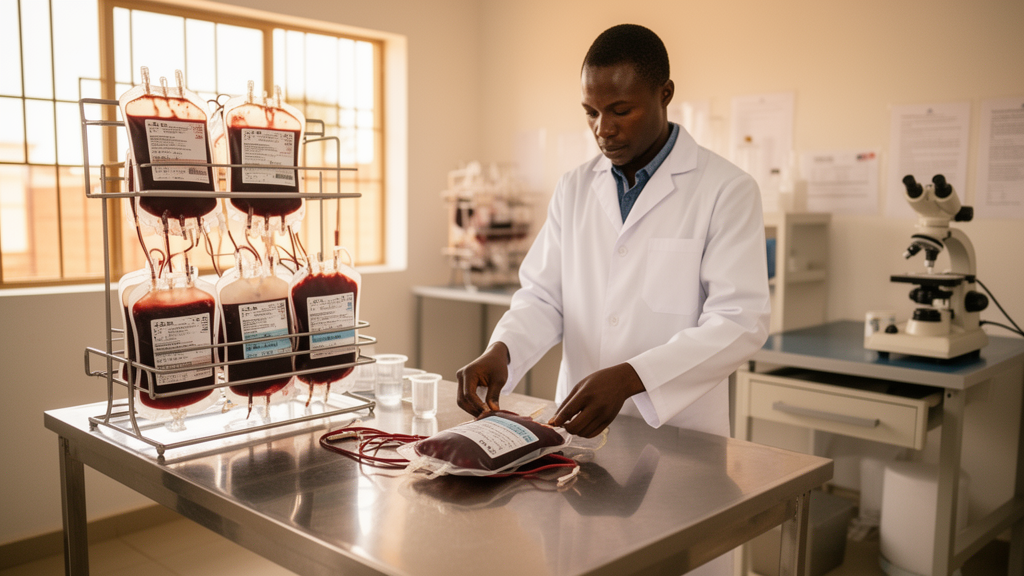
Every unit of blood collected at the Lilongwe branch of the Malawi Blood Transfusion Service (MBTS) passes through a battery of safety checks designed to intercept HIV, hepatitis and other transfusion-transmitted pathogens. What it does not routinely face is a test for malaria. A new cross-sectional study published in Frontiers in Malaria has now quantified the consequences of that gap: among 377 apparently healthy voluntary donors screened over a two-week period, 51 — 13.5 percent — carried malaria parasites in their bloodstream without a single symptom, and their blood was processed for clinical use under the same protocols applied to parasite-free donations.
The research team, led by Collins Bowa of Kamuzu Central Hospital’s laboratory department and collaborators at the University of Zambia, the MBTS, the Malawi-Liverpool-Wellcome Trust and the UNC Project, set out to answer three questions: how common is asymptomatic parasitemia among donors, which Plasmodium species are responsible, and what donor characteristics track with infection. Their findings carry weight well beyond Malawi’s borders, because the pattern they describe — a hidden reservoir of parasites circulating in a population assumed to be healthy — is one of the most stubborn obstacles to both blood safety and malaria elimination across sub-Saharan Africa.
The scale of the problem is framed by the epidemiology of the disease itself. The World Health Organization estimated roughly 249 million malaria cases globally in 2022, and Malawi bears a disproportionate share, with an estimated incidence of 393 cases per 1,000 population each year. Young children account for most infections, and malaria-induced anemia drives much of the demand for transfusion in the first place — meaning the very patients who need blood most urgently are also the ones most vulnerable to receiving a parasite-laden unit. Transfusion-transmitted malaria (TTM) can be particularly severe in immunocompromised recipients, pregnant women and children, yet routine post-transfusion malaria monitoring is not systematically implemented in Malawi, leaving the true clinical toll largely invisible.
To build their picture of the donor population, the researchers used systematic sampling, recruiting every third consecutive eligible donor after a random start until they reached 377 participants. The sample size was powered by an expected prevalence of 42.8 percent drawn from the most recent estimates of malaria among Malawian blood donors, and eligibility was restricted to healthy adults aged 18 to 65 who had no documented symptomatic malaria and had not taken antimalarial medication within the previous six weeks. The resulting cohort was heavily skewed toward young men: 82.2 percent were male, 75.6 percent were aged 18 to 25, and nearly 70 percent were students, reflecting the demographics of voluntary donation drives in the region.
The diagnostic strategy combined two complementary methods. Each donor unit was screened with a rapid diagnostic test targeting histidine-rich protein 2 (HRP2), an antigen specific to Plasmodium falciparum, the deadliest and most prevalent human malaria parasite. In parallel, thick and thin blood smears were prepared, heat-fixed or fixed in absolute alcohol, transported to the Kamuzu Central Hospital laboratory and stained with 3 percent Giemsa for 45 minutes before independent examination by two experienced biomedical scientists, with a third adjudicating any discordant readings. Microscopy added what the RDT could not: species identification beyond falciparum and quantification of parasite density, calculated against a standard reference white cell count of 8,000 per microliter.
The two methods told a story of near-agreement with instructive exceptions. The RDT flagged 51 positive samples, or 13.53 percent, while microscopy confirmed 48, or 12.73 percent. Three samples were RDT-positive but microscopy-negative, and three P. malariae infections were picked up by microscopy alone — a reminder that HRP2-based tests are blind to non-falciparum species by design. When species distribution was tallied across the 48 microscopy-confirmed infections, P. falciparum dominated at 85.4 percent, mixed P. falciparum and P. malariae infections accounted for 8.3 percent, and P. malariae alone appeared in 6.3 percent of cases. The presence of any non-falciparum parasites is notable, given that such infections are frequently underreported in elimination programs, even though prior Malawian research has placed their prevalence among adults at around 11.7 percent.
Parasite densities varied sharply by species, and the numbers matter for transfusion risk. P. falciparum infections showed the highest median density at roughly 3,000 parasites per microliter, with an interquartile range of 1,500 to 4,800 and individual readings spanning 200 to 8,000. Mixed infections sat at a median of about 1,800 parasites per microliter, while P. malariae infections recorded the lowest median at around 1,000. These levels are far from trivial: comparable work in Uganda has documented densities exceeding 1,500 parasites per microliter among asymptomatic donors, and a Burkina Faso study recorded ranges from 24 to 42,645. In a high-transmission setting, repeated exposure builds partial immunity that allows people to tolerate substantial parasitemia without fever or malaise — which is precisely why a donor can feel perfectly well while carrying thousands of parasites per microliter of blood destined for a transfusion bag.
The demographic patterns added texture, though the statistical signal was mixed. Bivariate analyses flagged age, occupation, residence, blood group, repellent use and travel history as factors associated with species distribution: mixed infections were more frequent in women (22.2 percent) than men (5.1 percent), the 41–60 age group showed P. malariae in half of its positive cases, urban residents carried a disproportionate share of P. malariae (23.1 percent versus none in rural areas), and blood group, repellent habits and travel history each reached significance in the species-level comparison. But when the team entered the candidate predictors into a multivariate binary logistic regression with a 0.05 significance threshold, no variable retained an independent association with overall infection. The adjusted odds ratios clustered near unity — males at 0.95, the 26–40 age group at 1.54, the 41–60 group at 0.77 — and the closest thing to a trend, proximity to mosquito breeding sites, produced an odds ratio of 2.28 with a confidence interval that just crossed 1. The authors interpret this cautiously: the absence of significant associations likely reflects sample size constraints and the marked gender imbalance rather than a true absence of risk factors.
Placed in regional context, the 13.5 percent prevalence lands squarely within a known spectrum. A Nigerian study reported 11.9 percent among voluntary donors, Ghana has documented rates as low as 2.5 percent, and a systematic review by Ahmadpour and colleagues found median prevalences of 10.54 percent by microscopy, 5.36 percent by PCR and just 0.38 percent by RDT — a gradient that itself illustrates how much infection standard screening misses. The mixed-species finding echoes patterns from Tanzania, where falciparum-malariae co-infections appeared in 23.6 percent of clinical cases, and Kenya’s Lake Victoria basin, where PCR identified 23.5 percent co-infections among children. Mixed infections are not a curiosity: systematic reviews have linked them to higher recurrence rates within 28 days of artemisinin-based combination therapy, likely because different species respond differently to the same drugs, complicating both treatment and clearance.
The study’s authors are candid about its limits. Microscopy loses sensitivity at low parasitemia and depends heavily on examiner skill, so the true prevalence may be higher than measured. HRP2-based RDTs carry a separate vulnerability: P. falciparum parasites with hrp2 gene deletions are increasingly reported across sub-Saharan Africa and would slip past the test entirely, which is why the authors recommend multi-antigen RDTs combining HRP2 and pLDH targets, and ultimately PCR-based screening to capture submicroscopic infections. The donor-only population also limits generalizability, and the gender imbalance may have masked real associations. Even so, the core conclusion stands on firm ground: roughly one in eight units collected at a major regional transfusion center carried malaria parasites, none of which would have been caught under current protocols. The authors argue that integrating malaria testing into standard donor screening, strengthening diagnostic capacity, and aligning blood safety programs with national malaria control efforts are no longer optional refinements but urgent prerequisites for protecting the children, pregnant women and immunocompromised patients who depend on transfusions most — and for ensuring that the blood supply, meant to save lives, does not quietly become a vector for one of Africa’s most persistent diseases.
Subject of Research: Asymptomatic malaria parasitemia prevalence and Plasmodium species distribution among blood donors at a Malawian transfusion center
Article Title: Prevalence and Plasmodium species distribution of asymptomatic malaria parasitemia among blood donors at the Lilongwe blood transfusion center
Article References: Bowa, C., Kalonga, N., Mbonshi, B., Sitali, L., Simwela, J., Kudowa, E., & Tepeka, A.-G. (2025). Prevalence and Plasmodium species distribution of asymptomatic malaria parasitemia among blood donors at the Lilongwe blood transfusion center. Frontiers in Malaria, 3, Article 1687355. https://doi.org/10.3389/fmala.2025.1687355
Image Credits: AI Generated
DOI: 10.3389/fmala.2025.1687355
Keywords: malaria, blood donors, transfusion-transmitted malaria, Plasmodium falciparum, Plasmodium malariae, Malawi, rapid diagnostic tests, microscopy, asymptomatic parasitemia, blood safety, parasite density, public health
Cite Scienmag News
Phoebe Ingram. (October 16, 2026). Hidden Malaria in the Blood Bank: One in Seven Donors at Malawi’s Largest Transfusion Center Carries Silent Parasites. Scienmag. https://scienmag.com/hidden-malaria-in-the-blood-bank-one-in-seven-donors-at-malawis-largest-transfusion-center-carries-silent-parasites/
Phoebe Ingram. "Hidden Malaria in the Blood Bank: One in Seven Donors at Malawi’s Largest Transfusion Center Carries Silent Parasites." Scienmag, 16 October 2026, https://scienmag.com/hidden-malaria-in-the-blood-bank-one-in-seven-donors-at-malawis-largest-transfusion-center-carries-silent-parasites/. Accessed 16 October 2026.
Phoebe Ingram. "Hidden Malaria in the Blood Bank: One in Seven Donors at Malawi’s Largest Transfusion Center Carries Silent Parasites." Scienmag. October 16, 2026. https://scienmag.com/hidden-malaria-in-the-blood-bank-one-in-seven-donors-at-malawis-largest-transfusion-center-carries-silent-parasites/


