


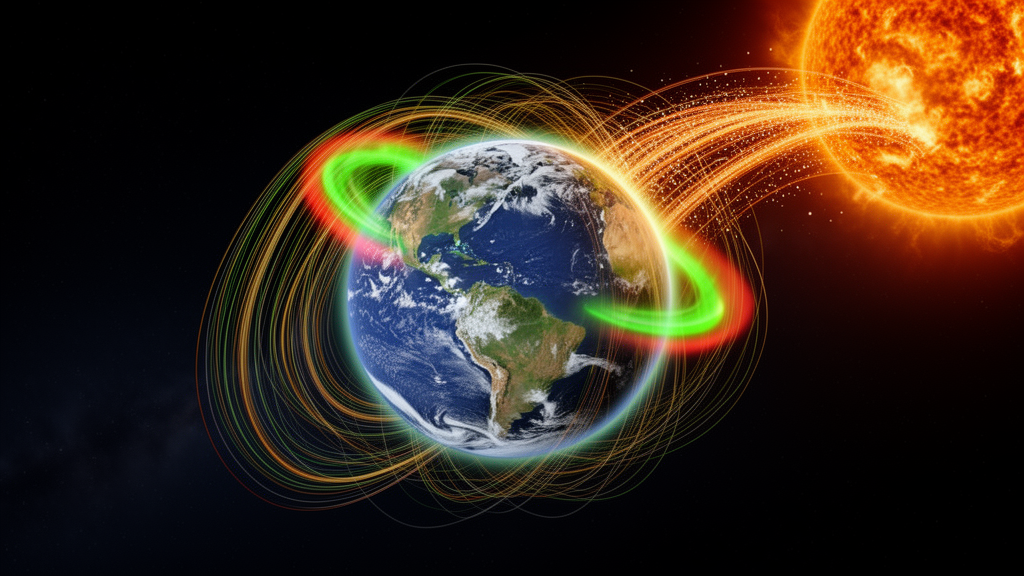
Every geomagnetic storm tells two stories: one about how quickly Earth’s magnetic field sinks into disturbance, and another about how slowly it climbs back out. For decades, scientists studying the statistics of these disturbances treated each excursion as a single burst with one characteristic duration. A new analysis of 45 years of high-resolution magnetometer data shows that this single-burst picture conceals two physically distinct processes whose timing statistics are fundamentally decoupled — and only one of them listens to the Sun.
The study, published in Frontiers in Astronomy and Space Sciences, dissects every negative excursion of the SYM-H index, a one-minute-resolution measure of the low-latitude magnetic disturbance, between January 1981 and May 2026. That record spans nearly five complete solar cycles and contains 78,096 separate disturbance events. Rather than measuring each excursion from threshold crossing to recovery as one undivided duration, the researcher split every event at its minimum: the growth lifetime runs from the downward crossing of a threshold to the deepest point of the disturbance, while the recovery lifetime runs from that minimum back up to the recovery crossing.
The split matters because the two halves of a storm are governed by different physics. Growth is driven from outside, as enhanced solar-wind convection injects energetic ions into the ring current and depresses the equatorial magnetic field. Recovery is controlled from inside, as charge exchange, Coulomb collisions, wave-particle scattering, and dayside outflow slowly drain the trapped population. The minimum of the excursion is the single instant at which accumulation gives way to loss, making it the natural dividing line between the two regimes.
When the two duration ensembles were fitted with a finite-range power law — a distribution whose slope is set by an exponent and whose reach is set by a temporal cutoff — the two channels turned out to be strikingly different. Growth lifetimes follow an exponent of 1.079 with a cutoff near 669 minutes, while recovery lifetimes follow a steeper exponent of 1.305 with a cutoff near 3,328 minutes, roughly five times longer. The separation between the two exponents, about 0.226, holds at every threshold tested, from quiet-time ripples at the median disturbance level all the way up to superstorm amplitudes near minus 300 nanotesla.
The asymmetry is not subtle. In the archetypal superstorm of September 1989, the field spent about 10 hours descending to its minimum and more than 63 hours climbing back — a factor of six in a single event. Across all 89 one-year windows in the record, the recovery exponent exceeded the growth exponent in every single window, a consistency that survives even when the analysis is restricted to the 45 non-overlapping windows that share no data.
The most surprising result emerges when the exponents are tracked against solar activity. The growth exponent rises significantly with sunspot number, with a correlation coefficient of about +0.56 in independent windows and a shift of roughly +0.10 from solar minimum to solar maximum. The recovery exponent, by contrast, is statistically flat across all five cycles, with any potential solar-cycle modulation bounded to roughly a tenth of the growth response. The solar cycle therefore imprints itself selectively on disturbance timing: it touches the growth slope and the temporal cutoffs of both channels, but leaves the recovery exponent untouched.
This decoupling resolves a long-standing puzzle. Earlier work had shown that the undivided burst lifetime of SYM-H follows a single power law that is robust to the choice of threshold, which seemed to suggest a unified underlying process. The new analysis shows that this apparent invariance is an emergent property. Because the recovery cutoff is roughly five times the growth cutoff, the tail of the combined burst distribution is dominated by configurations in which nearly the entire burst is recovery. The burst exponent is therefore pinned by the recovery channel, whose exponent is threshold-stable and cycle-flat, while the body of the distribution carries the growth signature. A single power-law fit to the composite returns an effective exponent that falls between the two channel values, reproducing the earlier result without requiring a single physical process.
Peeling back another layer, the recovery channel itself decomposes into a dwell — the contiguous run of samples tied at the minimum value — and a climb back to threshold. The dwell is steep, short-scaled, and flat across the solar cycle, while the climb transit carries a cycle-responsive exponent that mirrors the growth side. The composite recovery exponent is a mixture of these two sub-processes, and its flatness is a consequence of the standard storm-timing convention that assigns the cycle-flat dwell to the recovery channel.
The findings carry practical weight for space weather forecasting. Recovery-timing priors can be treated as cycle-independent provided their range is conditioned on solar phase, while growth-timing priors must be conditioned on cycle phase throughout. For modelers, the decoupling sets a falsifiable target: any stochastic description of SYM-H excursions must now produce two distinct exponents from one time series, route the solar-cycle imprint through the growth channel alone, and reproduce the symmetric cycle response of the underlying transit statistics.
The analysis applies specifically to low-to-mid-latitude disturbances, where the SYM-H index is most representative. Higher-latitude geomagnetic activity is known to follow different and more variable scaling behavior, shaped by complicated ionospheric effects that dominate closer to the poles. Extending the two-channel decomposition to those regions remains an open challenge for future work.
Subject of Research: Statistical scaling of geomagnetic storm growth and recovery timing across five solar cycles
Article Title: Growth–recovery decoupling in the timing of geomagnetic disturbances across five solar cycles
Article References: Wanliss, J. A. (2026). Growth–recovery decoupling in the timing of geomagnetic disturbances across five solar cycles. Frontiers in Astronomy and Space Sciences, 13, Article 1948617. https://doi.org/10.3389/fspas.2026.1948617
Image Credits: AI Generated
DOI: 10.3389/fspas.2026.1948617
Keywords: geomagnetic storms, SYM-H index, power-law distributions, solar cycle, ring current, space weather, magnetosphere, burst-lifetime statistics, Dst index, solar wind, Growth, recovery
Cite Scienmag News
Cameron Wolfe. (October 16, 2026). Geomagnetic Storms Hide Two Different Clocks, Five Solar Cycles of Data Reveal. Scienmag. https://scienmag.com/geomagnetic-storms-hide-two-different-clocks-five-solar-cycles-of-data-reveal/
Cameron Wolfe. "Geomagnetic Storms Hide Two Different Clocks, Five Solar Cycles of Data Reveal." Scienmag, 16 October 2026, https://scienmag.com/geomagnetic-storms-hide-two-different-clocks-five-solar-cycles-of-data-reveal/. Accessed 16 October 2026.
Cameron Wolfe. "Geomagnetic Storms Hide Two Different Clocks, Five Solar Cycles of Data Reveal." Scienmag. October 16, 2026. https://scienmag.com/geomagnetic-storms-hide-two-different-clocks-five-solar-cycles-of-data-reveal/


