


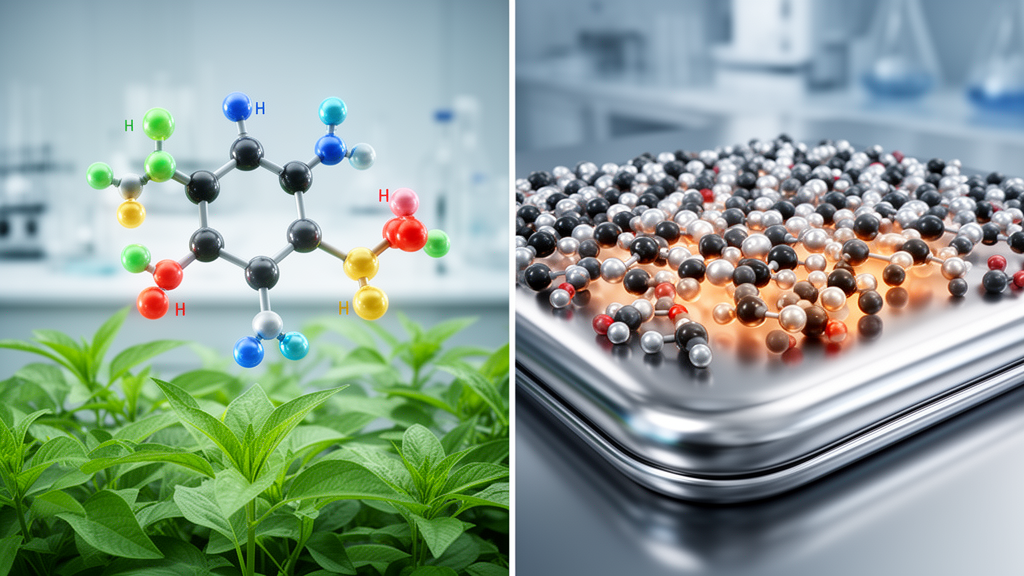
Syringic acid is one of nature’s quiet workhorses. This naturally occurring phenolic compound, found in honey, grapes, olives, dates, and spices, has long been recognized for its antioxidant, anti-inflammatory, antimicrobial, and anticancer properties. Now, a team of researchers at the University of Ibadan in Nigeria has taken this humble plant molecule and given it a chemical makeover that could see it protecting both human health and industrial infrastructure. By attaching allyl groups to two reactive sites of syringic acid, the researchers created three O-allylated derivatives and then subjected them to a battery of computational tests designed to reveal whether these modified molecules could serve as corrosion inhibitors for steel and as inhibitors of a medically important human receptor.
The three derivatives, named AS1, AS4AE, and SA4AE, share a common 3,5-dimethoxybenzene scaffold but differ in the substituents attached at specific positions of the benzene ring. AS1 carries a para-hydroxyl group with an allyl ester, AS4AE features two allyl ester groups, and SA4AE bears a para-allyloxy group with a free carboxylic acid. The research, published in Discover Chemistry, represents the first study to combine density functional theory electronic characterization with molecular docking, molecular dynamics simulations, and Monte Carlo corrosion modelling to evaluate O-allylated syringic acid derivatives across both biological and anticorrosion domains within a single computational framework.
To understand the electronic behaviour of these molecules, the team performed geometry optimization using the B3LYP method with the 6-311G basis set, a well-established level of density functional theory. Frontier molecular orbital energies, global reactivity descriptors, and condensed Fukui indices were then extracted to characterize how electrons are distributed across each molecule and where chemical reactions are most likely to occur. The results revealed a fascinating hierarchy of reactivity. SA4AE emerged as the most reactive derivative with the smallest energy gap of 6.35 electronvolts, while AS1 showed the greatest tendency to donate electrons with the least negative HOMO energy of minus 7.07 electronvolts. The methoxy atoms and ring carbons were identified as the principal nucleophilic sites, the regions where electron density is most available for transfer to metal surfaces or biological receptors.
The biological target chosen for this investigation was the adenosine A1 receptor, a seven-transmembrane G-protein-coupled receptor expressed in the central nervous system, the cardiovascular system, and the kidney. Activation of this receptor regulates heart rate and atrioventricular conduction, contributes to neuroprotection and cardioprotection, and plays a role in sodium retention and reduced glomerular filtration rate. A1 receptor inhibitors are considered vital in the treatment of acute heart failure and asthma, and they may offer defensive benefits against kidney injury and dementia. The researchers retrieved the three-dimensional crystal structure of the receptor from the Protein Data Bank and prepared it for molecular docking simulations using AutoDock Vina.
The docking results were striking. AS4AE demonstrated the strongest receptor binding among the three derivatives with a docking score of minus 7.3 kilocalories per mole, matching that of adenosine itself under identical computational conditions. This suggests comparable thermodynamic favourability at the A1 receptor active site. The strong interaction was attributed to multiple hydrogen-bond interactions with the amino acid residues TYR12 and ASN254, at distances of 2.99 and 2.50 angstroms respectively, along with a carbon-hydrogen bond interaction with GLU172 at 3.13 angstroms. In comparison, SA4AE and AS1 formed fewer interactions and recorded lower binding affinities of minus 6.1 and minus 6.7 kilocalories per mole respectively.
To validate the stability of these receptor-ligand interactions over time, the team ran 100-nanosecond molecular dynamics simulations using the OpenMM engine within a cloud-based Google Colaboratory environment. The root mean square deviation values for both the adenosine and AS4AE complexes stabilized between 1.5 and 2.1 angstroms from 5 to 55 nanoseconds, indicating that the AS4AE derivative remains firmly anchored in the binding pocket for extended periods. While adenosine showed slightly greater overall stability after a transient destabilization event around 56 nanoseconds, the AS4AE complex maintained a stable interaction profile throughout the simulation, supported by a double hydrophobic interaction with the flexible residue LEU250.
Drug-likeness and pharmacokinetic profiling added another layer of confidence to the biomedical potential of these compounds. All three derivatives satisfied Lipinski’s rules with zero violations, showing molecular weights between 238.24 and 306.31, moderate lipophilicity values between 1.82 and 2.85, and low topological polar surface areas between 64.99 and 71.06 square angstroms. The boiled egg plot revealed strong human intestinal absorption and blood-brain barrier permeability for all three compounds, and none were predicted to be P-glycoprotein substrates. ADMET analysis confirmed the absence of hepatotoxicity, mutagenicity, and metabolic interference through CYP3A4 pathways, painting a clean toxicity profile across the series.
On the industrial side, the corrosion inhibition potential of these derivatives was assessed against the Fe(110) surface in an acidic environment using Monte Carlo adsorption and quench molecular dynamics simulations with the COMPASS II force field. The Fe(110) model surface was constructed by cleaving the iron bulk crystal along the 110 Miller plane and expanded into a 10 by 10 supercell with a 30-angstrom vacuum layer. The simulated acidic environment comprised 280 water molecules, 10 hydroxonium ions, and 10 chloride ions loaded into the solvent layer above the iron surface. AS4AE proved the strongest corrosion inhibitor with an adsorption energy of minus 5520 kilocalories per mole, forming a parallel orientation to the iron plane that displaces the corrosive medium and prevents access by corrosive agents.
The radial distribution function analysis revealed that all three inhibitors exhibit interaction peaks below 3.5 angstroms, suggesting that their binding to the metal surface occurs through chemisorption rather than simple physisorption. This means the molecules form genuine chemical bonds with the iron surface, creating a protective molecular film that blocks corrosive species from reaching reactive metal sites. The binding energy increased in the order of AS1, SA4AE, and AS4AE, with AS4AE achieving the highest binding energy at 70 picoseconds during the 500-picosecond simulation period, confirming its superior capacity to anchor itself to the metal surface in acidic conditions.
The dual promise of these O-allylated syringic acid derivatives is remarkable. The same structural features that favour biological receptor-ligand interaction, namely aromatic rings with heteroatom functionalities and pi-conjugation, also govern strong adsorption on metal surfaces. AS4AE stands out as the lead candidate for both pharmaceutical and anticorrosion applications, matching adenosine’s binding affinity at the A1 receptor while simultaneously outperforming the other derivatives in surface adsorption parameters. The researchers acknowledge that these results have not been validated experimentally and that future work should include experimental in vitro and in vivo analyses, as well as electrochemical validation of the anticorrosion efficiency on mild steel in acidic and alkaline solutions. Nevertheless, this computational study establishes clear structure-activity relationships that could guide the design of next-generation multifunctional molecules derived from one of nature’s most accessible phenolic acids.
Subject of Research: Chemistry
Article Title: Corrosion and biological inhibition activity studies of O-allylated syringic acid derivatives via computational approaches
Article References: Odozi, N. W., Ojo, N. D., Bello, K. A., & Ibrahim, D. A. (2026). Corrosion and biological inhibition activity studies of O-allylated syringic acid derivatives via computational approaches. Discover Chemistry, 3(1), 582. https://doi.org/10.1007/s44371-026-01043-3
Image Credits: AI Generated
DOI: 10.1007/s44371-026-01043-3
Keywords: syringic acid, corrosion inhibition, density functional theory, molecular docking, molecular dynamics simulation, O-allylation, adenosine A1 receptor, drug-likeness, Monte Carlo simulation, Fe(110) surface, Corrosion, biological
Cite Scienmag News
Bethany Barker. (October 16, 2026). From Plant Chemistry to Steel Protection: Syringic Acid Derivatives Show Dual Promise as Drug Leads and Corrosion Inhibitors. Scienmag. https://scienmag.com/from-plant-chemistry-to-steel-protection-syringic-acid-derivatives-show-dual-promise-as-drug-leads-and-corrosion-inhibitors/
Bethany Barker. "From Plant Chemistry to Steel Protection: Syringic Acid Derivatives Show Dual Promise as Drug Leads and Corrosion Inhibitors." Scienmag, 16 October 2026, https://scienmag.com/from-plant-chemistry-to-steel-protection-syringic-acid-derivatives-show-dual-promise-as-drug-leads-and-corrosion-inhibitors/. Accessed 16 October 2026.
Bethany Barker. "From Plant Chemistry to Steel Protection: Syringic Acid Derivatives Show Dual Promise as Drug Leads and Corrosion Inhibitors." Scienmag. October 16, 2026. https://scienmag.com/from-plant-chemistry-to-steel-protection-syringic-acid-derivatives-show-dual-promise-as-drug-leads-and-corrosion-inhibitors/


