


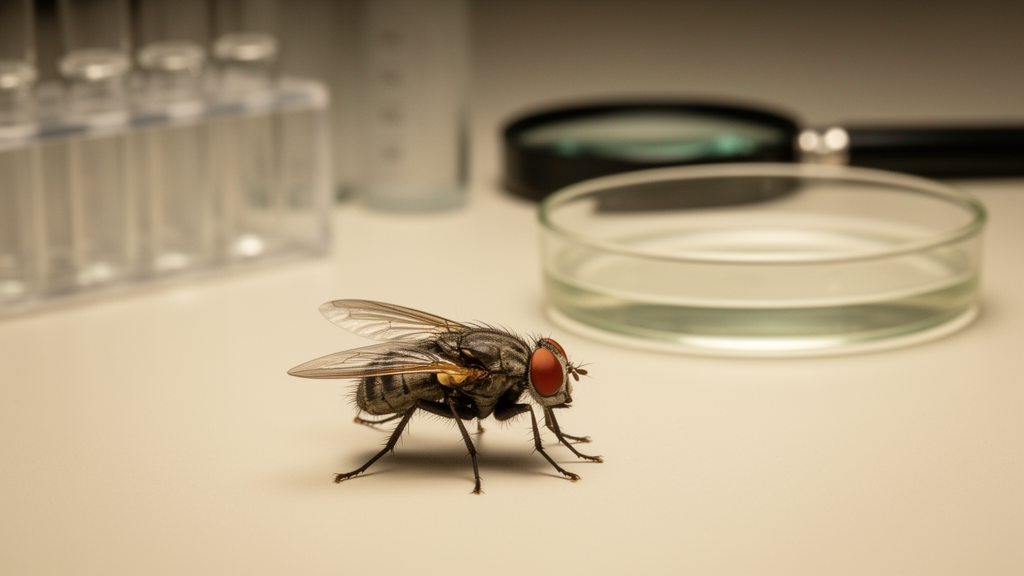
Thirty years ago, a single 65-amino-acid protein from the fruit fly rewrote one of biology’s most fundamental questions: how does a cell decide to die? In April 1994, researchers published the first description of reaper, the first Drosophila cell death gene, and in doing so laid the foundation for modern apoptosis research in the fly. A new review by Hermann Steller of The Rockefeller University, published in Frontiers in Cell Death, marks the thirtieth anniversary of that discovery and traces how a gene named for its lethal effect on embryos became a conceptual bridge connecting worms, flies, and humans in the study of programmed cell death (PCD).
The breakthrough came from a technical challenge. Unlike in the nematode C. elegans, where cell corpses can be spotted with Nomarski microscopy, dying cells are invisible in live Drosophila tissues. Steller’s laboratory first developed a technique using the vital dye acridine orange to visualize apoptotic cells in live fly embryos. Screening a collection of 129 chromosomal deletions covering more than half of the genome, only three overlapping deletions on the third chromosome produced embryos completely lacking acridine orange staining. A smaller deletion, Df(3R)H99, narrowed the interval, and chromosomal walking across the entire H99 region allowed the team to isolate the genes responsible for the cell-death phenotype.
Reaper was the first gene identified in that interval. Strikingly, its mRNA distribution largely anticipated the pattern of apoptosis in the Drosophila embryo, suggesting that the gene acts as a global convergence point for many different signaling pathways. Subsequent studies confirmed that reaper is a direct transcriptional target of an extraordinary range of inputs: Hox genes, segmentation genes, steroid hormone signaling, p53, microRNAs, JNK signaling, and histone-modifying enzymes. In contrast to its vast regulatory region, reaper encodes a tiny 65-amino-acid protein bearing an N-terminal IAP-binding motif (IBM) that mediates direct binding to and neutralization of DIAP1, the major inhibitor of apoptosis in flies.
That mechanism introduced a principle that now underpins cell death regulation across higher animals: apoptosis can be triggered by precisely controlled expression of IAP antagonists, rather than activation of caspases alone. DIAP1 is an essential survival factor required to prevent unwanted caspase activation in virtually all somatic cells. In living cells, DIAP1 and its mammalian counterpart XIAP repress caspases by direct binding and ubiquitylation. Deleting the RING domain of either protein completely abrogates anti-apoptotic activity, demonstrating that the E3-ligase function of these IAPs is essential and evolutionarily conserved. Once Reaper accumulates in a doomed cell, it binds DIAP1 and promotes self-conjugation and degradation of the protein, removing the major brake on caspase activity in a rapid switch of cell fate.
Reaper did not act alone. Shortly after its isolation, two additional pro-apoptotic genes, head involution defective (hid) and grim, were identified in the same H99 region, and a fourth family member, sickle, was found in 2002. Collectively known as RHG genes, they share an N-terminal IBM, a role in developmental apoptosis, and regulation by multiple developmental and stress pathways. Hid, a 410-amino-acid protein, is a direct molecular target of the Ras-MAPK pathway: survival signals activate MAPK, which phosphorylates and inhibits Hid, thereby saving cells that are primed to die. This mechanism is used, for example, to match the number of glial cells in the Drosophila CNS midline to neurons, which secrete the TGFα-like ligand Spitz that activates EGFR only on glial cells in contact with neurons.
The RHG proteins also cooperate through hetero-multimerization. Reaper and Grim contain an α-helical GH3 domain that promotes multimerization and localization to the outer mitochondrial membrane. Co-expression of grim with reaper or hid induces significantly higher levels of cell death than expression of these genes individually. Hid localizes to mitochondria via its C-terminal transmembrane domain and can recruit Reaper to the mitochondrial outer membrane, allowing more effective killing. Some cell types, including embryonic neuroblasts, do not express Hid and are killed by coordinated expression of reaper, grim, and possibly sickle, underscoring that different cell types have differential requirements for these proteins.
The conceptual bridge to mammals came six years after reaper, with the identification of Smac/DIABLO, Omi/HtrA2, and ARTS as mitochondrial IAP antagonists. The IBM is structurally conserved between Drosophila and mammalian IAP-antagonists and is required for IAP-binding and cell killing. Smac/DIABLO and Omi/HtrA2 reside in the mitochondrial intermembrane space and require mitochondrial outer membrane permeabilization to access cytosolic IAPs. ARTS, by contrast, shares no obvious sequence homology with RHG proteins but many functional similarities with Reaper: it does not require MOMP, acts upstream of cytochrome c and Smac/DIABLO, induces ubiquitin-proteasome-mediated degradation of XIAP, and is transcriptionally induced upon DNA damage by direct binding of p53 to its promoter. Inactivation of ARTS in mice elevates XIAP protein levels and attenuates stem cell apoptosis, suggesting ARTS may be a functional analog of Reaper.
Beyond the core machinery, Drosophila has proven indispensable for understanding caspase regulation in vivo. The initiator caspase Dronc is homologous to mammalian caspase-9 and requires binding to Dark, the Apaf-1 homolog, to form the apoptosome. Drice and Dcp-1 are caspase-3-like effector caspases that carry out cellular demolition. Although cytochrome c appears not strictly required for apoptosome activation in flies, mutations can delay developmental apoptosis, consistent with the idea that cytochrome c accelerates rather than initiates the caspase cascade. Mitochondrial dynamics and reactive oxygen species also critically influence cell death outcomes, and the Drosophila apoptosome functions analogously to its mammalian counterpart, making the fly a powerful model for caspase biology.
One of the most striking lessons from the fly is that apoptosis is not merely a demolition crew. Over the last two decades, Drosophila has emerged as a leading model for non-lethal roles of caspases in development, tissue remodeling, cell differentiation, proliferation, and neuronal remodeling. The first mechanistic proof that apoptotic caspases can drive differentiation without inducing apoptosis came from mouse lens fiber cell differentiation, overturning the dogma that caspases are inherently lethal. In Drosophila, caspase activity is essential for spermatid individualization, where inhibition prevents cytoplasmic clearance and results in male sterility. During metamorphosis, larval neurons prune their axons and dendrites in response to the steroid hormone ecdysone, and this remodeling requires localized activation of Dronc selectively within neurites destined for removal. Robust maintenance of DIAP1 and survival pathways in the soma ensures apoptotic thresholds are never reached, allowing a micro-apoptotic program powerful enough to remodel defined domains while preserving viability.
Drosophila also revealed that apoptotic cells can release mitogenic signals to stimulate proliferation of neighboring cells, a phenomenon now generally referred to as apoptosis-induced proliferation (AiP). Cells undergoing apoptosis in response to DNA damage stimulate proliferation of neighboring cells and aid tissue regeneration, mediated by p53-driven transcriptional activation of reaper and hid, inhibition of DIAP1, and de-repression of caspases. JNK signaling stimulates a positive feedback loop between p53 and RHG genes that amplifies the initial stimulus. The mitogens secreted by apoptotic cells include Wingless, Decapentaplegic, and Hedgehog. Because AiP is evolutionarily conserved, these findings carry obvious implications for tissue regeneration and cancer: chemotherapy using DNA-damaging agents may cause AiP, which in turn may contribute to the formation of metastases.
In 1994, PCD was basically synonymous with apoptosis. Since then, many forms of non-apoptotic PCD have been described, including autophagy-dependent developmental cell death, regulated necrosis, pyroptosis-like inflammatory death, and immune-induced death. While a direct physiological role of reaper in these processes remains to be demonstrated, reaper may contribute under pathological conditions. When apoptosis is blocked by caspase inhibitors, Eiger, the fly TNF homolog, can induce necroptosis in a process requiring the initiator caspase Dronc. Since Dronc is inhibited by DIAP1 and this repression is relieved by RHG proteins, reaper and its partners may affect other forms of cell death when core apoptotic pathways are genetically or pharmacologically inhibited.
Due to its genetic and anatomical accessibility, Drosophila continues to drive conceptual advances with relevance to cancer, neurodegeneration, immunity, and regeneration. Over the past three decades, the fly has provided fundamental insights into apoptosis, the non-lethal use of apoptotic proteins, alternative death pathways, and proliferation-death coupling. Many processes controlled by RHG proteins in Drosophila mirror phenomena in vertebrates, and RHG genes will remain essential tools for probing how a constitutively expressed cell suicide program is contained by the layered checkpoints that evolution has built from worms to flies to mammals.
Subject of Research: The legacy of the Drosophila reaper gene in apoptosis research
Article Title: Thirty years of reaper: lessons learned from programmed cell death in Drosophila
Article References: Steller, H. (2026). Thirty years of reaper: lessons learned from programmed cell death in Drosophila. Frontiers in Cell Death, 5, Article 1770008. https://doi.org/10.3389/fceld.2026.1770008
Image Credits: AI Generated
DOI: 10.3389/fceld.2026.1770008
Keywords: apoptosis, reaper, Drosophila, caspases, IAP, programmed cell death, Thirty, years, lessons, learned, programmed, cell
Cite Scienmag News
Juliet Wilcox. (October 16, 2026). Thirty Years of reaper: How a Tiny Fly Gene Rewrote the Rules of Cell Death. Scienmag. https://scienmag.com/thirty-years-of-reaper-how-a-tiny-fly-gene-rewrote-the-rules-of-cell-death/
Juliet Wilcox. "Thirty Years of reaper: How a Tiny Fly Gene Rewrote the Rules of Cell Death." Scienmag, 16 October 2026, https://scienmag.com/thirty-years-of-reaper-how-a-tiny-fly-gene-rewrote-the-rules-of-cell-death/. Accessed 16 October 2026.
Juliet Wilcox. "Thirty Years of reaper: How a Tiny Fly Gene Rewrote the Rules of Cell Death." Scienmag. October 16, 2026. https://scienmag.com/thirty-years-of-reaper-how-a-tiny-fly-gene-rewrote-the-rules-of-cell-death/


