


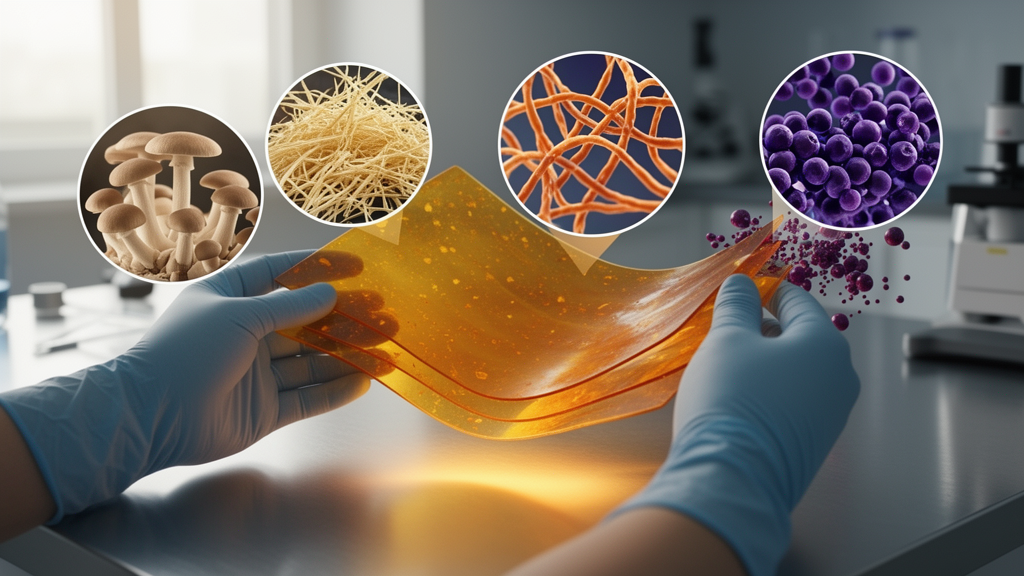
A humble mushroom, a protein from animal skin, and the same pigment that makes blueberries blue have been fused into a film strong enough to rival some engineering plastics — and it can shield against ultraviolet light, kill bacteria, mop up damaging free radicals, keep food fresh, and even tell you when that food has gone off. The breakthrough, published in Nature Sustainability, comes not from exotic chemistry but from a deceptively simple insight: tiny plant-derived molecules can act as molecular solder, welding together biological materials that normally refuse to cooperate.
The research team, led by Shangxian Xie and Hongbo Yu of Huazhong University of Science and Technology together with Yaxian Zhou of the Guangxi Shenguan Collagen Technology Research Institute, set out to tackle one of the most stubborn problems in sustainable materials science. Biopolymers — the proteins, polysaccharides and other macromolecules produced by living organisms — are abundant, renewable and biodegradable, making them obvious candidates to replace petroleum-based plastics. But when engineers try to blend different biopolymers into a composite, the components often behave like oil and water at the molecular level. Their mismatched interfaces couple weakly, so loads cannot transfer efficiently between them, and the resulting materials fall apart mechanically long before they can deliver useful functions.
Nature solved this problem billions of years ago. Biological composites such as bone, nacre and tendon achieve extraordinary toughness through hierarchical architectures in which stiff and soft phases are integrated across every length scale, from individual molecular bonds up to aligned microstructural lamellae. Previous bioinspired materials have mimicked these designs using synthetic polymers, ceramics and 3D-printed architectures, but replicating such cross-scale coherence in an all-biological system has remained elusive. The new study demonstrates that the missing ingredient may be something surprisingly small: natural low-molecular-weight compounds that sit at the heterointerfaces between mismatched biopolymers and reorganize the entire network around them.
To validate the concept, the researchers built a ternary model system abbreviated CMpA, combining collagen — the structural protein of skin, tendon and bone — with mycelium from the fungus Ganoderma lucidum, the reishi mushroom long prized in traditional medicine, and plant-derived anthocyanins, the pigments responsible for the reds, purples and blues of many fruits and flowers. Each component brings a different character to the mixture. Collagen forms strong fibrous networks. Fungal mycelium contributes a chitin-rich scaffolding of interwoven hyphae. Anthocyanins are small planar molecules decorated with hydroxyl groups capable of forming hydrogen bonds and π-stacking contacts with both proteins and polysaccharides.
Using molecular dynamics simulations, interfacial spectroscopy, mesoscale structural analysis and mechanical modelling, the team resolved exactly how the anthocyanin molecules transform the blend. The small molecules accumulate at the mismatched heterointerfaces, forming dense webs of non-covalent contacts that bridge collagen and mycelial surfaces. These local molecular associations then propagate upward through the hierarchy: individual pore walls consolidate, the network reorganizes into lamellae with strong orientational coherence, and continuous load-transfer pathways emerge across the entire film. In effect, the anthocyanins act as a cross-scale translator, converting local interfacial chemistry into mesoscale anisotropic architecture and, ultimately, macroscopic mechanical integrity.
The numbers are striking. The CMpA films achieved a tensile strength of 63.55 megapascals — comfortably in the range of commodity engineering plastics and far beyond what unmediated biopolymer blends typically manage. But strength is only half the story. Because every component retains its intrinsic functionality, the films simultaneously block ultraviolet radiation, scavenge antioxidant radicals, and inhibit bacterial growth. They also reduce the transmission of both oxygen and water vapour, the two main culprits in food spoilage. And because anthocyanins change colour in response to pH, the films double as built-in freshness indicators, shifting hue as food degrades and releases volatile amines.
In practical demonstrations, the films preserved fresh food while providing visual freshness indication, positioning them as candidates for a new generation of active and intelligent packaging. Such packaging would not merely passively contain food but actively extend shelf life through antioxidant and antibacterial action while signalling spoilage without electronic sensors. For an industry under pressure to eliminate single-use petroleum-based plastics, a compostable film that protects food, extends shelf life and communicates its own condition represents a compelling proposition.
Perhaps the most far-reaching aspect of the work is its generality. The researchers frame the strategy as a design principle rather than a one-off recipe: small-molecule-mediated local interfacial chemistry can be linked with mesoscale anisotropic network formation and macroscopic functional integration in a wide class of biopolymer systems. Anthocyanins are just one member of a vast family of plant secondary metabolites — including polyphenols, flavonoids and tannins — that naturally form non-covalent contacts with proteins and polysaccharides. The same logic could, in principle, be applied to pairings as diverse as silk proteins and nanocellulose, chitosan and lignin, or plant proteins and fungal scaffolds, each time using an appropriate natural small molecule as the interfacial mediator.
The approach also echoes strategies that living systems themselves employ. In plant cell walls, lignin and polysaccharides interlock through non-covalent interactions to produce wood’s remarkable strength. In mineralized tissues, small matrix proteins nucleate and organize apatite crystals within collagen fibrils. In extracellular matrices, proteoglycans such as decorin bridge collagen fibres to tune tissue mechanics. The CMpA system adds a new entry to this catalogue: a case where a dietary pigment, normally valued for colour and nutrition, is repurposed as a structural mediator that reorganizes an entire biopolymer network.
The study relied on a cross-scale methodology that is itself noteworthy. Molecular dynamics simulations resolved the local contacts between anthocyanins and the collagen and mycelial surfaces. Interfacial spectroscopy confirmed these associations experimentally. Mesoscale structural analysis revealed the lamellar pore-wall architecture and its orientational coherence, and mechanical modelling traced how load transfer and damage evolution proceed through the interpenetrating network. The team even made their representative volume element generation code openly available on Zenodo, supporting reproducibility in a field where simulation protocols are often opaque. All supporting data are provided with the paper, and the authors declare no competing interests.
Challenges remain before such materials reach supermarket shelves. Scaling production of consistent mycelium and collagen feedstocks, ensuring food-contact safety compliance, and matching the barrier performance of established polymer laminates will all demand further engineering. Yet the core result stands: a fully biological composite, assembled from renewable ingredients with a natural pigment as the molecular glue, achieves mechanical coherence and multifunctionality that neither component could deliver alone. As the search for sustainable replacements for conventional plastics intensifies, the idea that the answer might lie in the spaces between molecules — soldered shut by the same pigments that colour our food — is the kind of elegant, cross-disciplinary insight that could reshape how we design materials for a post-plastic world.
Subject of Research: Small-molecule-bound biopolymer networks for sustainable multifunctional composites
Article Title: Small-molecule-bound biopolymer networks for sustainable multifunctional composites
Article References: Tunuhe, A., Zheng, Z., Zhu, K., Zhao, Y., Ma, F., Gu, Y., Sha, J., Yu, H., Zhou, Y., & Xie, S. (2026). Small-molecule-bound biopolymer networks for sustainable multifunctional composites. Nature Sustainability. https://doi.org/10.1038/s41893-026-01967-9
Image Credits: AI Generated
DOI: 10.1038/s41893-026-01967-9
Keywords: Small-molecule-bound, biopolymer, networks, sustainable, multifunctional, composites, scientific research
Cite Scienmag News
Sloane Callahan. (October 16, 2026). Mushroom, collagen and berry pigment fuse into plastic-strength smart film. Scienmag. https://scienmag.com/mushroom-collagen-and-berry-pigment-fuse-into-plastic-strength-smart-film/
Sloane Callahan. "Mushroom, collagen and berry pigment fuse into plastic-strength smart film." Scienmag, 16 October 2026, https://scienmag.com/mushroom-collagen-and-berry-pigment-fuse-into-plastic-strength-smart-film/. Accessed 16 October 2026.
Sloane Callahan. "Mushroom, collagen and berry pigment fuse into plastic-strength smart film." Scienmag. October 16, 2026. https://scienmag.com/mushroom-collagen-and-berry-pigment-fuse-into-plastic-strength-smart-film/


