


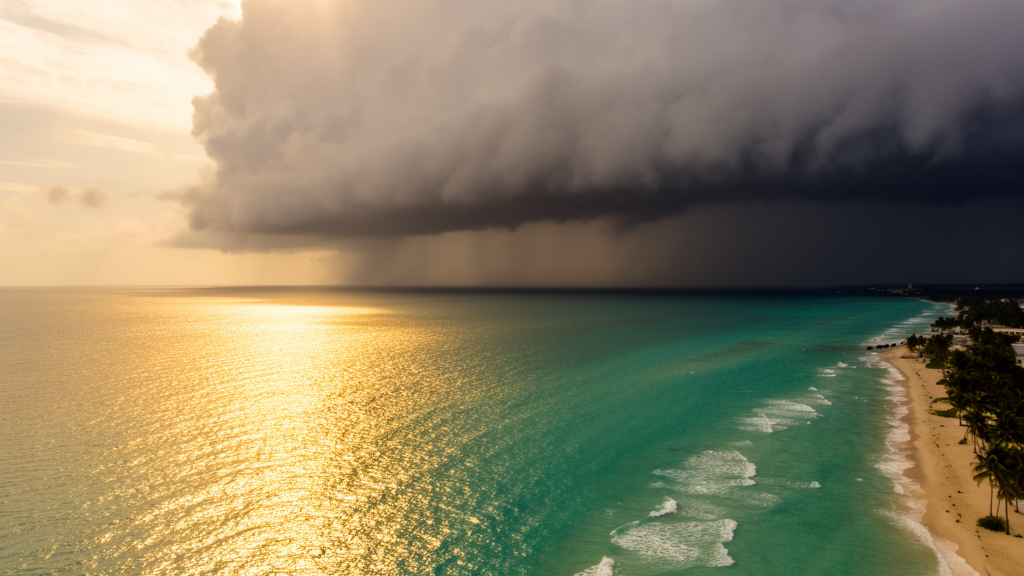
The waters off South Florida are getting hotter in a way that can be measured year by year, but the hurricanes that sweep through the region show no such steady march. A new analysis of more than four decades of satellite sea surface temperature data and historical storm records has found that marine heatwaves along the coast of Miami-Dade, Broward and Monroe Counties have intensified dramatically since 1982, while the frequency of major hurricanes passing within 500 kilometres of the shoreline has remained stubbornly variable, with no statistically detectable long-term trend. The study, published in the journal Environmental Challenges, is among the first to examine how these two extremes, oceanic and atmospheric, line up in time along this heavily developed stretch of the North Atlantic coast.
Marine heatwaves are defined as prolonged periods when ocean surface temperatures exceed a seasonally varying threshold, in this case the 90th percentile of a fixed 1982 to 2011 baseline climatology. To qualify as a discrete event, the anomalously warm conditions must persist for at least five consecutive days. The researchers applied this framework to daily sea surface temperature fields from the NOAA Optimum Interpolation dataset, which blends satellite and in situ observations at a quarter-degree resolution, and paired the results with tropical cyclone tracks from the International Best Track Archive for Climate Stewardship, filtered to storms passing within 500 kilometres of the South Florida coast.
What the analysis revealed is a striking asymmetry between the two hazards. Annual marine heatwave warm days increased by 35.33 days per decade, a result the Mann-Kendall statistical test rated as highly significant. Event frequency climbed by 1.89 events per decade, mean duration lengthened by 2.97 days per decade, and cumulative intensity, which integrates the temperature anomaly over the full duration of each event, rose by 35.54 degree-days per decade. All three trends were statistically robust, and the largest values occurred after 2014. Because the detection threshold is anchored to a fixed historical baseline, these increases represent genuine exceedance of past climatology rather than an artefact of a shifting reference period.
Hurricanes told a different story. Ninety tropical cyclones entered the 500-kilometre analysis domain between 1982 and 2024, including 21 Category 1 and 2 hurricanes, 16 Category 3 and 4 hurricanes, and 5 Category 5 storms, contributing 193 storm-active days in total. Yet when the researchers tested annual counts of Category 3 to 5 hurricanes for a monotonic trend, the result was null: the Sen slope estimate was 0.00 storms per decade with a p-value of 0.117. The record is dominated by pronounced interannual variability, with stretches of consecutive years recording zero major hurricanes in the domain, punctuated by episodic peaks in the mid-2000s and after 2010, when annual counts reached three to four storms.
The spatial pattern of the strongest storms is equally revealing. Category 3 to 5 hurricanes most frequently approach the study area from the east and southeast, with first entry points clustering between 24 and 28 degrees north latitude and 75 to 82 degrees west longitude, a corridor spanning the Florida Straits, the Bahamas and the adjacent western Atlantic. Tracks generally move westward or northwestward across the open ocean before some systems curve northward along the western Atlantic or into the eastern Gulf of Mexico, while a smaller group arrives from the Caribbean basin. This concentrated entry sector underscores how tightly the region’s hurricane exposure is channelled by large-scale steering flow.
Perhaps the most surprising finding concerns how rarely the two extremes actually coincide. Only 18 of the 193 tropical cyclone days, or 9.33 percent, overlapped with a marine heatwave in the domain-mean sea surface temperature record, and just 12 of the 90 storms showed any degree of regional temporal overlap at all. When overlap did occur, it was concentrated in the peak hurricane season from August through October, when both warm surface waters and cyclone activity are naturally more likely. The authors characterise this pattern as episodic rather than systematic, suggesting that the timing of the two hazards is governed largely by seasonality, storm tracks and large-scale variability rather than by any tight physical coupling.
That interpretation is consistent with the physics of marine heatwave formation. In subtropical settings, extreme ocean warming events are often driven by persistent high-pressure systems and weak winds, conditions that favour surface heating and stratification. Tropical cyclones, by contrast, are associated with strong wind forcing that mixes the upper ocean, entraining cooler subsurface water and cooling the sea surface, a process first described in detail by Price in 1981. The two phenomena therefore tend to favour opposite oceanic states, which may help explain why their day-level overlap remains limited even as heatwave activity surges.
The study also examined whether warmer waters during overlap days were associated with stronger storms. A descriptive Spearman correlation between maximum sustained wind speed and area-mean sea surface temperature anomaly on co-occurrence days yielded a coefficient of 0.42 with a p-value below 0.001, indicating a positive advisory-level association. However, the authors are careful to stress that this result is descriptive rather than causal. The advisory-level observations are not independent storm-level data points, the sample is conditioned on overlap, and Category 3 to 5 advisories appeared across a wide range of positive anomalies, with some of the highest anomalies occurring at lower wind speeds. Warm sea surface temperatures are one ingredient in the environmental setting for cyclone intensification, but they are far from sufficient on their own.
Event-based analysis of six named storms, including Irma in 2017, Ian in 2022, Idalia in 2023, Nicole in 2022, Matthew in 2016 and Sally in 2020, added further nuance. Periods when local sea surface temperature exceeded the local fixed-baseline 90th-percentile threshold did not consistently align with peak storm intensity, and post-peak changes in sea surface temperature anomaly varied across events. While cyclone-induced surface cooling through wind-driven mixing is physically plausible, the event windows lack a counterfactual comparison and subsurface observations, so the authors interpret these sequences as descriptive temporal patterns rather than evidence of a feedback mechanism between storms and heatwaves.
For coastal risk management, the implications are significant even without causal claims. The Florida Keys reef system is acutely sensitive to thermal stress, and prior heat exposure can weaken coral resilience before storm-driven wave damage arrives, a sequential hazard that does not require the two extremes to overlap on the same day. The study’s findings suggest that as marine heatwaves become more frequent, longer and more intense relative to the historical baseline, coastal ecosystems and infrastructure in South Florida will face mounting cumulative thermal stress, punctuated by the irregular but persistent threat of major hurricanes. The authors recommend that future work incorporate storm-centred spatial matching, subsurface ocean data, sensitivity analyses of buffer size and baseline period, and coupled ocean-atmosphere models to move beyond descriptive association toward mechanistic understanding of how these two faces of a warming climate interact.
Subject of Research: Temporal co-occurrence of marine heatwaves and tropical cyclones along the South Florida coast
Article Title: Spatiotemporal dynamics and regional temporal co-occurrence of marine heatwaves and tropical cyclones along the South Florida coast
Article References: Spatiotemporal dynamics and regional temporal co-occurrence of marine heatwaves and tropical cyclones along the South Florida coast. (n.d.). https://doi.org/10.1016/j.envc.2026.101688
Image Credits: AI Generated
DOI: 10.1016/j.envc.2026.101688
Keywords: marine heatwaves, tropical cyclones, South Florida, sea surface temperature, compound climate extremes, hurricane frequency, NOAA OISST, IBTrACS, coastal risk, ocean warming, Florida Keys, climate trends
Cite Scienmag News
Sloane Callahan. (October 16, 2026). Marine Heatwaves Surge Off South Florida While Hurricanes Stay Unpredictable. Scienmag. https://scienmag.com/marine-heatwaves-surge-off-south-florida-while-hurricanes-stay-unpredictable/
Sloane Callahan. "Marine Heatwaves Surge Off South Florida While Hurricanes Stay Unpredictable." Scienmag, 16 October 2026, https://scienmag.com/marine-heatwaves-surge-off-south-florida-while-hurricanes-stay-unpredictable/. Accessed 16 October 2026.
Sloane Callahan. "Marine Heatwaves Surge Off South Florida While Hurricanes Stay Unpredictable." Scienmag. October 16, 2026. https://scienmag.com/marine-heatwaves-surge-off-south-florida-while-hurricanes-stay-unpredictable/


