


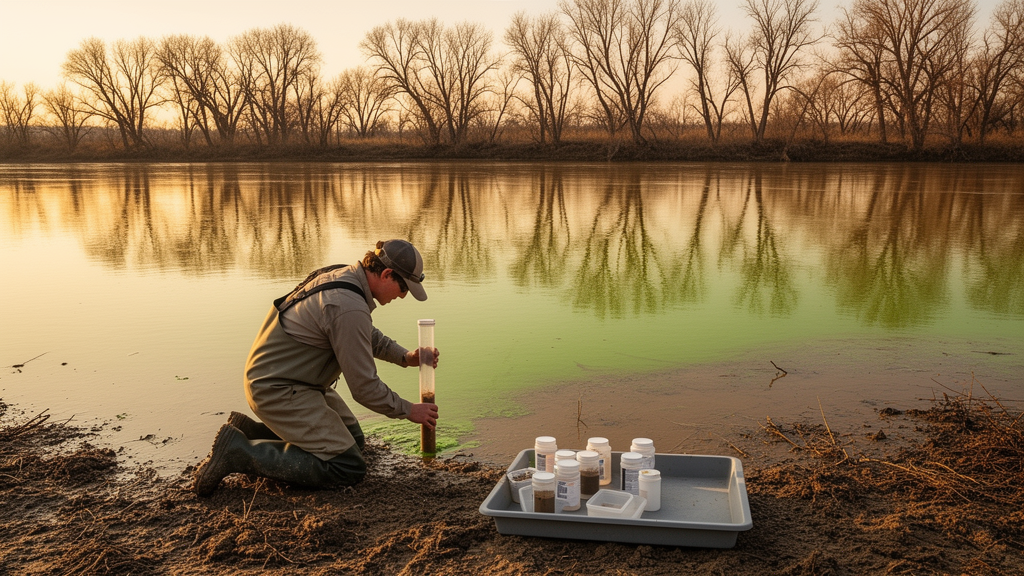
Along the braided corridor of the Missouri River, where oxbow lakes and ponds dot the floodplains of western Iowa and eastern Nebraska, a quiet geochemical drama is unfolding. A new study published in Environmental Geochemistry and Health reveals that small water bodies separated by only a few kilometers can carry dramatically different loads of toxic trace elements, and that the regional averages long used to characterize water quality in the area may be masking some genuinely concerning hotspots. The research, led by Onema C. Adojoh of Northwest Missouri State University together with colleagues, offers one of the most detailed site-by-site portraits yet of metal contamination in this stretch of the floodplain, and its findings carry implications for how environmental agencies monitor water quality far beyond the Midwest.
The team sampled water from six lakes and ponds across three site-wide surveys conducted in Summer 2024, Fall 2025, and Spring 2026, producing eighteen individual site-campaign observations. From each sample, they measured eleven trace elements that survived rigorous data verification: aluminum, arsenic, cadmium, cobalt, copper, iron, manganese, nickel, lead, selenium, and zinc, all standardized to micrograms per liter. These are not obscure contaminants. Arsenic and lead are among the most notorious poisons in environmental health, cadmium accumulates in kidneys and bones, and excess manganese has been linked to neurological harm. Even elements such as copper and zinc, essential nutrients in trace amounts, become ecologically damaging when concentrations climb too high.
To translate raw concentrations into something actionable, the researchers deployed two complementary screening tools. The first was the exceedance ratio, calculated simply as the measured concentration of an element divided by its screening benchmark, so that any value above one signals a potential concern. The second was the Heavy Metal Pollution Index, or HPI, a composite metric first developed in the 1990s that weights multiple metals together into a single score reflecting overall water quality. By combining these indices with a variance-partitioning statistical analysis, the team could ask two distinct questions: which water bodies are the most contaminated, and what factor, location or season, best explains the variation they observed.
The answer to the first question was unambiguous. Lake Manawa, a popular recreation spot near Council Bluffs, Iowa, recorded the highest mean HPI of any site at 327.13, along with the highest overall mean exceedance ratio of 1.85. Digging into the element-level data, the researchers found that the lake’s poor showing was driven principally by cobalt, which exceeded its benchmark by an average factor of 7.19, followed by lead at 5.16 times the benchmark, manganese at 1.99, aluminum at 1.94, and cadmium at 1.49. A cobalt exceedance of more than sevenfold is striking, since cobalt is rarely the headline contaminant in freshwater assessments, and a lead ratio above five raises immediate questions about legacy sources such as historical industrial activity, atmospheric deposition from the era of leaded gasoline, or contaminated sediments resuspended into the water column.
Among the remaining five sites, Pinky’s Glen posted the highest mean exceedance ratio at 1.57, dominated by manganese at 5.31 times its benchmark, aluminum at 3.24, and cobalt at 3.15. Steinhart Park showed a similar fingerprint, with elevated manganese at 5.61, cobalt at 3.05, and aluminum at 2.59. The recurring trio of manganese, aluminum, and cobalt at these sites is geochemically suggestive. All three elements are abundant in the region’s glacial tills and alluvial sediments, and their co-elevation can reflect natural weathering of fine-grained deposits, particularly under the low-oxygen conditions that develop in stagnant pond bottoms where manganese and iron oxides dissolve and release bound metals into the water. Distinguishing between such geogenic enrichment and genuine anthropogenic pollution is precisely the kind of question that confirmatory monitoring, with sediment chemistry and speciation analysis, would need to answer.
The variance partition delivered the study’s most conceptually important result. Using an additive two-factor model, the researchers found that the identity of the water body itself accounted for more than 90 percent of the variation in seven of the eleven elements analyzed: aluminum, cobalt, copper, iron, manganese, lead, and zinc. In other words, each pond and lake carries its own geochemical fingerprint, shaped by its local catchment, sediment history, and hydrology, so distinct from its neighbors that sampling one tells you almost nothing about the others. The campaign factor, by contrast, dominated for only two elements: it explained 95.8 percent of the variation in arsenic and 54.2 percent of the variation in cadmium. This suggests that arsenic levels in these waters fluctuate strongly between surveys, possibly in response to seasonal changes in redox conditions, water level, or sediment disturbance, while the other metals remain stubbornly anchored to place.
For environmental managers, this statistical architecture has a blunt practical message: pooled regional averages are the wrong tool for this landscape. If water-body identity explains over 90 percent of the variance for most metals, then a single regional mean conceals exactly the information that matters, namely which specific lakes exceed safe thresholds and by how much. A regional program that samples one representative pond and extrapolates to the floodplain would likely declare the area broadly acceptable while missing a lake like Lake Manawa, where the composite pollution index towers over its neighbors. The study’s authors argue that monitoring should instead be site-specific and analyte-specific, prioritizing the locations and elements where exceedances are real and repeated.
To formalize that prioritization, the team constructed an equal-weight ranking score that combined three normalized metrics: the mean HPI, the frequency with which benchmarks were exceeded, and the mean exceedance ratio. The exercise produced a clear shortlist. Lake Manawa, Pinky’s Glen, and Steinhart Park emerged as the three highest priorities for confirmatory monitoring, each for slightly different reasons. Lake Manawa’s case rests on its exceptional cobalt and lead levels, while Pinky’s Glen and Steinhart Park share a manganese-aluminum-cobalt signature that may point to sediment chemistry and oxygen dynamics as the controlling processes. Confirmatory monitoring, the researchers emphasize, would involve denser temporal sampling, sediment and pore-water analysis, and measurements of metal speciation, the chemical forms that determine how bioavailable, and therefore how toxic, each element actually is to aquatic organisms and humans.
The study also recovered a physicochemical dataset that frames the metal findings in context. Carter Lake recorded the highest mean total dissolved solids at 264.67 milligrams per liter and the highest electrical conductivity at 529.33 microsiemens per centimeter, indicators of its higher dissolved ion load. Water temperatures across the surveys ranged from 3.03 to 6.57 degrees Celsius, and mean pH values sat in the circumneutral band between 6.95 and 7.62. These parameters matter because metal behavior in water is exquisitely sensitive to them. Circumneutral pH limits the dissolution of many metal species, while conductivity and dissolved solids influence how metals complex with dissolved organic matter and carbonate ions, altering both their transport and their toxicity. The cold temperatures during sampling may also slow the microbial and geochemical reactions that mobilize metals from sediments, meaning warm-season conditions could push concentrations in either direction.
The authors are careful to flag the limits of their design. Because the three surveys occurred in different years rather than within a single annual cycle, temporal comparisons and benchmark exceedances must be interpreted as screening-level evidence rather than definitive trend statements. That caution is scientifically appropriate, but it does not blunt the central finding. In a floodplain landscape scarred and reshaped by more than a century of Missouri River engineering, agricultural runoff, and industrial legacy, six neighboring water bodies behave as six independent geochemical systems. The study’s call to abandon pooled regional assessment in favor of targeted, site-by-site monitoring is a challenge to conventional water-quality practice, and one that, if heeded, could uncover hidden contamination hotspots in floodplains well beyond the Iowa-Nebraska border.
Subject of Research: Trace-element contamination dynamics in Missouri River floodplain lakes and ponds
Article Title: Spatial and campaign-scale dynamics of trace elements in lakes and ponds of the Iowa and Nebraska – Missouri River floodplain
Article References: Adojoh, O. C., Trabal, W., Adewuyi, F., Ayinde, K., Bellamy, M., Meziani, M. J., & Monroe, L. (2026). Spatial and campaign-scale dynamics of trace elements in lakes and ponds of the Iowa and Nebraska – Missouri River floodplain. Environmental Geochemistry and Health, 48(16), Article 642. https://doi.org/10.1007/s10653-026-03525-w
Image Credits: AI Generated
DOI: 10.1007/s10653-026-03525-w
Keywords: trace elements, Missouri River floodplain, heavy metal pollution index, Lake Manawa, water quality monitoring, manganese, cobalt, lead contamination, exceedance ratio, floodplain lakes, environmental geochemistry, Iowa and Nebraska
Cite Scienmag News
Sloane Callahan. (October 16, 2026). Hidden Metal Hotspots in Missouri River Floodplain Lakes Defy Regional Averages. Scienmag. https://scienmag.com/hidden-metal-hotspots-in-missouri-river-floodplain-lakes-defy-regional-averages/
Sloane Callahan. "Hidden Metal Hotspots in Missouri River Floodplain Lakes Defy Regional Averages." Scienmag, 16 October 2026, https://scienmag.com/hidden-metal-hotspots-in-missouri-river-floodplain-lakes-defy-regional-averages/. Accessed 16 October 2026.
Sloane Callahan. "Hidden Metal Hotspots in Missouri River Floodplain Lakes Defy Regional Averages." Scienmag. October 16, 2026. https://scienmag.com/hidden-metal-hotspots-in-missouri-river-floodplain-lakes-defy-regional-averages/


