


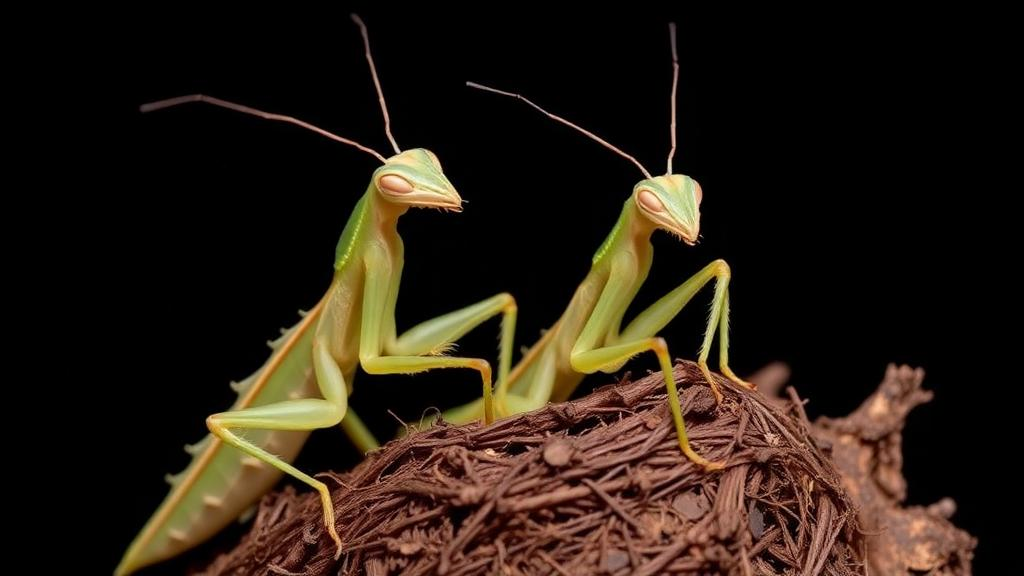
The Chinese mantid, Tenodera sinensis, is one of the most familiar predators in North American gardens and meadows, a large insect introduced from Asia in the late nineteenth century that has since spread across temperate North America. It is also a workhorse of mantid research, a favorite subject for studies of predatory behavior, physiology, and perhaps most famously of sexual cannibalism, the phenomenon in which a female eats her mate before, during, or after copulation. Yet despite decades of attention, the species’ breeding system has remained surprisingly opaque. Scientists have lacked the genetic tools needed to ask basic questions about who fathers whose offspring, how sperm from competing males is used, and how wild populations are structured. A new study published in the Journal of Orthoptera Research addresses that gap by developing ten polymorphic microsatellite DNA markers for T. sinensis and, in a striking proof of concept, using a single locus to demonstrate multiple paternity in a clutch of nymphs collected from the wild.
Microsatellites are short, tandemly repeated stretches of DNA that mutate rapidly and vary dramatically among individuals, making them ideal genetic fingerprints for paternity testing and population genetics. The research team faced an immediate obstacle: primers developed for three other mantid species either failed to amplify or produced no useful variation in T. sinensis samples. The researchers therefore began from scratch, drawing genomic DNA from mantids collected at a wild population in western New York. They used a technique known as hybridization capture, in which biotinylated probes matching common repeat motifs are allowed to bind complementary sequences in fragmented genomic DNA, then pulled out of the mixture with streptavidin-coated magnetic beads. The captured fragments were amplified by PCR, cloned, and sequenced, yielding sixteen candidate microsatellites. Of these, six loci amplified successfully and proved polymorphic.
The laboratory workflow behind this achievement was exacting. Genomic DNA was fragmented enzymatically, ligated to custom-designed linkers, and hybridized to probes for CA and GA dinucleotide repeats under a carefully controlled series of salt-buffer washes at escalating stringency. Colonies carrying large inserts were identified by blue-white screening and colony PCR, then sequenced commercially. Primers were designed to roughly twenty nucleotides in length with fifty percent GC content and two GC clamps at their three-prime ends, and a universal M13 sequence was added to forward primers while a PIG tail sequence was appended to reverse primers to promote complete adenylation during amplification. These details matter because they determine how cleanly and reproducibly a locus can be genotyped across hundreds of future samples.
Six loci proved useful, but they carried a well-known liability. Dinucleotide microsatellites such as the TG repeats in locus SK1 are notorious for stutter, a PCR artifact in which polymerase slippage generates a ladder of spurious peaks one or two base pairs shorter than the true allele. On a capillary electrophoresis trace, this produces a tall main peak flanked by progressively shorter echoes, and in heterozygous individuals with similarly sized alleles the overlapping stutter signals can even create interference patterns that complicate scoring. The researchers adopted conservative criteria, treating the largest peak in each series as the true allele, but they recognized that cleaner markers were needed for unambiguous genotyping.
Fortuitously, a draft genome of T. sinensis was published in 2024, and the team exploited it to solve the stutter problem. Using the bioinformatic tool Krait, they searched the genome assembly for tetranucleotide repeats, motifs four base pairs long repeated between ten and twenty-four times. Four of nine candidate loci with newly designed primers amplified reliably and proved polymorphic. Tetranucleotide repeats produce far cleaner electropherograms because stutter products, which arise in increments of a single repeat unit, are separated by four bases rather than two, yielding discrete, easily assigned peaks. The combined panel ultimately spanned ten loci with four to thirteen alleles each and heterozygosities ranging from 0.35 to 0.94, a level of variation the authors describe as well suited for studies of relatedness, breeding biology, and population structure.
The characterization also revealed features of the loci themselves that inform their future use. Locus CRAM8 carries a compound repeat of imperfect TG and AG motifs, while SK18 holds an uninterrupted TG run of thirty-seven repeat units. Three loci showed significant departures from Hardy-Weinberg equilibrium driven by heterozygote deficits, which the authors suggest may reflect inbreeding or null alleles that fail to amplify. One pair of loci, SHMS and QHMS, displayed significant linkage disequilibrium, hardly surprising given that they sit roughly 188 kilobases apart on the same genome contig. These caveats aside, the panel showed no widespread linkage, meaning each locus contributes largely independent information.
The centerpiece of the study, however, is a paternity analysis that would have been impossible without these markers. The researchers collected a single ootheca, the foamy egg case that female mantids encase their eggs in, from a wild population in Fredonia, New York, and genotyped sixteen nymphs that hatched from it at the CRAM12 locus, a tetranucleotide repeat particularly resistant to stutter. The progeny array contained five alleles distributed across six distinct genotypes. Because every nymph carried one of two alleles, 242 or 250 base pairs long, the researchers inferred the mother’s genotype as 242/250. Subtracting one maternal allele from each nymph left three obligate paternal alleles: 210, 214, and 222 base pairs. Two alleles could theoretically come from a single heterozygous father, but three cannot, so the clutch must have been sired by at least two males.
This finding of multiple paternity in a wild North American population dovetails neatly with field observations of female T. sinensis mating with more than one male and with molecular evidence of mixed paternity in other Tenodera species. It is directly relevant to one of the thorniest puzzles in mantid evolutionary ecology: sexual cannibalism. Theoretical work going back decades has shown that the fitness consequences of a female eating her mate depend critically on the breeding system, including whether she has already stored sperm from other males and whether a cannibalized male can still fertilize some eggs. Markers like these now make it possible to measure sperm precedence and post-copulatory sexual selection directly, rather than inferring them from behavior alone. The authors also flag a lingering taxonomic wrinkle: a Japanese study that reported multiple paternity in T. aridifolia may actually have examined T. sinensis, since phylogenetic work shows that Japanese specimens once labeled T. aridifolia are the sister species’ relative, and puzzlingly, that study’s microsatellite primer failed to amplify in the New York samples.
For a species that may now be the most widely distributed temperate-zone mantid on Earth, and a staple of both classrooms and laboratories, T. sinensis has been oddly under-equipped genetically. This new marker set changes the landscape. With ten variable loci, clean tetranucleotide chemistry, and a demonstrated ability to resolve paternity from a single clutch, researchers can now probe sperm competition, reproductive success after sexual cannibalism, and the fine-scale genetic structure of wild populations with confidence. What began as a methodological paper thus ends with a biological headline: in the wild, at least one mantid mother’s egg case held evidence of at least two fathers, confirming that the mating game in these iconic predators is more complex than a single deadly tryst.
Subject of Research: Development of microsatellite genetic markers for the praying mantid Tenodera sinensis and their use to demonstrate multiple paternity
Article Title: Microsatellite markers for the praying mantid Tenodera sinensis ( Mantodea , Mantidae ) and the demonstration of multiple paternity
Article References: Microsatellite markers for the praying mantid Tenodera sinensis ( Mantodea , Mantidae ) and the demonstration of multiple paternity. (n.d.). https://doi.org/10.3897/jor.35.166724
Image Credits: AI Generated
Keywords: praying mantid, Tenodera sinensis, microsatellites, multiple paternity, sexual cannibalism, paternity testing, population genetics, Mantodea, genetic markers, ootheca, tetranucleotide repeats, wild populations
Cite Scienmag News
Juliet Wilcox. (October 16, 2026). Genetic Toolkit Reveals Praying Mantids Take Multiple Fathers Into the Nest. Scienmag. https://scienmag.com/genetic-toolkit-reveals-praying-mantids-take-multiple-fathers-into-the-nest/
Juliet Wilcox. "Genetic Toolkit Reveals Praying Mantids Take Multiple Fathers Into the Nest." Scienmag, 16 October 2026, https://scienmag.com/genetic-toolkit-reveals-praying-mantids-take-multiple-fathers-into-the-nest/. Accessed 16 October 2026.
Juliet Wilcox. "Genetic Toolkit Reveals Praying Mantids Take Multiple Fathers Into the Nest." Scienmag. October 16, 2026. https://scienmag.com/genetic-toolkit-reveals-praying-mantids-take-multiple-fathers-into-the-nest/


