


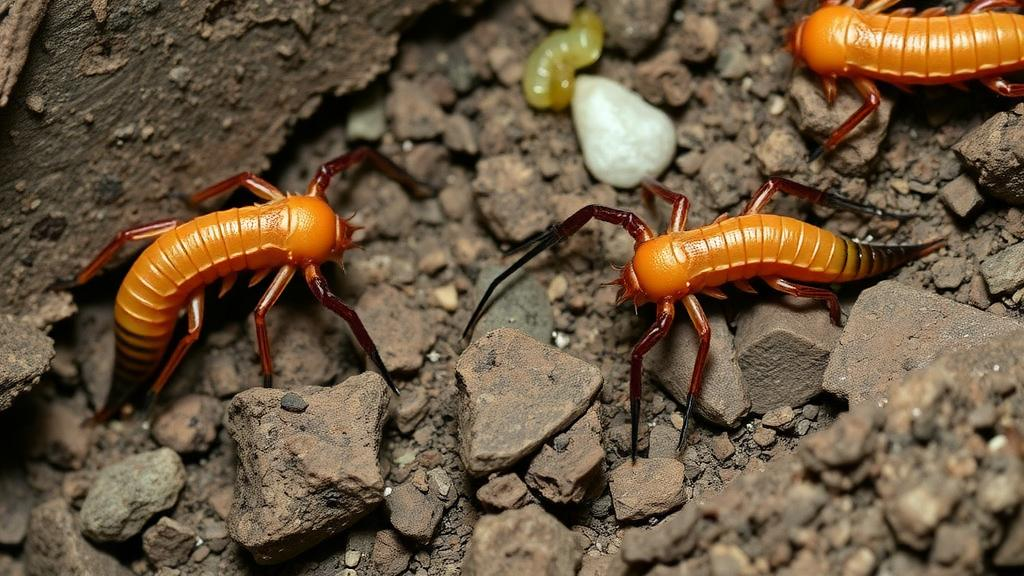
Deep in the cool, damp refugia of western Honshu Island, Japan, scientists have identified two insect species that have, until now, slipped through the net of formal taxonomy. The creatures belong to Grylloblattodea, an ancient and exceedingly strange order of insects often called ice crawlers or rock crawlers, and to the East Asian genus Galloisiana. In a study published in the journal Subterranean Biology, researchers describe Galloisiana harimensis sp. nov. and Galloisiana kawamurai sp. nov., bringing the global count of species in the genus to thirteen. The discovery is significant not simply because two new names enter the scientific literature, but because it exposes how much hidden diversity still lurks among animals that few people will ever see alive in the wild.
Grylloblattodea are among the most evolutionary isolated lineages of living insects, a relict group whose closest relatives perished tens of millions of years ago. They are wingless, flat-bodied, long-antennaled predators of cold places, typically thriving at high elevations, near snowfields, or inside caves and rocky seeps where temperatures remain low and stable. The genus Galloisiana, established by Caudell in 1924, is restricted to East Asia, with known populations in Japan, eastern Russia, China and the Korean Peninsula. Before this study, five species were recognized in Japan, yet the genus has long been regarded as a taxonomic puzzle. Several Japanese populations clearly exist that could not be assigned to any named species, and for some described species, the available type material is so incomplete that adult morphology remains entirely unknown.
That inadequacy of historical descriptions is a recurring theme in Galloisiana research, and it is one reason why the new study required such an unusual combination of evidence. Galloisiana notabilis, for example, was described from immature specimens, so the traits of adults have never been formally characterized. Galloisiana kiyosawai and G. chujoi were each described from female specimens alone, meaning that no male has ever been examined for either species. Because these insects are partially subterranean, dispersal between populations is presumed to be poor, encouraging strong geographic differentiation, yet the morphological differences among resulting species are often subtle and difficult to interpret. Without males, whose genital structures typically carry the clearest species-specific signatures, traditional identification often stalls at the level of genus.
To break through this impasse, the research team conducted inventory surveys across Japan and applied an integrated approach, combining careful morphological analysis with molecular phylogenetics. Specimens were collected from multiple sites, and for three known species, G. chujoi, G. nipponensis and G. yuasai, some material came from areas close to the original type localities, anchoring the comparisons to the very populations on which the species names were first founded. Morphological work was performed under a stereomicroscope, with male genitalia cleared in a ten percent potassium hydroxide solution to reveal fine sclerotized structures, and multi-focused digital images were stacked from series of photographs taken with a camera mounted on the microscope. The type specimens of both new species are deposited in the Museum of Nature and Human Activities in Hyogo.
The molecular half of the study relied on two genetic markers: the mitochondrial cytochrome c oxidase subunit II gene, abbreviated COII, and the nuclear 28S ribosomal RNA gene. DNA was extracted from middle legs using a Chelex-based protocol, amplified with published primer pairs under standardized cycling conditions, and sequenced bidirectionally. The resulting sequences were aligned with the MAFFT software package using the L-INS-i algorithm, and a maximum likelihood phylogeny was reconstructed with IQ-TREE, employing ultrafast bootstrap approximations over one thousand replicates. Substitution models were selected by ModelFinder under the Bayesian information criterion, with GTR+F chosen for both markers. Newly generated sequences were deposited in the international DNA sequence databases, and voucher specimens were archived so that every DNA record corresponds to a physical, verifiable insect.
The phylogenetic results delivered a decisive verdict. The western Honshu and Shikoku populations form a well-supported clade, subdivided into three distinct subclades: one containing G. chujoi from Kagawa Prefecture on Shikoku, one containing the population from Mie and Shiga Prefectures, and one containing the population from Hyogo Prefecture. Multiple individuals from each geographic grouping formed their own monophyletic clusters with maximal or near-maximal statistical support. In plain terms, the DNA of these populations is as distinct as that of recognized species elsewhere in the tree, and the two unnamed populations, previously catalogued informally as Galloisiana sp. 4 and sp. 5, warranted formal description as new species in their own right.
The first newcomer, Galloisiana harimensis, was found in Sayo Town, Hyogo Prefecture, and carries a name derived from Harima, the historic designation for the central-western region of the prefecture. Morphologically, it is a classic example of how deceptive Galloisiana identification can be. In general appearance it closely resembles G. nipponensis, the very type species of the genus, yet the two are readily separated by a combination of fine characters. Each cervical sclerite of G. harimensis bears four to six large bristles, or macrosetae, compared with six to nine in G. nipponensis, and the male genitalia show a distinctive bump on the sclerotized apical surface of the left phallomere that is absent in its eastern relative. Measurements such as head width, antennomere proportions and ovipositor lengths were tabulated in detail, with the ratio of the third to second antennomeres falling below three in both sexes of the new species.
The second species, Galloisiana kawamurai, was discovered near a cave in Inabe City, Mie Prefecture, with an additional specimen from Taga Town in neighboring Shiga Prefecture. The species epithet honors Kohei Kawamura, a collector whose contribution made the study possible, and the insect bears the Japanese common name Suzuka-Garoa-mushi, referencing the Suzuka Mountains. It too resembles G. nipponensis superficially, but differs consistently: its cervical sclerites carry only three or four macrosetae, the distal process of the male subgenital plate is very short rather than long, and the stylus is slender and oval rather than tube-shaped. The phylogenetic analysis revealed an intriguing relationship, pairing G. kawamurai with the eyeless G. chujoi from Shikoku in a well-supported clade, while G. harimensis occupies its own fully supported subclade within the same western lineage, a finding consistent with earlier molecular work on the group.
The crux of the discovery lies in the power of male genital morphology combined with genetics. Females of the three closely related species, G. harimensis, G. kawamurai and G. nipponensis, look remarkably alike, and even the molecular tree alone cannot be inspected in the field. But the male genitalia, with their species-specific bumps, processes and sclerotized zones, provide a reliable diagnostic fingerprint once specimens are cleared and imaged. The difficulty, however, is practical: adult males of Galloisiana are notoriously hard to collect, and most available specimens are larvae or adult females. This sampling bias has historically hampered taxonomy in the group, which is why the authors emphasize that future progress depends on systematic, targeted collection of adult males and females together, so that morphology and genetics can continue to be interpreted in tandem.
Beyond the immediate satisfaction of naming two new species, the study carries broader implications for biodiversity science. Ice crawlers are cold-adapted remnants of ancient lineages, and their populations are often isolated in montane and subterranean refugia that are acutely vulnerable to climate warming. Every unnamed species in such a group represents an uncounted unit of biodiversity, invisible to conservation planning and evolutionary study alike. By showing that cryptic, geographically structured diversity persists within an apparently well-known genus on one of the world’s most thoroughly surveyed archipelagos, the research underscores a sobering point: even in the twenty-first century, in developed countries with centuries of natural history behind them, entirely new species of strange and ancient insects are still waiting, quietly crawling through the darkness of Japanese caves and mountainsides, for someone to finally give them a name.
Subject of Research: Taxonomic description of two new ice crawler insect species of the genus Galloisiana from western Honshu, Japan
Article Title: Two new species of Galloisiana Caudell, 1924 ( Insecta , Grylloblattodea ) from Western Honshu Island, Japan
Article References: Two new species of Galloisiana Caudell, 1924 ( Insecta , Grylloblattodea ) from Western Honshu Island, Japan. (n.d.). https://doi.org/10.3897/subtbiol.56.194481
Image Credits: AI Generated
DOI: 10.3897/subtbiol.56.194481
Keywords: Galloisiana, Grylloblattodea, ice crawlers, new species, Japan, taxonomy, molecular phylogenetics, Subterranean Biology, Honshu, entomology, cave fauna, biodiversity
Cite Scienmag News
Gavin Prescott. (October 16, 2026). Hidden Ice-Age Relics: Two New Species of Enigmatic Rock Crawlers Discovered in Western Japan. Scienmag. https://scienmag.com/hidden-ice-age-relics-two-new-species-of-enigmatic-rock-crawlers-discovered-in-western-japan/
Gavin Prescott. "Hidden Ice-Age Relics: Two New Species of Enigmatic Rock Crawlers Discovered in Western Japan." Scienmag, 16 October 2026, https://scienmag.com/hidden-ice-age-relics-two-new-species-of-enigmatic-rock-crawlers-discovered-in-western-japan/. Accessed 16 October 2026.
Gavin Prescott. "Hidden Ice-Age Relics: Two New Species of Enigmatic Rock Crawlers Discovered in Western Japan." Scienmag. October 16, 2026. https://scienmag.com/hidden-ice-age-relics-two-new-species-of-enigmatic-rock-crawlers-discovered-in-western-japan/


