


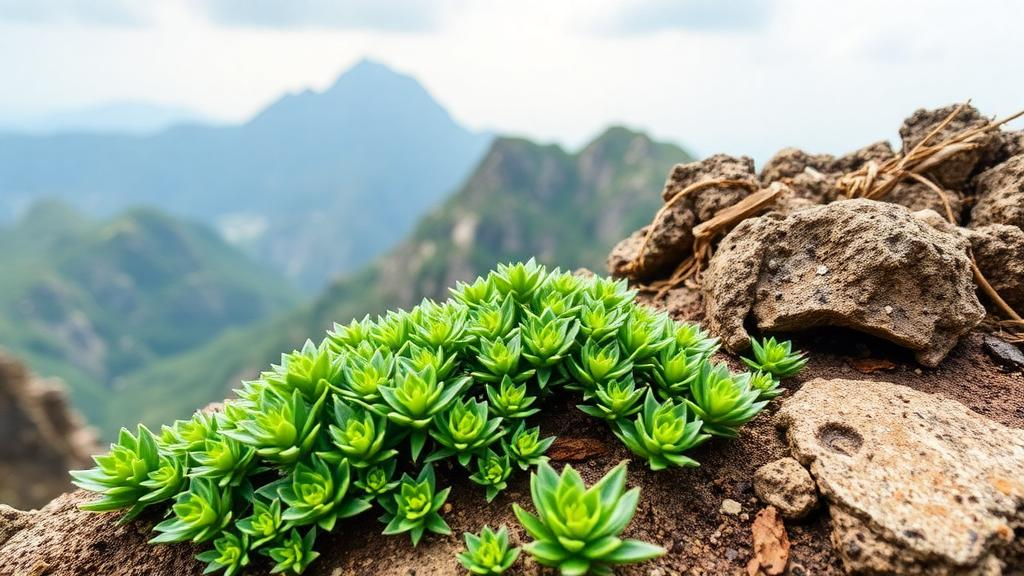
On the granite slopes of Hengshan Mountain in China’s Hunan Province, one of the country’s most storied sacred peaks, botanists have identified a plant that no one had ever formally named. The succulent herb, now described as Sedum hengshanense, belongs to the stonecrop family Crassulaceae and was first noticed in April 2024 during a field survey, when researchers encountered a perennial, tufted Sedum in full flower that matched none of the other species growing at the site, including S. grammophyllum, S. sarmentosum, S. emarginatum, S. bulbiferum and S. alfredii. Two years of follow-up expeditions, comparative morphology and DNA analysis have now confirmed that the plant is new to science, and it is already carrying a worrying conservation label: Vulnerable.
The genus Sedum is the largest in Crassulaceae, with roughly 490 accepted species distributed on every continent except Antarctica. Its major centers of diversity lie in the Euro-Mediterranean region, West and Central Asia, East Asia and North America, particularly the United States and Mexico. These succulent herbs are typically adapted to arid or rocky habitats, and many are familiar to gardeners: species such as S. acre and S. lineare are grown as ornamentals, while others like S. sarmentosum and S. praealtum feature in traditional medicine. Perhaps most strikingly, S. plumbizincicola accumulates heavy metals so efficiently that it is being explored for soil remediation at contaminated sites.
China is a global hotspot for the genus. Around 148 species occur in the country, and 118 of them are found nowhere else. Twenty-seven of China’s Sedum species have been described as new to science in just the past two decades, a pace of discovery that suggests the true diversity of the group remains substantially underestimated. The new species from Hengshan fits squarely into that pattern. Living plants were transplanted to the Wuhan Botanical Garden and the Nanyue Arboretum of Hunan Province, where they are thriving under cultivation, allowing researchers to document the species’ morphology in detail alongside herbarium specimens and scanning electron micrographs of pollen and seeds.
Under the microscope, Sedum hengshanense reveals a suite of characters that set it apart. The plant is a completely glabrous perennial herb with fertile, succulent stems; older stems sprawl prostrate and bear persistent withered leaves, while young stems rise 6 to 12 centimeters tall. Its leaves are arranged alternately and overlap like roof tiles, an oblong-lanceolate shape measuring 7 to 10 millimeters long and 1.5 to 2.0 millimeters wide, only about 0.6 millimeters thick. Young leaves are not twisted at the apex, and the leaf margins carry conspicuous papillae, tiny bumps that are especially prominent on the upper portion of the blade. At the base of each leaf sits a long spur, 1.0 to 1.4 millimeters long, with a sharply acuminate tip.
The flowers are equally diagnostic. Each actinomorphic, sessile flower carries five unequal, fleshy green sepals whose apices are papillate, five elliptic-lanceolate yellow petals 5 to 6 millimeters long with a shortly mucronate tip, meaning each petal ends in a small abrupt point, and ten stamens. The nectar scales, small structures at the base of the carpels that secrete nectar, are broadly spatulate to subtrapezoid with obtuse apices, roughly 0.5 by 0.3 millimeters. Pollen grains are tricolpate and ellipsoid, 26 to 28 micrometers long, with irregularly etched surface ornamentation. The seeds are ellipsoid and densely papillate, 0.6 to 0.8 millimeters long. Flowering runs from April to May, with fruiting from May to June.
Based on the adaxially gibbous, meaning hump-backed, carpels and follicles, the species is placed in Sedum sect. Sedum, a section comprising more than 60 species, of which 49 are recorded from China. Within that section, the new species is morphologically most similar to S. spiralifolium, S. sarmentosum, S. lineare, S. polytrichoides and S. morrisonense. It shares with the first three a perennial habit, a basal leaf spur, comparable petal and nectar scale sizes and papillate seed surfaces. But a combination of characters, alternate rather than verticillate phyllotaxy, papillate leaf margins and sepal apices, longer basal leaf spurs with acuminate tips, and petals with mucronate apices, consistently separates it from all five relatives. Against S. polytrichoides, it has longer basal leaf spurs, 1.0 to 1.4 millimeters versus roughly 0.8 millimeters, and oblong-lanceolate rather than linear leaves. Against S. morrisonense, its closest look-alike, it has smaller, thinner leaves, longer spurs with acuminate rather than obtuse tips, and spatulate rather than obovate nectar scales.
Molecular evidence backs up the morphology. The researchers used the nuclear ribosomal internal transcribed spacer region, ITS, the workhorse marker for Sedum phylogenetics, assembling a dataset of 81 sequences representing Crassulaceae accessions. Two sequences of the new species were newly generated from samples collected at two populations on Hengshan Mountain, while 79 others were downloaded from public databases, with Aeonium viscatum and Greenovia aizoon serving as outgroups. Maximum-Likelihood analysis in IQ-TREE, using the SYM+I+G4 substitution model selected by the Bayesian information criterion and 5,020 ultrafast bootstrap replicates, and Bayesian-Inference analysis in MrBayes under the GTR+I+G model, run for two million generations across two independent chains, yielded largely congruent topologies.
The result was unambiguous. Sedum hengshanense forms a distinct lineage and is recovered as sister to the clade comprising S. spiralifolium, S. sarmentosum and S. lineare, with full statistical support, a bootstrap value of 100 percent and a posterior probability of 1. The researchers also checked whether the species had been collected before and overlooked, combing through specimen records from major Chinese herbaria including PE, IBSC, KUN, NAS, WUK and LBG. One intriguing find emerged: a specimen collected at Nantianmen on Hengshan as far back as June 1964, held at the NAS herbarium, turned out to belong to the new species, meaning the plant had been sitting unrecognized in a collection for more than six decades.
In the wild, Sedum hengshanense is known only from Hengshan Mountain in central Hunan, at elevations of 480 to 1,250 meters, growing mainly on moist rocky cliffs, especially above 1,000 meters. The type specimen was collected at Zhurong Peak, the mountain’s summit, at 1,245 meters. Three populations have been documented, comprising fewer than 1,000 mature individuals in total, and two of them, near the summit of Zhurong Peak, are vulnerable to disturbance from tourism development on the heavily visited mountain. Following the IUCN Red List Categories and Criteria, the species is assessed as Vulnerable under criteria C2a(i) and D1.
The discovery adds a new name to one of botany’s most species-rich genera and underscores how much remains undocumented even in well-studied regions. Roughly 20 new species assignable to Sedum sect. Sedum have been described from East Asia in recent years, particularly from China, indicating that the diversity of this section is still incompletely charted. The authors note that their phylogenetic analysis relied on a single molecular marker and limited intraspecific sampling, one sequence from each of two populations, so broader population-level sampling across all known sites, together with additional markers, will be needed to fully assess the species’ genetic diversity. For now, the plant that waited quietly on Hengshan’s cliffs, and in a herbarium drawer since 1964, finally has a name, and a race against tourism pressure on its only known home has formally begun.
Subject of Research: Description and phylogenetic placement of the new plant species Sedum hengshanense from Hunan, China
Article Title: Sedum hengshanense ( Crassulaceae ), a new species from Hunan, central China
Article References: Qiu, X.-D., Xia, J.-L., Zhang, F.-D., Wang, G.-P., Tan, G.-P., Xiong, Y., Wang, S.-W., Wei, N., & Wang, Q.-F. (2026). Sedum hengshanense (Crassulaceae), a new species from Hunan, central China. PhytoKeys, 279, 201-214. https://doi.org/10.3897/phytokeys.279.192928
Image Credits: AI Generated
DOI: 10.3897/phytokeys.279.192928
Keywords: Sedum hengshanense, Crassulaceae, new species, Hengshan Mountain, Hunan, China, phylogenetics, ITS, taxonomy, Vulnerable, biodiversity, stonecrop
Cite Scienmag News
Margaret Porter. (October 16, 2026). New Stonecrop Species Unearthed on Sacred Chinese Mountain. Scienmag. https://scienmag.com/new-stonecrop-species-unearthed-on-sacred-chinese-mountain/
Margaret Porter. "New Stonecrop Species Unearthed on Sacred Chinese Mountain." Scienmag, 16 October 2026, https://scienmag.com/new-stonecrop-species-unearthed-on-sacred-chinese-mountain/. Accessed 16 October 2026.
Margaret Porter. "New Stonecrop Species Unearthed on Sacred Chinese Mountain." Scienmag. October 16, 2026. https://scienmag.com/new-stonecrop-species-unearthed-on-sacred-chinese-mountain/


