


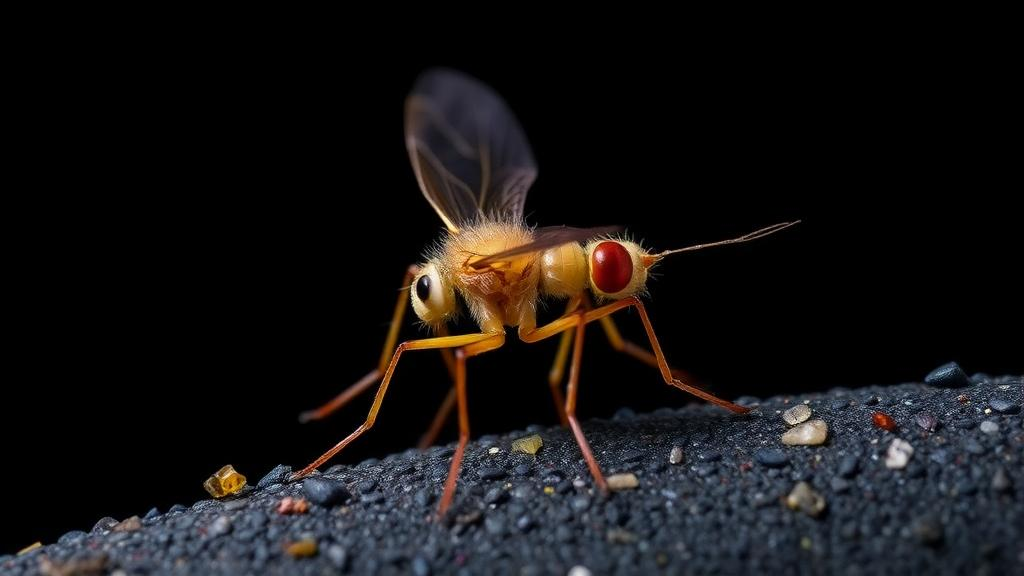
Deep in the rivers of Western Siberia lives a tiny non-biting midge that has managed to evade scientists for nearly half a century. Known only as Chironomus sp. J, this elusive insect was first discovered in 1991 from larvae collected in the Inya River near Novosibirsk, and until now it had never been recorded anywhere else on Earth. A new study published in Comparative Cytogenetics has finally lifted the veil on this mysterious species, presenting the first detailed data on chromosomal polymorphism in its two known populations and confirming its remarkably close relationship to a sibling species called Chironomus nudiventris.
The research, conducted by Golygina at the Institute of Cytology and Genetics of the Siberian Branch of the Russian Academy of Sciences, focused on larvae collected from two sites along the Inya River in Novosibirsk province. One population, designated NSK-IN, was sampled near the river’s mouth within Novosibirsk city itself, while the other, NSK-IT, was found approximately 100 kilometres upstream near the town of Toguchin. Despite decades of intensive sampling across hundreds of water bodies throughout the Palearctic region of Eurasia by numerous researchers, Chironomus sp. J has stubbornly refused to appear anywhere beyond these two locations, making it one of the most geographically restricted members of its species group.
Chironomus sp. J belongs to the Chironomus plumosus group of sibling species, a collection of morphologically nearly identical insects that can only be reliably distinguished by examining their giant polytene chromosomes under a microscope. These chromosomes, found in the salivary glands of larvae, display characteristic banding patterns that serve as a kind of genetic barcode for each species. The new study confirms that Chironomus sp. J possesses a haploid chromosome number of four with an arm combination designated AB CD EF G, placing it firmly within what cytogeneticists call the thummi cytocomplex.
What makes this species particularly fascinating is its relationship with Chironomus nudiventris, which has a haploid chromosome number of three due to a fusion that joins arms E and G into a single chromosome. Apart from this fundamental difference in chromosome number, the two species are astonishingly similar. Their main banding sequences are identical across most chromosomal arms, and even the polymorphic variants found in heterozygous individuals of Chironomus sp. J match sequences previously documented in Chironomus nudiventris and other members of the group. The researchers calculated cytogenetic distances between the two species using two different approaches, obtaining values of 0.058 and 0.471 depending on whether the chromosomal fusion was taken into account.
The lower distance value of 0.058 is comparable to that between other closely related species pairs in the genus, such as Chironomus agilis and Chironomus sp. prope agilis, which differ mainly in the size of their centromeric heterochromatin. The higher value of 0.471, while substantially greater, remains well below the distance of 0.843 recorded between another sibling pair, Chironomus plumosus and Chironomus borokensis, which similarly share many identical banding sequences. These comparisons place Chironomus sp. J and Chironomus nudiventris among the most closely related species pairs within the entire plumosus group.
In total, the banding sequence pool of Chironomus sp. J comprises 15 distinct sequences distributed across five polymorphic chromosomal arms designated A, B, D, E and F. Arms C and G were found to be completely monomorphic in both populations studied. The most variable arms proved to be B and D, which harboured three banding sequences each. Several of these sequences are not unique to Chironomus sp. J but are shared with Chironomus nudiventris and other species in the group, providing strong evidence that they originated in a common ancestor before these species diverged from one another.
One particularly intriguing finding concerns the banding sequence p’spJD3, which the researchers determined to be an intermediate form between two sequences found in Chironomus nudiventris. This intermediate position suggests that the sequence existed in the ancestral gene pool before the two species split. Its apparent absence from Chironomus nudiventris raises questions about whether it was genuinely lost during that species’ evolution or whether it simply remains undetected due to its rarity or the technical difficulty of identifying it in chromosome preparations.
The two populations studied displayed strikingly different levels of chromosomal polymorphism. The upstream population NSK-IT was entirely monomorphic, with every larva showing the same homozygous combination of banding sequences across all chromosomal arms. In contrast, the downstream population NSK-IN, located within Novosibirsk city, exhibited high levels of inversion polymorphism, with between 62 and 65 percent of larvae carrying heterozygous inversions and an average of 0.83 to 0.88 heterozygous inversions per larva depending on the year of collection. The researchers speculate that this difference may be related to anthropogenic pollution, as the NSK-IN site sits downstream from a major road with heavy traffic that could contribute contaminants to the river sediments. However, they also acknowledge that the small sample size from NSK-IT, which included only three larvae from 1988 and eleven from 2001, means that some inversions might have been missed.
The shared presence of polymorphic banding sequences between Chironomus sp. J and Chironomus nudiventris, combined with the unique distribution of certain other sequences, allows researchers to reconstruct the branching order within this subgroup of sibling species. The data indicate that Chironomus sp. J and Chironomus nudiventris separated from each other after diverging from other group members such as Chironomus entis and Chironomus muratensis. Among these relatives, Chironomus muratensis stands out as particularly close, sharing identical banding sequences in arms B, E and F, though it differs notably in the banding pattern of arm G.
With a known range spanning barely 100 kilometres of a single river system, Chironomus sp. J possesses the smallest documented distribution of any species in the plumosus group, with the sole exception of the recently described Chironomus sp. K from Japan. Whether this species is truly endemic to the Inya River or simply overlooked due to a preference for riverine habitats that researchers tend to skip in favour of lakes and ponds remains an open question. What is certain is that after nearly fifty years of searching, this remarkable midge continues to remain as elusive as its mythical namesake, hiding in plain sight along the muddy banks of a Siberian river while scientists race to understand its place in the evolutionary tapestry of one of the most speciose genera of freshwater insects on the planet.
Subject of Research: Chromosomal polymorphism and cytogenetic relationships of the elusive non-biting midge species Chironomus sp. J within the Chironomus plumosus sibling-species group
Article Title: Chironomus sp. J – an elusive species from the Chironomus plumosus (Linnaeus, 1758) sibling-species group ( Diptera , Chironomidae )
Article References: Golygina, V. V. (2025). Chironomus sp. J – an elusive species from the Chironomus plumosus (Linnaeus, 1758) sibling-species group (Diptera, Chironomidae). Comparative Cytogenetics, 19, 209-219. https://doi.org/10.3897/compcytogen.19.172398
Image Credits: AI Generated
DOI: 10.3897/compcytogen.19.172398
Keywords: Chironomus sp. J, Chironomus plumosus group, Chironomus nudiventris, polytene chromosomes, chromosomal polymorphism, banding sequences, cytogenetic distance, sibling species, Chironomidae, Western Siberia, Inya River, inversion polymorphism
Cite Scienmag News
Drew Townsend. (October 16, 2026). Elusive Siberian Midge Revealed as One of the Closest Known Relatives of Its Sibling Species. Scienmag. https://scienmag.com/elusive-siberian-midge-revealed-as-one-of-the-closest-known-relatives-of-its-sibling-species/
Drew Townsend. "Elusive Siberian Midge Revealed as One of the Closest Known Relatives of Its Sibling Species." Scienmag, 16 October 2026, https://scienmag.com/elusive-siberian-midge-revealed-as-one-of-the-closest-known-relatives-of-its-sibling-species/. Accessed 16 October 2026.
Drew Townsend. "Elusive Siberian Midge Revealed as One of the Closest Known Relatives of Its Sibling Species." Scienmag. October 16, 2026. https://scienmag.com/elusive-siberian-midge-revealed-as-one-of-the-closest-known-relatives-of-its-sibling-species/


