


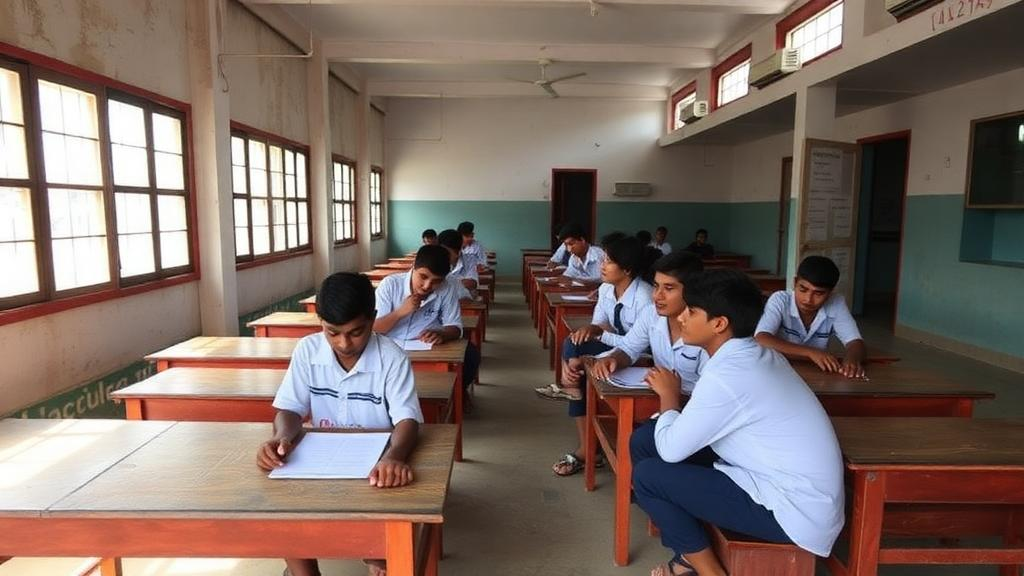
A new study from the Indian Sundarban Delta has revealed a troubling picture of educational decline in one of the world’s most ecologically fragile regions, where student enrolment has fallen sharply and dropout rates have more than tripled in just four years. The research, conducted in the Gosaba Community Development Block, highlights how climate vulnerability and inadequate infrastructure are undermining efforts to achieve quality education for all.
The study, published in SN Social Sciences, examined the state of education in Gosaba through secondary data from India’s official education and census databases. Researchers found that student enrolment dropped from 41,661 in the 2012-13 academic year to just 30,922 by 2016-17, a decline of more than 10,000 students. During the same period, the dropout rate surged from 4.87 percent to 16.78 percent, signaling a deepening crisis in educational retention across the deltaic landscape.
Gosaba Community Development Block sits within the Indian Sundarban Delta, a UNESCO World Heritage region characterised by its mangrove forests, tidal waterways, and extreme vulnerability to cyclones and sea-level rise. The geographic isolation of the area, combined with recurrent natural disasters, creates unique barriers to educational delivery that are rarely captured in national-level assessments. The researchers argue that this micro-level evidence is essential for understanding how Sustainable Development Goal 4, which calls for inclusive and equitable quality education, can be achieved in ecologically fragile zones.
The analysis drew on data from the Unified District Information System for Education, the Census of India 2011, and the National Institute of Educational Planning and Administration. Using descriptive statistics and Pearson correlation analysis, the team evaluated school distribution, enrolment patterns, dropout rates, teacher characteristics, pupil-teacher ratios, and school infrastructure across the block. The methodological approach allowed the researchers to identify relationships between physical infrastructure, teacher availability, and learning outcomes in a region where such connections had previously gone undocumented at this scale.
Infrastructure findings revealed stark disparities that persist despite some improvements over the study period. Only 27 percent of schools in Gosaba had access to electricity, while a mere 8 percent offered computer facilities to students. These figures stand in sharp contrast to national averages and underscore the digital divide that separates deltaic communities from urban educational centres. The correlation analysis demonstrated that schools with better infrastructure tended to have better teacher availability and stronger learning outcomes, suggesting that physical resources and human capital are deeply intertwined in shaping educational quality.
The pupil-teacher ratio emerged as a critical variable in the study’s findings. In regions where teacher shortages compound infrastructural deficits, the quality of instruction suffers disproportionately. The researchers noted that schools with favourable ratios correlated positively with learning outcomes, reinforcing established evidence that teacher availability is one of the strongest predictors of educational quality in developing contexts. The findings align with broader scholarship on the knowledge capital of nations, which demonstrates that cognitive skills and human capital formation are fundamental drivers of long-term economic growth.
The environmental context of the Sundarban Delta cannot be separated from its educational challenges. The region faces escalating threats from climate change, including intensified cyclonic activity, salinisation of agricultural land, and gradual submergence of low-lying areas. These environmental stressors disrupt schooling through physical damage to educational facilities, displacement of communities, and economic pressures that force families to prioritise immediate livelihood needs over education. The Intergovernmental Panel on Climate Change has identified such regions as particularly vulnerable to the intersection of environmental degradation and socio-economic marginalisation.
The study’s authors argue that conventional, one-size-fits-all educational policies are inadequate for regions like the Sundarban Delta. Instead, they call for context-specific and integrated approaches that simultaneously address educational infrastructure, teacher deployment, and environmental resilience. Such policies would need to account for the unique geographical constraints of deltaic communities, where access to schools may be limited by waterways, where cyclone preparedness must be built into educational planning, and where livelihood insecurity directly affects school attendance and retention.
The research contributes to a growing body of evidence highlighting the challenges of achieving Sustainable Development Goal 4 in marginalised regions. Previous studies across South Asia have documented similar patterns, where infrastructure deficits, teacher shortages, and socio-economic vulnerabilities combine to produce poor educational outcomes. The Gosaba findings add a crucial environmental dimension to this literature, demonstrating that ecological fragility is not merely a backdrop to educational inequality but an active force that shapes access, quality, and continuity of learning.
As the international community approaches the 2030 deadline for the Sustainable Development Goals, the Gosaba study serves as a stark reminder that progress toward quality education remains uneven and that the most vulnerable communities continue to be left behind. The researchers emphasise that without targeted interventions addressing both educational and environmental challenges in regions like the Indian Sundarban, the global promise of inclusive, equitable quality education for all will remain unfulfilled for millions of children living at the frontlines of climate change.
Subject of Research: Quality education and SDG 4 achievement in the Gosaba Community Development Block of the Indian Sundarban Delta
Article Title: A progressive study on quality education (SDG 4) in Gosaba Community Development Block of the Indian Sundarban Delta
Article References: Pal, A., Hansda, T., & Ghosh, T. (2026). A progressive study on quality education (SDG 4) in Gosaba Community Development Block of the Indian Sundarban Delta. SN Social Sciences, 6(9), Article 365. https://doi.org/10.1007/s43545-026-01650-y
Image Credits: AI Generated
DOI: 10.1007/s43545-026-01650-y
Keywords: SDG 4, quality education, Sundarban Delta, Gosaba, school infrastructure, dropout rate, pupil-teacher ratio, climate vulnerability, educational policy, India, rural education, sustainable development
Cite Scienmag News
Courtney Benton. (October 16, 2026). Sundarban Schools Show Alarming Decline as Enrolment Falls and Dropout Rates Soar. Scienmag. https://scienmag.com/sundarban-schools-show-alarming-decline-as-enrolment-falls-and-dropout-rates-soar/
Courtney Benton. "Sundarban Schools Show Alarming Decline as Enrolment Falls and Dropout Rates Soar." Scienmag, 16 October 2026, https://scienmag.com/sundarban-schools-show-alarming-decline-as-enrolment-falls-and-dropout-rates-soar/. Accessed 16 October 2026.
Courtney Benton. "Sundarban Schools Show Alarming Decline as Enrolment Falls and Dropout Rates Soar." Scienmag. October 16, 2026. https://scienmag.com/sundarban-schools-show-alarming-decline-as-enrolment-falls-and-dropout-rates-soar/


