


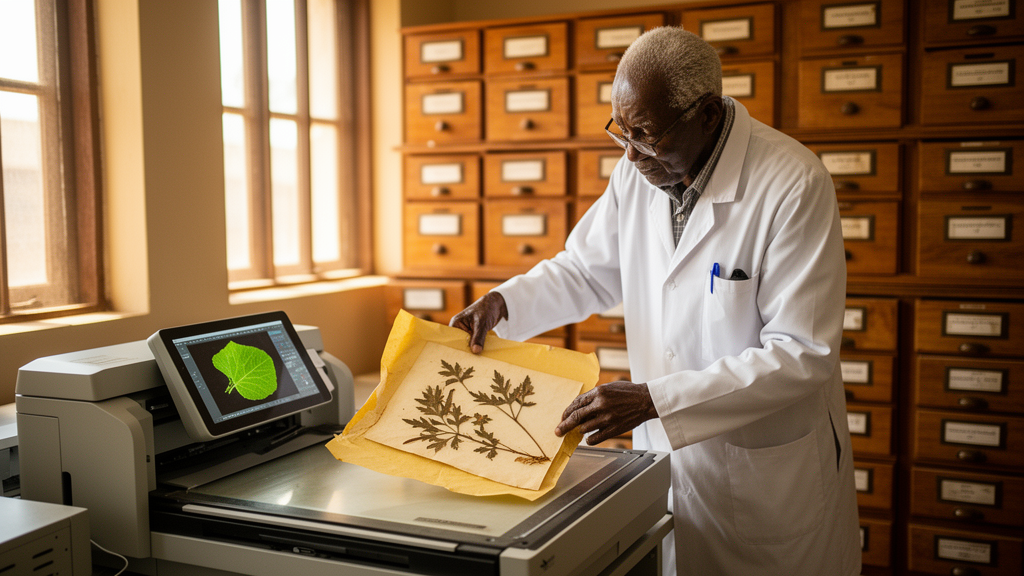
Deep inside Harare, in a building that has quietly accumulated botanical evidence for more than a century, sit over 500,000 pressed plant specimens — leaves flattened onto cardboard sheets, roots tangled in newspaper, and handwritten labels recording where botanists stood decades before GPS satellites existed. This is the National Herbarium and Botanic Garden of Zimbabwe, known by its institutional code SRGH, and it ranks as the third largest plant collection in southern Africa. A new study published in Natural History Collections and Museomics examines what happens when such an analogue archive is converted into digital data, and the answer is both encouraging and uncomfortable: digitisation works, but the resulting knowledge flows disproportionately through institutions outside the country that collected the plants in the first place.
The scale of the global challenge puts Zimbabwe’s effort in context. Roughly 406 million plant specimens are preserved across the world’s 4,035 active herbaria, forming the empirical backbone of botanical science. These collections anchor species descriptions, taxonomic revisions and nomenclature, and increasingly they serve a second life as datasets for studying climate change — tracking shifts in species distributions, flowering times and plant invasions across decades. Digitisation, the conversion of physical specimens and their label metadata into digital formats, has transformed these dusty cabinets into what researchers call a virtual metaherbarium: globally interlinked biodiversity data that anyone with an internet connection can query. But that transformation has been deeply uneven. European and North American institutions have made substantial progress, while collections in biodiversity-rich regions of the Global South remain only partially digitised due to financial, technical and infrastructural constraints.
Zimbabwe’s herbarium carries a colonial history that explains much of its current profile. During the era of the Rhodesia-Nyasaland Federation, the institution served as the central repository for collections made across Malawi, Zambia and Zimbabwe, which is why it holds such vast historical material from the wider southern African region. The collection includes approximately 2,750 type specimens — the original physical material upon which species names are based, making them the single most taxonomically important category of specimen in any herbarium. Much of this material was collected before geospatial technologies existed, so labels contain handwritten locality descriptions of varying precision, and the specimens themselves face ongoing risks of physical degradation. Without digitisation, this analogue archive remains poorly integrated into modern data-driven research and policy frameworks.
The digitisation effort began in earnest in the early 2000s with support from the Southern African Botanical Diversity Network, which trained herbarium staff and produced a comprehensive checklist of Zimbabwean plants alongside national Red Data Lists. Subsequent initiatives layered on top of this foundation: the African Plants Initiative focused on imaging type specimens and integrating African collections into global information systems; a project funded through the Seed Innovation Fund of the Convention on Biological Diversity helped migrate the herbarium’s database from the older Pretoria Computerised Information System to the Botanical Research and Herbarium Management System, known as BRAHMS; and a Crop Wild Relatives project supported by the Max Planck Institute resulted in roughly 2,000 specimens of wild plant genetic resources being digitised. Each initiative built capacity and momentum, demonstrating that strategic prioritisation and partnerships can enable effective digitisation even under severe resource constraints.
The technical workflow itself follows internationally recognised standards and offers a template for similar institutions. Specimens are first selected and prepared, with taxonomic names verified and physical condition assessed. Each specimen is then imaged using either a flatbed scanner or a camera-based workstation to produce high-resolution digital photographs. Label information — collector name, collection number, locality, date and taxonomic identification — is transcribed into a database following the Darwin Core standard, the lingua franca of biodiversity informatics. Geographic coordinates are reconstructed using online mapping tools, historical maps, gazetteers and expert knowledge where possible. Records pass through quality control to verify completeness and accuracy before being integrated into the herbarium database and prepared for sharing through international biodiversity data platforms such as the Global Biodiversity Information Facility.
The results reveal both milestone and imbalance. To date, approximately 20 percent of the herbarium collection — 109,218 specimen records — has been transcribed into digital format. The digitised dataset is taxonomically uneven, reflecting deliberate prioritisation of ecologically dominant and economically important groups: the grass family Poaceae accounts for 17.1 percent of digitised records and the legume family Fabaceae for 12.5 percent, followed by Asteraceae, Cyperaceae and Rubiaceae. Type specimens constitute 1,673 of the digitised records, representing roughly 55 percent of all type specimens held at SRGH — a meaningful fraction of the collection’s taxonomic crown jewels now accessible to researchers worldwide who would otherwise need to travel physically to Harare.
But here is where the story turns uncomfortable. Analysis of datasets available through GBIF indicates that approximately 138,671 occurrence records relating to Zimbabwean plants have been published for global access — and the majority originate from institutions outside Zimbabwe. Institutions in the United Kingdom account for 45 percent of the published dataset, followed by the United States with 18 percent. Within the region, South Africa contributes 9.9 percent, whereas Zimbabwe itself contributes only 5.3 percent. This imbalance reflects both the historical dispersal of specimens to foreign institutions during the colonial period and the limited national capacity for large-scale data mobilisation today. A substantial proportion of digitised occurrence data from biodiversity-rich regions is currently published through institutions outside the country of origin, a pattern that raises questions about data ownership, attribution and equitable use — concerns that align with broader discussions around indigenous data sovereignty and the CARE principles, which emphasise collective benefit, authority to control, responsibility and ethics in data governance.
The study also identifies a research-policy gap that deserves attention. Digitised herbarium data has enhanced opportunities for biodiversity research in Zimbabwe, including species distribution studies, conservation assessments and ecological analyses, and emerging analytical tools such as phylospatial — which integrates species distributions with phylogenetic diversity metrics — further increase the value of occurrence data for identifying areas of high conservation importance. Yet explicit examples of digitised herbarium data informing national biodiversity strategies, protected area planning, extinction risk assessments or environmental decision-making remain relatively limited. This gap reflects broader challenges in translating scientific data into policy-relevant outputs and highlights the need to strengthen institutional linkages between research institutions and environmental governance structures. Meanwhile, the human capital benefits — staff trained in specimen imaging, biodiversity data standards, georeferencing and database management, plus training opportunities for students — often go unrecognised by universities, policy makers and funding agencies.
Digital repatriation offers one mechanism for addressing these historical imbalances. Brazil’s Reflora Virtual Herbarium has facilitated access to millions of specimen images and associated metadata held in international collections, enabling researchers to access nationally relevant biodiversity information without the costs associated with physical repatriation. Although digital repatriation does not replace discussions surrounding the return of physical collections, it represents a cost-effective mechanism for improving access to dispersed botanical knowledge. Looking forward, emerging technologies offer additional efficiency gains: optical character recognition for automated label transcription, machine-learning approaches to georeferencing and improved imaging technologies could significantly accelerate digitisation workflows — but realising these benefits requires sustained institutional investment in infrastructure, training and long-term data stewardship, not short-term project funding alone.
Zimbabwe’s experience suggests five strategic priorities for sustaining digitisation in biodiversity-rich countries. Herbarium digitisation should be integrated into national biodiversity information systems and supported through long-term government investment rather than relying solely on short-term projects. Institutions should strengthen biodiversity informatics capacity through training, mentorship programmes and staff exchanges. Regional collaboration should be enhanced through networks that facilitate sharing of expertise, harmonisation of standards and development of guidelines for data stewardship — with existing initiatives such as SABONET providing a foundation for regional working groups focused on data governance and collaborative capacity development. Herbaria should increase their visibility within scientific conferences, environmental forums and policy processes by demonstrating relevance to climate change adaptation, ecosystem restoration, invasive species management and sustainable development. Finally, international institutions should develop practical mechanisms for supporting resource-constrained herbaria through technical assistance, shared infrastructure, collaborative research projects, mentorship and support for data publication. The lesson from Harare is ultimately about equity: substantial progress is achievable in resource-constrained environments through targeted investment and international collaboration, but sustainable partnerships must move beyond data extraction towards equitable collaboration that prioritises local leadership, co-development of research agendas and shared ownership of outcomes — so that the countries whose plants populate the world’s herbaria can fully participate in and benefit from the global plant knowledge systems their biodiversity makes possible.
Subject of Research: Digitising plant collections in Zimbabwe: Implications for biodiversity data mobilisation and global plant knowledge
Article Title: Digitising plant collections in Zimbabwe: Implications for biodiversity data mobilisation and global plant knowledge
Article References: Mutasa, K. B. (2026). Digitising plant collections in Zimbabwe: Implications for biodiversity data mobilisation and global plant knowledge. Natural History Collections and Museomics, 3, Article e196914. https://doi.org/10.3897/nhcm.3.196914
Image Credits: AI Generated
Keywords: Digitising, plant, collections, Zimbabwe, Implications, biodiversity, data, mobilisation, global, knowledge, scientific research
Cite Scienmag News
Margaret Porter. (October 16, 2026). Zimbabwe’s century-old plant archive goes digital, revealing who owns biodiversity data. Scienmag. https://scienmag.com/zimbabwes-century-old-plant-archive-goes-digital-revealing-who-owns-biodiversity-data/
Margaret Porter. "Zimbabwe’s century-old plant archive goes digital, revealing who owns biodiversity data." Scienmag, 16 October 2026, https://scienmag.com/zimbabwes-century-old-plant-archive-goes-digital-revealing-who-owns-biodiversity-data/. Accessed 16 October 2026.
Margaret Porter. "Zimbabwe’s century-old plant archive goes digital, revealing who owns biodiversity data." Scienmag. October 16, 2026. https://scienmag.com/zimbabwes-century-old-plant-archive-goes-digital-revealing-who-owns-biodiversity-data/


