


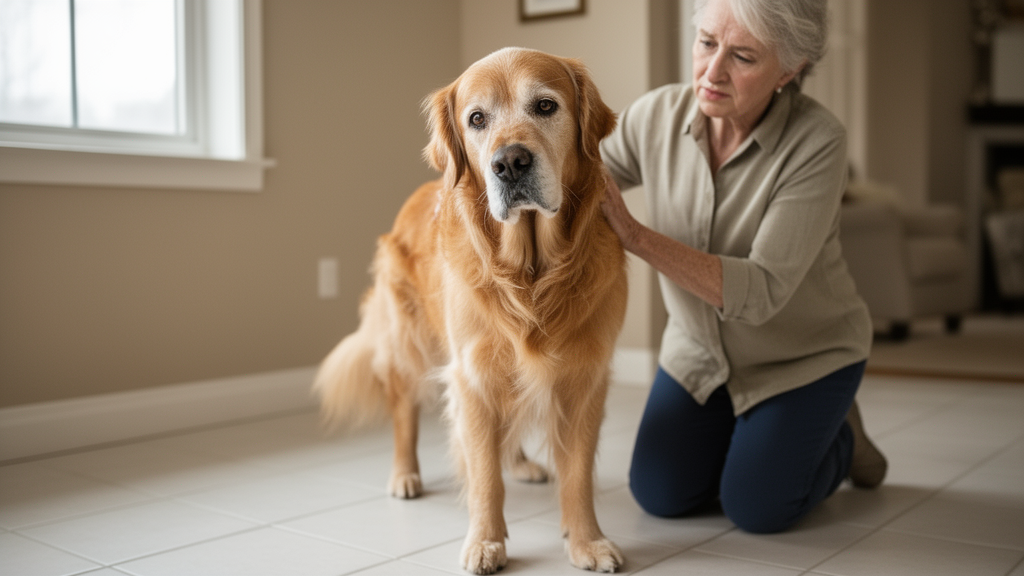
For owners of senior dogs, few things are as disheartening as finding yet another accident on the living room floor. The usual assumption is that the aging bladder has simply given up: an infection, an incontinence problem, or the first hints of kidney disease. But a new longitudinal study of 84 elderly companion dogs suggests that this instinct may often be wrong. In the work, published in the Journal of Veterinary Internal Medicine, researchers at North Carolina State University found that house soiling in old dogs tracked far more closely with declines in executive function than with laboratory evidence of urinary tract disease, raising the possibility that the accident on the carpet is sometimes a message from the brain rather than the bladder.
The parallels with human medicine are striking. In elderly people, dementia and urinary dysfunction frequently exacerbate one another; people living with dementia are more than twice as likely to be diagnosed with urinary tract infections in the emergency department, and acute confusion, including delirium, is often blamed on infection. Yet the relationship between bacteriuria and cognitive deterioration in humans remains controversial, and asymptomatic bacteriuria is so prevalent in nursing homes that it is routinely overtreated despite no demonstrated benefit. The veterinary team, led by Shaghayegh Rafatpanah Baigi and senior author Natasha Olby, wanted to know whether the same tangled relationship exists in dogs, whose cognitive decline, known as canine cognitive dysfunction syndrome, shares many features with Alzheimer’s disease.
The dogs in the study came from the university’s Longitudinal Study of Neuroaging, an ambitious ongoing effort that examines aging pet dogs every six months across domains ranging from hearing and mobility to sleep and brain health. For the present analysis, the researchers enrolled clinically stable client-owned dogs with a fractional lifespan of at least 0.75, meaning they had lived out at least three-quarters of their breed-adjusted life expectancy. The 84 dogs included in the final dataset were, on average, 12.77 years old at enrollment, a mean fractional lifespan of 0.99, and included 53 spayed females, 29 neutered males, and two intact animals, spanning small, medium, and large breeds from Chihuahuas to Great Danes.
At each biannual visit, a free-catch urine sample was collected and analyzed before any cognitive testing. The team measured urine specific gravity, the concentration of the urine, and screened for four abnormalities: pyuria, or excess white blood cells; hematuria, or red blood cells; bacteriuria; and proteinuria. Owners completed the Canine Dementia Scale, a validated 17-item questionnaire, from which the house soiling domain yielded a score from 0 to 25. The dogs then faced a battery of cognitive challenges, including a sustained gaze test of attention, a working memory task, a pointing cue assessing social interpretation, and two transparent-cylinder tasks probing executive function. In the inhibitory control task, dogs had to suppress the impulse to reach straight through the clear plastic wall of a treat-filled cylinder and instead use the open ends. The detour task, a harder variant, blocked the dog’s preferred route and demanded flexible problem-solving.
Across 231 urinalyses, the results confounded expectations. Only about 13 percent of samples showed any abnormality other than mild proteinuria: 19 samples had pyuria, 14 hematuria, and 11 bacteriuria. Protein, by contrast, was detected in 84 percent of samples, though usually at trace or low levels. Urine specific gravity ranged from 1.005 to 1.056, with a median of 1.027, and declined significantly with age in mixed-effects models, consistent with the gradual loss of renal concentrating ability that has been documented in both aging humans and aging dogs. Females had significantly higher odds of bacteriuria than males, but sex did not predict any other abnormality.
Soiling behavior told a very different story. Scores ranged from 0 to 25 with a median of 3, and in the final multivariable model, each additional year of age was associated with an estimated 71 percent increase in the expected soiling score, while each 0.001 increase in urine specific gravity was associated with roughly a 2.4 percent lower expected score. Critically, neither pyuria nor bacteriuria predicted soiling, and there was no sex difference in soiling behavior. The two variables that mattered, age and dilute urine, pointed toward aging physiology rather than infection or inflammation. Lower specific gravity did track with higher International Renal Interest Society kidney disease staging, confirming its value as a practical marker of renal function, but even kidney stage did not fully explain the soiling trend.
The cognitive testing added the most provocative finding. After adjusting for age, each one-point increase in the soiling score corresponded to a 1.13 percentage-point decrease in inhibitory control performance and a 0.84 percentage-point decrease in detour task performance. These two tasks are canonical measures of executive function in dogs, probing impulse control, response inhibition, and cognitive flexibility, deficits that are well-documented in human Alzheimer’s disease and increasingly recognized in dogs with cognitive dysfunction. By contrast, sustained gaze duration and working memory were predicted by age alone, and pointing cue performance was associated with neither age nor any urinary variable. This domain-specific pattern suggests that soiling is tied specifically to impaired executive control rather than to global cognitive decline, echoing human literature emphasizing that dementia erodes different cognitive domains at different rates.
Interpretation requires care, as the authors themselves emphasize. Soiling is, in the framework of canine cognitive dysfunction, typically a late-stage sign: prior cohorts report that loss of housetraining is uncommon in borderline or mild disease and emerges as impairment deepens. The link between soiling and poor executive performance could mean that accidents in the home reflect failed impulse control or impaired decision-making, a failure to inhibit a prepotent response to eliminate wherever the dog happens to be, rather than simple disorientation or a failing bladder. Alternatively, age-related dilution of urine might contribute to accidents through mechanisms that remain incompletely understood. Causality, the team stresses, cannot be established from this exploratory analysis.
The study has acknowledged limitations. Urine cultures were not performed, so occult infections in free-catch samples could not be excluded. Visits with findings suggestive of active urinary tract infection were stopped before cognitive testing, a biosecurity measure for the shared testing room, which removed a small number of observations. The cohort skewed female and toward healthier dogs, and the rarity of abnormal urinalyses limited statistical power to detect subtle associations. Immunosenescence, the blunting of immune responses with age, may even mean that pyuria underestimates infection in geriatric animals, just as it does in elderly humans. One curious result, that dogs with hematuria actually performed better on inhibitory control, was flagged by the authors as likely spurious given the tiny number of hematuria cases.
Even with those caveats, the practical message for veterinarians and owners is potentially transformative. In this cohort, soiling behavior was not a reliable flag for urinary tract pathology, which was far less common than anticipated, but it did correlate with measurable executive dysfunction. A house-soiling senior dog, the findings suggest, warrants not just a urinalysis and course of antibiotics but a careful cognitive assessment, and the Canine Dementia Scale soiling domain may prove a cheap, owner-reported window into brain health. As more dogs live into their twilight years, a routine soiled rug may increasingly be the first visible tremor of a mind in decline.
Subject of Research: The association between urinalysis abnormalities, house soiling behavior, and cognitive decline in aging dogs
Article Title: The relationship between urinalysis abnormalities, soiling behavior, and cognitive decline in aging dogs
Article References: Rafatpanah Baigi, S., Yang, C.-C., Mondino, A., Fefer, G., Panek, W. K., Case, B. C., Griffith, E. H., Gruen, M. E., & Olby, N. J. (2026). The relationship between urinalysis abnormalities, soiling behavior, and cognitive decline in aging dogs. Journal of Veterinary Internal Medicine, 40(5), Article aalag208. https://doi.org/10.1093/jvimsj/aalag208
Image Credits: AI Generated
Keywords: aging dogs, canine cognitive dysfunction, house soiling, urinalysis, urine specific gravity, executive function, CADES, veterinary medicine, dementia, urinary tract infection, cognitive decline, longitudinal study
Cite Scienmag News
William Thompson. (October 16, 2026). House Soiling in Old Dogs May Signal Failing Brains, Not Bladders. Scienmag. https://scienmag.com/house-soiling-in-old-dogs-may-signal-failing-brains-not-bladders/
William Thompson. "House Soiling in Old Dogs May Signal Failing Brains, Not Bladders." Scienmag, 16 October 2026, https://scienmag.com/house-soiling-in-old-dogs-may-signal-failing-brains-not-bladders/. Accessed 16 October 2026.
William Thompson. "House Soiling in Old Dogs May Signal Failing Brains, Not Bladders." Scienmag. October 16, 2026. https://scienmag.com/house-soiling-in-old-dogs-may-signal-failing-brains-not-bladders/


