


Deep in the subarctic taiga of the Kola Peninsula, in northwestern Russia, an unassuming field experiment from 1993 has yielded results that are reshaping what scientists know about moth communication at the top of the world. Researchers testing synthetic chemical lures in boreal forests near the industrial city of Monchegorsk have documented, for the first time, sex attractants for 14 species of moths that had never before been coaxed into a trap by human-made pheromone mimics. The findings, published in the journal Nota Lepidopterologica, fill a conspicuous gap in the chemical ecology of high-latitude insects and could lay the groundwork for monitoring programs in some of the planet’s least-studied forest ecosystems.
The scale of the knowledge gap that motivated the study is staggering. Moths and butterflies, with roughly 170,000 to 180,000 described species, are among the most diverse animal groups on Earth, and the vast majority of them rely on pheromones—airborne chemical signals—to find mates. Yet sex pheromones have been chemically identified for only about 700 moth species, and field-confirmed attraction to synthetic mixtures extends that figure to roughly 2,000 species. That is less than two percent of the lepidopteran species presumed to communicate chemically. The shortfall reflects decades of research prioritized by economics: pheromone science has concentrated overwhelmingly on agricultural and forest pests, leaving keystone, indicator, and threatened species in remote regions largely ignored.
The study’s design was elegantly economical. Rather than attempting the costly laboratory work of extracting and identifying a pheromone for each target species, the researchers exploited a well-known shortcut in chemical ecology: many related moth species share the same building blocks for their pheromones. Eight commercially available (Z)-monounsaturated aliphatic compounds—chemicals such as (Z)-7-dodecenyl acetate, (Z)-9-tetradecenyl acetate, and (Z)-11-hexadecenal—were selected based on prior knowledge of noctuid pheromones accumulated by the early 1990s. These were deployed singly and in binary mixtures, some at multiple component ratios, producing 26 distinct lure types, each impregnated onto red rubber septa at a dose of one milligram.
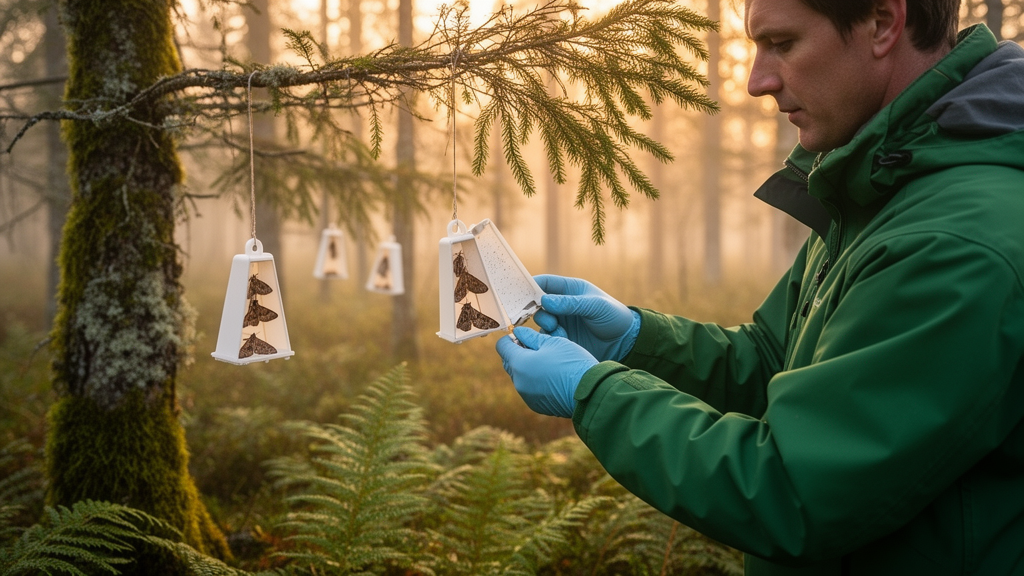
The fieldwork took place across three contrasting sites in the central Kola Peninsula, all within the subarctic boreal forest zone. One was a sparse, dry Scots pine forest severely damaged by emissions from the Monchegorsk copper–nickel smelter; a second, a lightly polluted Norway spruce–mountain birch stand beside a sedge bog; and the third, a dense old-growth spruce forest bordering a peat-moss bog some 64 kilometers southeast of the city. In total, 260 white delta traps with sticky inserts were suspended from tree branches at heights of one to two meters, spaced at least ten meters apart to prevent chemical plumes from interfering with one another. The traps ran from 17 July to 12 August 1993 and were inspected three times over the exposure period.
The catch was remarkable in its diversity for so brief a campaign. The traps captured 18 moth species spanning six families: one Yponomeutidae, one Argyresthiidae, one Coleophoridae, one Crambidae, two Geometridae, and twelve species of Noctuidae, the owlet moths. In total, 352 noctuid individuals were taken, alongside nearly 2,100 specimens from the non-noctuid species. Five lure compositions attracted nothing at all, but the remaining 21 drew moths from across the regional fauna—many of them species that had resisted other collection methods, including the fermented sugar bait traps traditionally used by lepidopterists in the region.
Some of the individual successes were dramatic. A binary 1:10 mixture of (Z)-5-tetradecenyl acetate and (Z)-7-tetradecenyl acetate proved highly attractive to the yponomeutid moth Paraswammerdamia conspersella, snaring some 1,800 individuals even though neither compound alone worked: (Z)-7-tetradecenyl acetate on its own caught only a handful, and (Z)-5-tetradecenyl acetate caught none. The case illustrates a central principle of pheromone chemistry—ratio matters. For the unidentified Coleophora species, the strongest response came to a 10:1 blend of (Z)-5-decenyl acetate and (Z)-7-dodecenyl acetate, with three of the five effective lures for that moth containing (Z)-5-decenyl acetate, a compound already known to attract several of its relatives. Argyresthia pygmaeella, the second most abundant moth in the region, was drawn to (Z)-11-hexadecenyl acetate, the same lure that attracted the crambid Eudonia murana.
Among the twelve noctuids, patterns emerged that echoed findings from as far away as Northern Finland and North America. All four lures attractive to Syngrapha parilis contained (Z)-7-dodecenyl acetate, consistent with earlier Finnish work, and that same compound attracted five related Syngrapha species in previous studies elsewhere. Sympistis funebris responded most strongly to a 1:10 mixture of (Z)-7-tetradecenyl and (Z)-9-tetradecenyl acetates, while Sympistis lapponica favored a 1:100 blend of (Z)-7-dodecenyl acetate with (Z)-9-tetradecenyl acetate. Enargia paleacea was taken with a 10:1 mixture of (Z)-9-tetradecenyl acetate and (Z)-11-hexadecenyl acetate—remarkably, the same two components, at a very different 1:500 ratio, attract its North American cousin E. infumata. Mniotype adusta, Diarsia mendica, and Coranarta cordigera all responded to lures featuring (Z)-9-tetradecenyl acetate, with the latter two showing their largest catches to blends containing a minor proportion of (Z)-11-hexadecenal, a component never before reported as attractive for any Diarsia species.
The study also delivered a sobering lesson about the limits of single-chemical fixes. Several lures attracted multiple moth species, a phenomenon well documented in earlier work: synthetic pheromones aimed at Grapholita plum moths in Bulgarian orchards inadvertently drew 29 and 12 additional leafroller species respectively, and lures developed for six economically important forest pests in Czechoslovakia attracted 32 species in total. Non-target species, it turns out, often share one or more key pheromone components with the intended targets. For monitoring programs, this cross-attraction is a double-edged sword—it can inflate bycatch and complicate species-specific counts, but it also multiplies the informational value of every trap, effectively surveying whole communities with a modest chemical toolkit.
Perhaps the most practically significant finding concerns what the synthetic lures did not catch. Only four of the twelve noctuid species attracted—Enargia paleacea, Mniotype adusta, Diarsia mendica, and Eurois occulta—overlapped with the 21 species collected using fermented sugar bait traps at the same sites in 1991–1993. The two methods, in other words, sample largely complementary slices of the moth fauna. The authors suggest that combining chemical lures with sugar baits would substantially enhance monitoring efficiency in subarctic forests. Meanwhile, several abundant local species, including Acronicta auricoma, Hyppa rectilinea, and multiple Xestia species, remain stubbornly resistant: none responded to the lures, and their attractants are still unknown. The study also failed to confirm an earlier report of (Z)-11-hexadecenyl acetate attracting Anarta melanopa, a species known to fly during the trap period, a reminder that geographic variation in pheromone composition can undermine lure performance across regions.
Why publish a dataset from a field season more than three decades old? The researchers explain that the industrial pollution gradient project the lures were designed for was terminated in 1993, and a comparison with the Pherobase database revealed no published attractant information for 14 of the 18 species captured. Rather than let the data languish, the team released these preliminary but unique results to support future monitoring programs for boreal and subarctic moths. In an era of rapid climate-driven range shifts and expanding industrial footprints in northern forests, reliable tools for tracking moth populations—many of which are keystone pollinators, herbivores, and prey items—are increasingly urgent. The Kola Peninsula experiment demonstrates that straightforward, widely accessible screening of common pheromone analogues can reveal attractants for species rarely targeted by pheromone science, helping to close one of chemical ecology’s most persistent geographic blind spots, one sticky trap at a time.
Subject of Research: Identification of synthetic sex attractants for boreal forest moth species through field pheromone lure screening
Article Title: New sex attractants for 14 boreal forest moth species ( Lepidoptera )
Article References: Kozlov, M. V. (2026). New sex attractants for 14 boreal forest moth species (Lepidoptera). Nota Lepidopterologica, 49, 51-61. https://doi.org/10.3897/nl.49.178270
Image Credits: AI Generated
DOI: 10.3897/nl.49.178270
Keywords: Lepidoptera, sex pheromones, boreal forest, Kola Peninsula, Noctuidae, chemical ecology, field screening, moth monitoring, synthetic lures, subarctic, pheromone analogues, insect conservation
Cite Scienmag News
Gavin Prescott. (October 16, 2026). Old Traps, New Science: Sex Attractants Uncovered for 14 Boreal Forest Moths. Scienmag. https://scienmag.com/old-traps-new-science-sex-attractants-uncovered-for-14-boreal-forest-moths/
Gavin Prescott. "Old Traps, New Science: Sex Attractants Uncovered for 14 Boreal Forest Moths." Scienmag, 16 October 2026, https://scienmag.com/old-traps-new-science-sex-attractants-uncovered-for-14-boreal-forest-moths/. Accessed 16 October 2026.
Gavin Prescott. "Old Traps, New Science: Sex Attractants Uncovered for 14 Boreal Forest Moths." Scienmag. October 16, 2026. https://scienmag.com/old-traps-new-science-sex-attractants-uncovered-for-14-boreal-forest-moths/


