


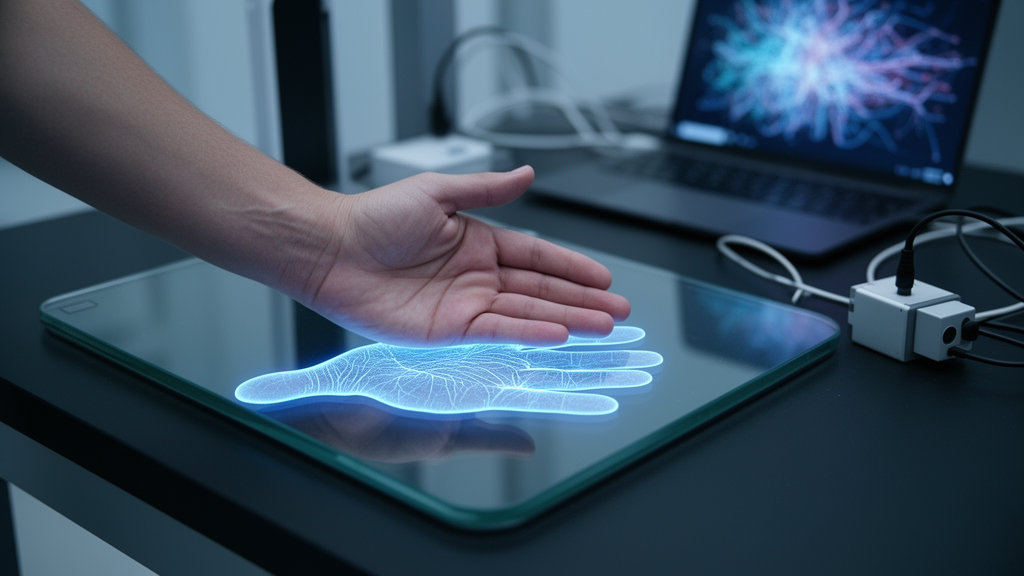
A person’s palm may soon become one of the most reliable keys in digital security, thanks to a new deep learning architecture that borrows a mathematical tool from centuries past. Researchers have introduced FrDPalmNet, a neural network that weaves fractional calculus into the very wiring of a convolutional network to achieve remarkably accurate palmprint-based human authentication. The system, described in the journal Multimedia Tools and Applications, reached correct recognition rates as high as 99.83 percent on a widely used benchmark, with error rates so low that misidentification becomes an exceptionally rare event.
Palmprint recognition belongs to the broader family of biometric technologies that also includes fingerprint, face, and iris recognition. Like fingerprints, palmprints carry a dense pattern of principal lines, wrinkles, and ridges that differ from person to person and remain stable over a lifetime. Unlike fingerprints, palms offer a larger skin area, which means more discriminative texture can be captured in a single image. That richness has made palmprints attractive for security applications, from access control in restricted facilities to unlocking smartphones, yet extracting reliable features from palm images has long posed a challenge, particularly when lighting, pose, or image quality vary.
Traditional approaches to palmprint recognition relied on handcrafted descriptors, such as competitive codes, local line directional patterns, and ordinal representations, which encode the orientation and intensity of palm lines in compact mathematical forms. These methods performed well under controlled conditions but struggled with unconstrained imaging. Deep convolutional neural networks changed the landscape by learning features directly from data, and recent years have seen palmprint systems built on architectures such as ResNet, densely connected networks, and attention-augmented models. The new work pushes this evolution further by injecting fractional derivatives, a concept from non-integer calculus, into the network’s skip connections.
Skip connections are a signature element of modern deep networks. Introduced in residual architectures, they carry information from earlier layers directly to later ones, allowing gradients to flow backward during training without vanishing and enabling networks to grow very deep without losing the details captured in early stages. In FrDPalmNet, the researchers replaced conventional skip connections with weights derived from the Grünwald-Letnikov formulation of the fractional derivative. This formulation generalizes differentiation to non-integer orders, and its defining property is non-locality: the derivative at a point depends not just on the immediate neighborhood but on the entire history of the function leading up to that point.
That non-locality is precisely what the authors exploit. By weighting skip connections with fractional derivative operators, the network effectively gains a form of memory, blending local features detected in a given layer with global context accumulated across the depth of the model. The result is a richer feature representation of each palm image, one that captures both fine-grained ridge patterns and broader structural cues such as the geometry of principal lines. The researchers report that this fractional weighting improves matching accuracy compared with standard integer-order skip connections, and they demonstrate the effect across multiple values of the fractional order to show the design’s robustness.
FrDPalmNet builds on a ResNet34 backbone, a moderately deep convolutional architecture that has proven effective in image recognition tasks. On top of this backbone, the authors attach a dual attention mechanism, which refines intermediate features by attending to both channel-wise and spatial information. Channel attention highlights which feature dimensions are most informative for distinguishing one palm from another, while spatial attention emphasizes the image regions, such as the central palm area where discriminative lines concentrate, that matter most. Attention modules are applied at each level of the network, ensuring that feature refinement happens continuously rather than only at the final stage.
The architecture is also densely connected, meaning that each layer receives inputs from all preceding layers within a block. This design, popularized by densely connected convolutional networks, encourages feature reuse and strengthens gradient flow during training. Combined with the fractional skip connections, the dense connectivity allows the network to preserve and recombine palm features across multiple scales, from coarse global shapes to fine local textures. The authors frame this as incorporating memory into the system, a nod to the historical dependence inherent in fractional operators.
Training the network involves optimizing its parameters with a combination of two loss functions: large-margin cosine loss and focal loss. Large-margin cosine loss, originally developed for face recognition, pushes the network to learn embeddings in which images of the same palm cluster tightly while images of different palms are separated by a wide angular margin. Focal loss, introduced for dense object detection, down-weights easy examples and focuses the learning signal on hard cases, which helps the model handle difficult or ambiguous palm images. Together, these losses shape a feature space that is both discriminative and robust.
The experimental evaluation was conducted on three open-source palmprint databases: CASIA, IIT Delhi, and Tongji. These datasets are among the most widely used benchmarks in the palmprint recognition literature, and they collectively cover thousands of palm images from hundreds of subjects, captured under varying conditions. On CASIA, FrDPalmNet achieved a correct recognition rate of 99.83 percent with an equal error rate of 0.25 percent. On IIT Delhi, the figures were 98.95 percent and 0.44 percent, and on Tongji, 99.22 percent and 0.46 percent. The equal error rate represents the point at which false acceptance and false rejection rates are equal, and values below half a percent indicate a system that rarely mistakes one person for another while still admitting genuine users.
These results either surpass or match the performance of other state-of-the-art methods considered in the study, positioning FrDPalmNet among the leading palmprint recognition systems reported to date. The authors also conducted additional experiments comparing different attention modules and exploring various fractional orders, providing evidence that the fractional derivative component, rather than the attention mechanism alone, drives the accuracy gains. The work suggests that ideas from fractional calculus, a branch of mathematics with roots in the behavior of real materials and anomalous diffusion, can find concrete application in biometric security, and it opens a path for further exploration of fractional operators in other pattern recognition domains where combining local and global information is essential.
Subject of Research: Palmprint-based human authentication using a deep neural network with fractional derivative weighted skip connections and dual attention
Article Title: FrDPalmNet: Dual attention and densely connected blocks with fractional weighted skip connections for palmprint-based human authentication
Article References: FrDPalmNet: Dual attention and densely connected blocks with fractional weighted skip connections for palmprint-based human authentication. (n.d.). https://doi.org/10.1007/s11042-026-21963-7
Image Credits: AI Generated
DOI: 10.1007/s11042-026-21963-7
Keywords: palmprint recognition, biometrics, fractional calculus, deep learning, attention mechanism, ResNet34, skip connections, Grünwald-Letnikov derivative, cosine loss, focal loss, CASIA database, human authentication
Cite Scienmag News
Blake Davidson. (October 16, 2026). Fractional Calculus Meets Deep Learning in New Palmprint Authentication Network. Scienmag. https://scienmag.com/fractional-calculus-meets-deep-learning-in-new-palmprint-authentication-network/
Blake Davidson. "Fractional Calculus Meets Deep Learning in New Palmprint Authentication Network." Scienmag, 16 October 2026, https://scienmag.com/fractional-calculus-meets-deep-learning-in-new-palmprint-authentication-network/. Accessed 16 October 2026.
Blake Davidson. "Fractional Calculus Meets Deep Learning in New Palmprint Authentication Network." Scienmag. October 16, 2026. https://scienmag.com/fractional-calculus-meets-deep-learning-in-new-palmprint-authentication-network/


