


…
…
The concept of a wireless skin that can survive the realities of daily wear rests on a deceptively simple observation drawn from biology: an octopus does not maintain a single rigid posture when it interacts with its environment, and it does not expend energy uniformly across all of its behaviors. Instead, it reshapes its body to fit the moment and modulates its metabolic output according to demand. The researchers behind the energy-resilient wireless skin, or ERWS, translated this behavioral logic into an engineering blueprint for wearable electronics, arguing that a device strapped to a wrist, chest, or limb should likewise reconfigure how it spends its scarce energy budget as conditions change around it. The result is a system that treats energy availability not as a fixed constraint but as a variable to be sensed and responded to in real time, much as a living organism responds to shifts in food supply or threat level.
To appreciate why such adaptivity matters, it helps to consider the fundamental tension that has long divided wearable wireless systems into two camps. Active radios, exemplified by the Bluetooth transceivers embedded in smartwatches and fitness bands, offer rich functionality: they can stream high-rate data, support localization, and carry complex multimodal sensor payloads. That capability comes at a steep energetic price, because a transmitter that generates its own carrier signal and modulates it at high data rates consumes orders of magnitude more power than a circuit that merely reflects an existing signal. Passive schemes, most notably backscatter communication, invert this bargain. A backscatter tag does not synthesize its own radio wave; it modulates the impedance of its antenna to reflect an incoming carrier, imprinting information onto the reflection. The power cost of this operation can be small enough to run from harvested ambient energy, but the data rates, range, and protocol flexibility are correspondingly limited. Most existing wearables commit to one side of this trade-off at design time, which means they either drain batteries quickly or sacrifice functionality when the energy supply falters.
The ERWS sidesteps this dichotomy by embedding both modes in a single conformal platform and providing the machinery to move between them automatically. When harvested or stored energy is plentiful, the device operates actively, supporting multimodal physiological sensing and localization with the full fidelity that an active link permits. When energy becomes scarce, whether because the wearer has moved indoors away from light, because the RF environment has shifted, or because sustained sensing has depleted reserves, the system degrades gracefully into a low-power posture, continuing to sense and transmit through backscatter rather than going dark. This is the essence of energy resilience: not the elimination of energy constraints, but the ability to remain useful across the full range of energy conditions a real-world deployment will encounter.
The temporal dimension of this switching is governed by an undervoltage-lockout-based energy management scheme, a technique with deep roots in power electronics. Undervoltage lockout is a protection mechanism long used in integrated circuits to prevent a chip from operating at supply voltages low enough to cause malfunction or data corruption. In the ERWS, the same principle is repurposed as a decision boundary: as the stored energy voltage drifts downward, the lockout threshold triggers a transition from active to passive operation, and as harvesting replenishes the reserve, the system climbs back across the threshold into active mode. This creates a hysteresis-like behavior in which the device autonomously matches its communication strategy to its energy state without requiring user intervention, cloud coordination, or complex software scheduling. The elegance of the approach lies in its simplicity, since the switching decision is made by circuit-level physics rather than by a power-hungry supervisory process.
The spectral dimension of the co-design is equally consequential. The system assigns Bluetooth communication and RF energy harvesting to the 2.4 GHz band, while reserving the 915 MHz band for wake-up signaling and backscatter communication. This dual-band partitioning is not arbitrary. The 2.4 GHz industrial, scientific, and medical band is globally available and hosts the Bluetooth ecosystem, giving the active mode immediate interoperability with the phones, gateways, and computers that wearers already carry. Its shorter wavelength also permits compact antennas suitable for a skin-conformal form factor. The 915 MHz band, by contrast, offers superior propagation characteristics for the passive mode: lower frequencies diffract more readily around the body and penetrate obstacles more effectively, which matters greatly when a backscatter tag must reflect a signal to a reader across a room or through clothing. Separating the two functions across bands also prevents the energy-harvesting receiver and the backscatter pathway from interfering with one another, allowing the device to sip power from ambient RF while simultaneously conversing over a passive link.
The spatial dimension of the co-design addresses a problem that has quietly limited many flexible electronics demonstrations: the conflict between mechanical softness and electromagnetic performance. Radio-frequency components, particularly antennas, are sensitive to the geometry of their conductors and the dielectric environment around them. Stretching, bending, or creasing a conventional antenna detunes it, shifting its resonant frequency and degrading radiation efficiency. Yet a wearable skin is by definition subjected to exactly these deformations every time the wearer moves. The ERWS resolves this through an island-bridge architecture, a strategy in which rigid functional islands carrying the RF-sensitive components are connected by stretchable serpentine bridges that absorb mechanical strain. Because the islands themselves do not deform appreciably, the antennas, solar cells, and circuitry mounted on them retain their electromagnetic characteristics even as the overall platform stretches to accommodate the body. The bridges act as mechanical fuses, localizing strain in the interconnects where it does no electromagnetic harm.
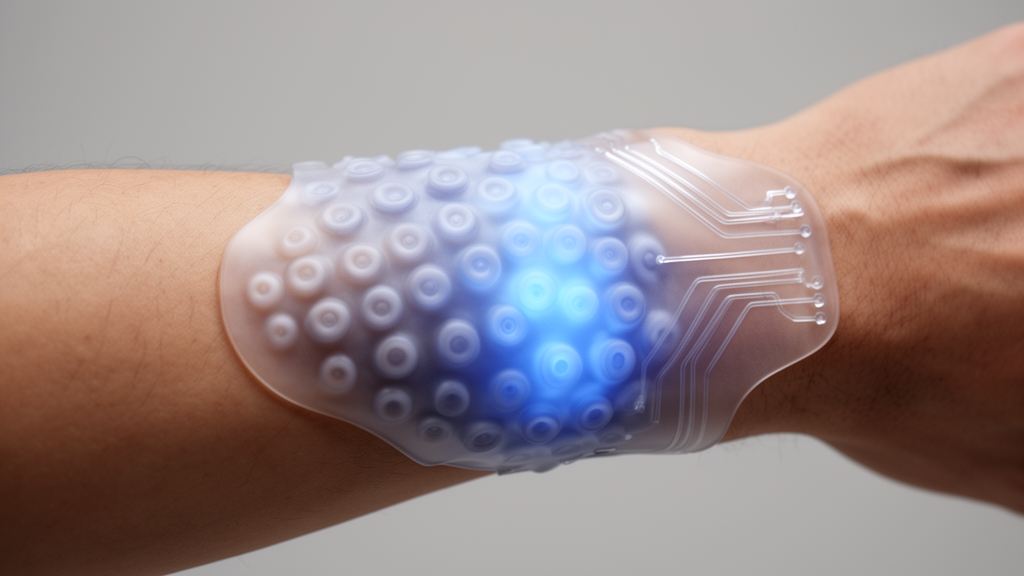
This architecture is realized through vertical integration of three functional layers: a flexible optically transparent antenna, a flexible solar cell, and a central functional island. The transparency of the antenna is more than an aesthetic choice. By allowing light to pass through the antenna layer to the solar cell beneath it, the design avoids the shading losses that would otherwise occur when an opaque conductor sits atop a photovoltaic element. This stacking permits the device to harvest solar energy without enlarging its footprint, a critical consideration for a skin-conformal wearable where surface area is scarce. The combination of solar and RF harvesting gives the system two complementary energy channels: solar input dominates in well-lit conditions and can deliver meaningful power, while RF harvesting provides a trickle of energy even in darkness or indoors, drawing on the ambient radio fields generated by Wi-Fi access points, cellular base stations, and broadcast transmitters that saturate modern environments.
The experimental characterization reported in the paper demonstrates that these design principles survive contact with reality. The device autonomously transitions between active and passive modes as energy conditions fluctuate, maintaining reliable communication in both regimes. It tolerates mechanical deformation without losing electromagnetic performance, confirming that the island-bridge decoupling does its job. It harvests energy from both solar and RF sources, and it carries out multimodal physiological monitoring, the practical payload that gives a wearable its clinical and consumer value. Multimodal sensing, in this context, means the device can track more than one category of physiological signal, which is essential for applications ranging from continuous health monitoring to mission-critical personnel tracking where a single vital sign is rarely sufficient.
Placed in a broader context, the ERWS contributes to a growing recognition that the future of wearables lies not in any single breakthrough but in co-design across domains that have traditionally been engineered separately. Power management, antenna design, communication protocol selection, and mechanical architecture each impose constraints on the others, and optimizing any one in isolation tends to push problems onto the rest of the system. The time-frequency-space co-design framework articulated in this work is a statement about methodology as much as about hardware: it argues that energy resilience emerges only when the temporal logic of mode switching, the spectral allocation of communication and harvesting functions, and the spatial arrangement of components are conceived together. For the field of flexible electronics, which has produced impressive individual components, stretchable antennas, conformal sensors, thin-film photovoltaics, but has struggled to assemble them into systems that operate persistently under dynamic real-world conditions, this systems-level perspective may prove as influential as any specific component innovation.
The applications suggested by this capability extend across the domains named in the abstract. In healthcare, an energy-resilient skin could support continuous physiological monitoring that does not fail when a patient moves through poorly lit corridors or when a wearable goes days between charges, a persistent operational envelope that matters for fragile populations and post-operative care. In the ambient Internet-of-Things, vast numbers of low-value nodes cannot practically be serviced by batteries, and a platform that sustains itself through harvesting while degrading gracefully when energy is scarce fits the economic and logistical realities of large-scale deployment. In mission-critical applications, where first responders, soldiers, or industrial workers operate in unpredictable environments, the guarantee that a device will remain locatable and communicative even when its energy supply collapses could carry direct safety implications. The bio-inspired framing that opens the paper thus closes the loop on a practical engineering achievement: by imitating the adaptive, energy-aware behavior of an organism, the designers produced a wearable that behaves less like a gadget with a fixed operating envelope and more like a resilient participant in its environment, adjusting its posture to whatever the moment demands.
Subject of Research: Wearable electronics
Article Title: A bio-inspired energy-resilient wireless skin
Article References: Chen, Z.-H., Chen, H., Qu, H.-T., & Lu, W.-B. (2026). A bio-inspired energy-resilient wireless skin. npj Flexible Electronics. https://doi.org/10.1038/s41528-026-00653-2
Image Credits: AI Generated
DOI: 10.1038/s41528-026-00653-2
Keywords: wearables, backscatter, flexible electronics, energy harvesting, wireless communication, bio-inspired, energy-resilient, wireless, skin, scientific research
Cite Scienmag News
Denise Maddox. (October 16, 2026). Octopus-inspired wireless skin switches between active and passive modes to keep wearables alive. Scienmag. https://scienmag.com/octopus-inspired-wireless-skin-switches-between-active-and-passive-modes-to-keep-wearables-alive/
Denise Maddox. "Octopus-inspired wireless skin switches between active and passive modes to keep wearables alive." Scienmag, 16 October 2026, https://scienmag.com/octopus-inspired-wireless-skin-switches-between-active-and-passive-modes-to-keep-wearables-alive/. Accessed 16 October 2026.
Denise Maddox. "Octopus-inspired wireless skin switches between active and passive modes to keep wearables alive." Scienmag. October 16, 2026. https://scienmag.com/octopus-inspired-wireless-skin-switches-between-active-and-passive-modes-to-keep-wearables-alive/


