


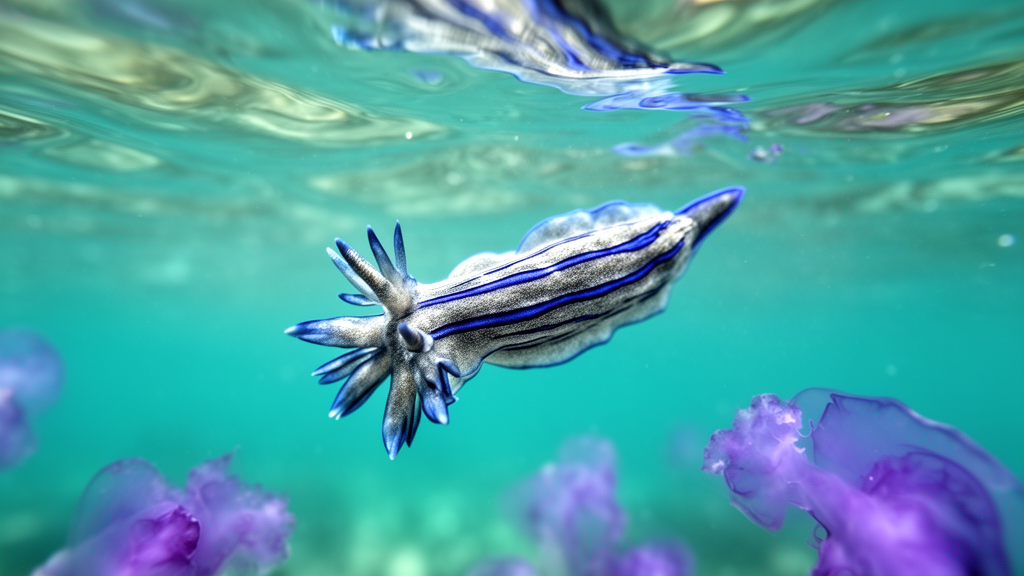
Beneath the warm, coral-fringed waters of Vietnam glides a sea slug that divers and scientists have long called by a single name. Its common nickname, the Blue Dragon, could hardly be more fitting for an animal now revealed to be far more mysterious than anyone expected. A new study published in the journal ZooKeys has applied a battery of molecular and morphological techniques to the nudibranch Pteraeolidia semperi, a species long thought to range across the entire Indo-Pacific, and found that the name conceals a tangle of distinct evolutionary lineages, at least two of which share the same Vietnamese reefs.
Pteraeolidia is an extraordinary animal even by the flamboyant standards of sea slugs. Members of the family Facelinidae, these aeolid nudibranchs can grow up to 300 millimetres long, care for their offspring, and, most remarkably, farm living algae inside their own bodies. The algae in question are zooxanthellae, dinoflagellates of the family Symbiodiniaceae, the same group that powers coral reefs. The slugs acquire them horizontally by feeding, and once ingested the symbionts are taken up into the cells of the digestive gland, where they photosynthesise, multiply and provide their hosts with a solar-powered energy supply. Juveniles that have not yet acquired their algae are almost completely white; colour returns as the internal gardens become established, which is why the appearance of these animals depends so heavily on the concentration of symbionts in their tissues.
For decades the genus was considered taxonomically simple. A revision in 1982 treated Pteraeolidia ianthina as the single valid species and folded P. semperi and P. scolopendrella into it as synonyms. Later work chipped away at that consensus. Wilson and Burghardt established in 2015 that P. ianthina is actually restricted to its type locality, Sydney Harbour, and subsequent molecular surveys uncovered hidden genetic diversity across the Indo-Pacific. What was missing was a detailed, integrative look at any one region, combining DNA barcodes, nuclear markers and anatomy in a single framework. The new study provides exactly that for Vietnam, where the sea slug fauna remains remarkably underexplored; a single review had identified only about 120 sea slug species in Vietnamese waters, far fewer than neighbouring regions of the Indo-West Pacific.
Between 2016 and 2023, researchers from the Vietnamese-Russian Tropical Centre collected 35 specimens by scuba diving at depths of two to 16 metres from five localities spanning central and southern Vietnam: Nha Trang, Phan Rang, Binh Dinh, Tho Chu and the Spratly Islands. Each animal was photographed alive and preserved in 96 percent ethanol, and DNA was extracted from small pieces of foot muscle. The team amplified fragments of two mitochondrial markers, the standard animal barcode gene COI and the ribosomal 16S rRNA gene, plus one nuclear marker, histone H3, producing alignments of 671, 471 and 338 base pairs respectively. Sequences were checked for pseudogenes by translation into amino acids, verified against GenBank, and analysed with Bayesian and maximum-likelihood phylogenetic methods alongside the automatic species-delimitation algorithm ASAP and TCS haplotype networks.
The results were striking. The Vietnamese specimens split into two deeply divergent clades, designated Clade A and Clade B, both recovered with maximal or near-maximal statistical support. Their mitochondrial COI sequences differ by more than 30 percent, an abnormally high figure for animals within a single genus, and 16S shows comparable divergence. Nuclear data told a more discriminating story: the H3 sequences of the two clades are separated by ten fixed nucleotide substitutions, roughly three percent pairwise divergence. Because H3 is biparentally inherited, such fixed differences between animals living side by side are strong evidence of restricted gene flow and hence reproductive isolation. In other words, the two clades are not merely genetically colourful populations of one species; they are independent evolutionary lineages that do not interbreed, even where they occur in sympatry at Nha Trang.
The species-delimitation analysis, meanwhile, exposed just how messy the bigger picture is. Rather than one clean barcoding gap separating within-species from between-species variation, the ASAP algorithm identified four, yielding estimates that ranged from six to as many as 20 molecular operational taxonomic units depending on the distance model used. Vietnamese animals fell into four of these MOTUs, three within Clade A and one within Clade B. Within each clade, mitochondrial divergence is itself enormous: the maximum distance inside Clade A nearly equals the minimum distance between the two clades, a symptom of substitution saturation in which the COI signal has effectively become scrambled by repeated mutations. Notably, one unit within Clade B, MOTU20, corresponds to true P. ianthina from Sydney Harbour, which the authors confirm is a valid species best kept separate from the P. semperi complex altogether.
Can the eye tell the two Vietnamese lineages apart? Largely yes, though with caveats. Clade A animals are darker, with an almost opaque body ranging from pale beige to dark orange, rows of zooxanthellae visible just beneath the epidermis, continuous lemon-coloured patches on the head running into the oral tentacles, and three to five purple rings on each tentacle. Clade B animals are semi-transparent, cream-violet or beige-brown, dotted with white or yellow pigment spots, often with bushier cerata arranged in several rows rather than one, and usually just two distinct purple rings on the tentacles. The authors suggest the colour difference may reflect the depth at which the symbionts sit within the tissues. Internally, however, the two clades are anatomically near-identical: the triangular jaws, the uniserial radula with its characteristic rows of cusps, and the diaulic reproductive system show no consistent differences. Since the original P. semperi was described from alcohol-bleached specimens, direct colour comparison with the type material is impossible, adding a further layer of taxonomic difficulty.
The most provocative finding concerns the runaway evolution of the mitochondrial genome. The extreme divergence is concentrated in Clade A, which sits on a long, unstable branch in COI trees, while nuclear H3 divergence remains at levels typical for closely related aeolid species. The authors argue this pattern is best explained by an accelerated mitochondrial mutation rate, and they propose a tantalising hypothesis: the photosymbiotic lifestyle itself may be the driver. Mitochondrial respiratory genes could be under unusual selective pressures in an animal packed with oxygen-producing algae, or, alternatively, the high tissue oxygen levels generated by photosynthesis may flood cells with reactive oxygen species that overwhelm DNA repair systems and boost mutagenesis, affecting not only protein-coding genes but ribosomal RNA as well. Similar mitochondrial hyperdiversity linked to symbionts has been documented in amphipods, periwinkles and other nudibranchs, but the idea that photosymbiosis might accelerate mtDNA evolution in sea slugs remains preliminary and will require whole-genome data to test properly.
The biogeographic analysis adds a final flourish. Haplotype networks built from COI sequences, including data mined from GenBank across the Indo-West Pacific, show strong geographic structure: haplogroups from Egypt, Fiji, Hawaii, Singapore and Sydney each form distinct clusters, while peripheral regions such as Hawaii and Egypt host only single, genetically isolated haplogroups. The greatest diversity clusters around the Coral Triangle, the recognised epicentre of marine biodiversity, and spills into nearby Vietnamese waters, where Nha Trang alone hosts both clades. Borderline sites track their neighbours: Tho Chu samples resemble those from Singapore, and Spratly specimens sit close to haplotypes from Sulawesi. The Sydney haplogroup stands apart from all other Australian samples, corroborating the status of P. ianthina as a local endemic.
What the study ultimately delivers is a sobering lesson for biodiversity science wrapped in a dazzling package. A single, familiar name applied across half an ocean’s worth of reefs conceals at least two reproductively isolated species in Vietnam alone, and likely many more across the Indo-Pacific, with mitochondrial DNA too fast-evolving and too saturated to count them reliably on its own. The authors argue that rapid nuclear markers and, eventually, genomic-scale data are essential to resolve species limits in a genus whose mitochondria refuse to behave. For now, the Blue Dragon keeps most of its secrets, but Vietnam’s waters, at least, are home to more dragons than the history books recorded.
Subject of Research: Cryptic species diversity and accelerated mitochondrial evolution in the Pteraeolidia semperi nudibranch complex from Vietnam
Article Title: Dragons guard secrets: integrative systematics of Pteraeolidia semperi species complex ( Gastropoda , Nudibranchia ) from Vietnam
Article References: Dragons guard secrets: integrative systematics of Pteraeolidia semperi species complex ( Gastropoda , Nudibranchia ) from Vietnam. (n.d.). https://doi.org/10.3897/zookeys.1293.195366
Image Credits: AI Generated
DOI: 10.3897/zookeys.1293.195366
Keywords: nudibranch, Pteraeolidia, cryptic species, sea slug, photosymbiosis, zooxanthellae, mitochondrial DNA, Vietnam, molecular taxonomy, Indo-Pacific, species delimitation, marine biodiversity
Cite Scienmag News
Gavin Prescott. (October 16, 2026). Blue Dragon sea slugs hide at least two species off Vietnam, DNA study reveals. Scienmag. https://scienmag.com/blue-dragon-sea-slugs-hide-at-least-two-species-off-vietnam-dna-study-reveals/
Gavin Prescott. "Blue Dragon sea slugs hide at least two species off Vietnam, DNA study reveals." Scienmag, 16 October 2026, https://scienmag.com/blue-dragon-sea-slugs-hide-at-least-two-species-off-vietnam-dna-study-reveals/. Accessed 16 October 2026.
Gavin Prescott. "Blue Dragon sea slugs hide at least two species off Vietnam, DNA study reveals." Scienmag. October 16, 2026. https://scienmag.com/blue-dragon-sea-slugs-hide-at-least-two-species-off-vietnam-dna-study-reveals/


