


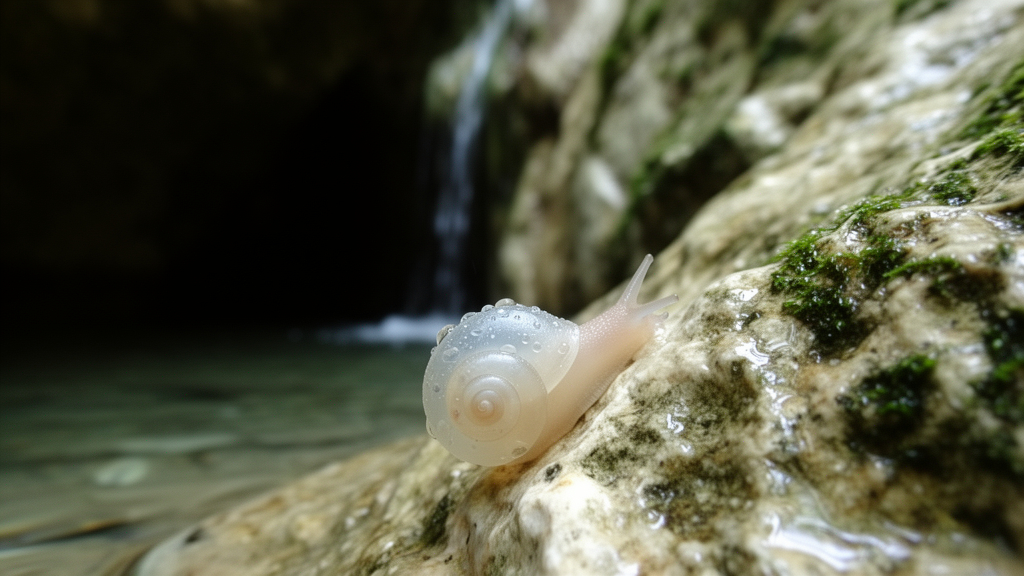
Deep beneath the mountains of the Peloponnese, in the dark water channels of an ancient karst system, a tiny translucent snail has been hiding from science. Researchers describing the species have named it Cyllena hermes, a new genus and species of stygobiont hydrobiid gastropod discovered at a karstic spring on the foothills of Mt Kyllini in Korinthia, southern Greece. The animal, barely wider than a millimetre, is completely unpigmented and eyeless, a classic example of the evolutionary transformations that occur when lineages commit permanently to life underground. Its description, published in the journal Subterranean Biology, adds a new branch to the tree of European freshwater molluscs and underscores how much of the continent’s subterranean biodiversity remains undocumented.
The discovery is significant because Europe is one of the world’s great centres of subterranean life. The continent encompasses eleven of the twenty-six globally recognized hotspots of subterranean biodiversity, and its freshwater underworld is richer in species than that of any other continent. Obligately subterranean aquatic species, known as stygobionts, account for up to eight percent of Europe’s total freshwater fauna. Among these, molluscs rank as the second most diverse group after crustaceans, and within the molluscs the family Hydrobiidae dominates, with more than 350 described subterranean species. The Balkan Peninsula, together with parts of southern France and Spain, forms a major hotspot of stygobiont gastropod diversity with more than 400 described species, and Greece sits at the southern margin of this biological treasure house.
Greece’s geology makes it ideal terrain for such finds. Carbonate rocks underlie roughly forty-one percent of the country’s surface and include more than ten thousand known caves, providing extensive habitat for subterranean fauna. The country hosts an exceptionally rich and highly endemic subterranean fauna of more than 981 species in 493 genera, nearly half of them found nowhere else. Yet the documented stygobiont gastropod fauna of Greece remains comparatively limited, with only a handful of hydrobiid and moitessieriid species recorded, several of which were described on shell morphology alone and whose systematic placement remains unresolved. Against this backdrop, the discovery of a well-characterized new genus from the Peloponnese carries particular taxonomic weight.
The type locality lies within the Stymphalia basin, a closed karst polje of approximately 216 square kilometres at elevations of 600 to 800 metres, ringed by the mountain massifs of Kyllini, Oligyrtos and Mavrovouni. The basin’s geology is dominated by the carbonate formations of the Tripolis Unit, and karstification controlled by Alpine fault systems has produced a well-developed underground drainage network characterized by conduit-dominated flow. At the lowest point of the basin sits Lake Stymphalia, a shallow, eutrophic lake with pronounced seasonal fluctuations, drained through natural swallow holes and artificial channels associated with the ancient Hadrian aqueduct. Tracer tests have shown that the Stymphalia karst system is hydraulically connected to an extensive regional network discharging toward the Argolic Plain and the Argolic Gulf, meaning water, and whatever lives in it, can travel far beyond the basin’s visible boundaries.
Seven specimens, six mature and one immature, were collected by hand from stones, gravel, fallen leaves, caddisfly cases and dead logs at the spring, which emerges at about 610 metres elevation and forms a small stream flowing toward the lake. The researchers documented the animals with digital photography through a stereomicroscope, examined the shell and protoconch of the immature specimen with scanning electron microscopy, and took precise measurements of shell height and width and aperture dimensions from the mature individuals. Four of the specimens were then dissected to reveal the anatomy of the soft body, particularly the reproductive system, which proved decisive for the species’ classification.
The shell of Cyllena hermes is minute, reaching a maximum height of only 0.76 millimetres and a maximum width of 1.46 millimetres, with up to 2.25 whorls. It is thin-walled, colourless, glossy and transparent when fresh, with a depressed spire and an extremely wide, open umbilicus that reveals the inner whorls, giving it a valvatiform to planorboid, or flat-coiled, shape. The head is white-creamy in colour, entirely lacking dark pigments and eye spots, and the animal has no ctenidium, the gill structure present in many related snails. The operculum, the small door the snail draws over its shell opening, is circular, thin, corneous and orange-coloured, without the peg-like thickening seen in some relatives.
It was the genital anatomy, however, that set the species apart. The bursa copulatrix is pyriform, with a thick, short bursal duct less than half the length of the bursa itself, and there is a single, large, irregularly shaped proximal seminal receptacle. The penis is large relative to the head, dorso-ventrally flattened, with a folded proximal portion, a blunt distal apex bearing a papilla, and a single elongate, blunt medial lobe on its left side. Following a diagnostic framework that emphasizes the combined morphology of male and female genitalia in delimiting valvatiform hydrobiid genera, the authors compared the new species against more than twenty related genera across the Balkans and the Mediterranean Basin. The unique combination of shell and anatomical characters precluded assignment to any previously described genus, justifying the erection of a new monotypic genus. The name Cyllena honours the nymph of Mt Kyllini who, in Greek mythology, nurtured the god Hermes, while the species name hermes refers to the messenger god himself, said to have been born in a cave on the very mountain where the snail was found.
So far, Cyllena hermes is known only from its type locality, despite extensive sampling throughout Korinthia. Such extreme restriction is consistent with patterns seen in other stygobiont valvatiform hydrobiids, many of which exhibit extraordinarily narrow geographic ranges. Although interstitial habitats may allow some subterranean fauna to disperse, species with low-spired, wide-umbilicate shells appear to have particularly limited dispersal capacity, displaying far more pronounced endemism than their turbospiral relatives. At the same spring, the researchers also recorded four other freshwater gastropods, including the endemic hydrobiids Isimerope semele and Daphniola longipenia, the latter’s new locality record extending its known distribution in the Peloponnese. Intriguingly, specimens of all these species were found incorporated into the larval cases of caddisflies, tiny insect larvae that build protective cases from available materials, including living snail shells.
The restricted range of the new species has immediate conservation implications. Its extent of occurrence and area of occupancy are both estimated at just four square kilometres, and following a precautionary approach under IUCN guidelines, the authors assessed the species as Vulnerable under Criterion D2. The Stymphalia basin faces serious threats from repeated prolonged drought and water abstraction for supply to neighbouring areas, which have caused a dramatic shrinkage of Lake Stymphalia in recent years. Subterranean freshwater habitats across Europe are increasingly pressured by groundwater overextraction, contamination and climate change, stresses that alter hydrological regimes, degrade habitat quality and can favour opportunistic surface species over specialized stygobionts. Because a species confined to a single spring can be wiped out by a single disruption to its water supply, every undetected population matters.
The discovery also highlights how fragmentary knowledge of Greece’s aquatic subterranean life remains. Of the roughly ten thousand caves recorded in the country, faunistic data exist for only about 550. The only fully described stygobiont assemblage comes from Melissotrypa Cave in Thessaly, one of the few subterranean ecosystems worldwide sustained by chemoautotrophic sulfur-oxidizing bacteria, which hosts sixteen aquatic species, half of them endemic and new to science. The Stymphalia karst aquifer, a sensitive, heterogeneous and dynamic hydrogeological system, evidently harbours its own specialized fauna that surfaces only sporadically at springs. As the authors note, findings like this underline the importance of targeted exploration of karst ecosystems, because each spring that dries or each aquifer that is pumped dry may silently erase species that science has not yet had the chance to name.
Subject of Research: A new stygobiont hydrobiid gastropod genus and species from a karstic spring in the Stymphalia basin, southern Greece
Article Title: From the dark to the light: A new genus and species of stygobiont hydrobiid ( Caenogastropoda , Truncatelloidea ) from southern Greece
Article References: Radea, C., Protopapas, D., Parmakelis, A., & Koskeridou, E. (2026). From the dark to the light: A new genus and species of stygobiont hydrobiid (Caenogastropoda, Truncatelloidea) from southern Greece. Subterranean Biology, 57, 1-21. https://doi.org/10.3897/subtbiol.57.189090
Image Credits: AI Generated
DOI: 10.3897/subtbiol.57.189090
Keywords: stygobiont, hydrobiidae, gastropoda, karst, Greece, Peloponnese, Lake Stymphalia, new species, subterranean biodiversity, IUCN Vulnerable, cave fauna, taxonomy
Cite Scienmag News
Gavin Prescott. (October 16, 2026). Tiny Blind Snail Named After Hermes Emerges From a Greek Karst Spring. Scienmag. https://scienmag.com/tiny-blind-snail-named-after-hermes-emerges-from-a-greek-karst-spring/
Gavin Prescott. "Tiny Blind Snail Named After Hermes Emerges From a Greek Karst Spring." Scienmag, 16 October 2026, https://scienmag.com/tiny-blind-snail-named-after-hermes-emerges-from-a-greek-karst-spring/. Accessed 16 October 2026.
Gavin Prescott. "Tiny Blind Snail Named After Hermes Emerges From a Greek Karst Spring." Scienmag. October 16, 2026. https://scienmag.com/tiny-blind-snail-named-after-hermes-emerges-from-a-greek-karst-spring/


