


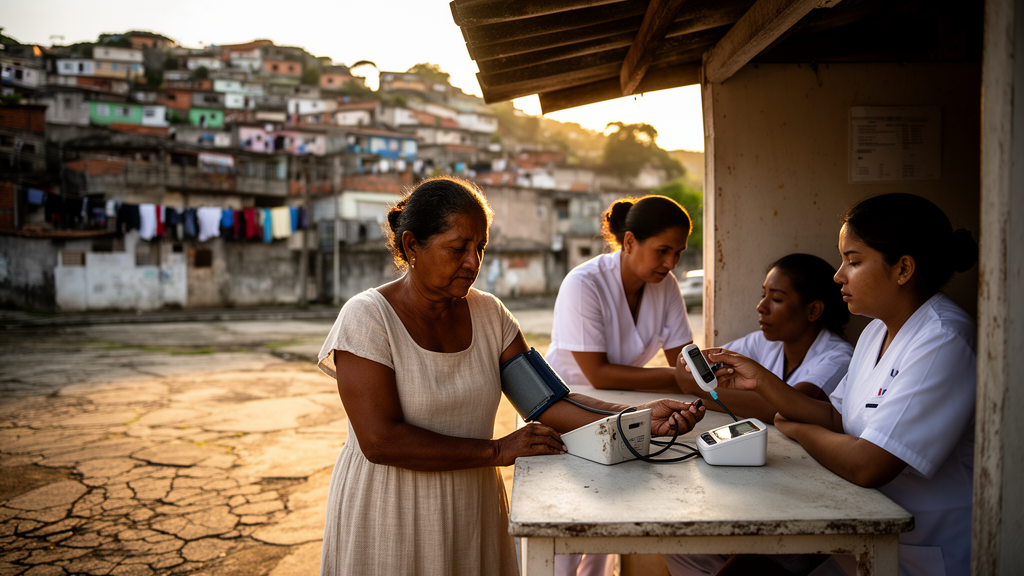
One of the largest cross-sectional surveys in Brazil has delivered a striking quantification of how deeply social inequality is written into the country’s chronic disease burden. Analyzing data from more than 21,000 adults surveyed in the 2023 Vigitel national telephone survey, researchers at the Federal University of Rio Grande found that the combined effects of sex, race, and education are not merely correlated with diabetes and hypertension—they appear to account for a substantial fraction of the disease burden itself. According to the study, published in BMC Public Health, more than one in three cases of diabetes and nearly half of all cases in which diabetes and hypertension coexist could be attributed to low educational attainment alone.
The research team, led by Rosália Garcia Neves and colleagues, set out to answer a question that has long troubled public health researchers: when diabetes and hypertension strike certain groups far more often than others, how much of that excess is explained by social position rather than biology or chance? To do this, they turned to an analytical approach that has gained momentum in epidemiology over the past decade—intersectionality. Rather than treating sex, race, and education as separate, independent risk factors, intersectional analysis examines what happens when these dimensions of social identity overlap and compound one another in real lives.
The framework the researchers employed is known as the “multiple jeopardy” hypothesis, operationalized through a Jeopardy Index. The logic is intuitive but powerful: a person who belongs to multiple socially disadvantaged groups at once—say, a Black woman with low educational attainment—faces risks that are not simply additive but potentially multiplicative, because discrimination, material deprivation, and reduced access to quality healthcare interact and reinforce each other. The reference group in the analysis was the most advantaged combination: white men with high educational attainment, against whom all other intersections of sex, race, and schooling were compared.
The data came from Vigitel 2023, Brazil’s ongoing national surveillance system that interviews adults aged 18 and older by telephone in state capitals. With 21,690 respondents, the survey offered enough statistical power to dissect the population into fine-grained intersectional groups. The outcomes of interest were self-reported diabetes mellitus, self-reported hypertension, and—critically—the co-occurrence of both conditions in the same individual, a combination that dramatically raises the risk of cardiovascular disease, kidney failure, and premature death.
The headline finding is stark. Black, Brown (mixed-race), Asian, and Indigenous women with low educational attainment had a four-fold higher probability of presenting with both diabetes and hypertension compared with white men holding high educational attainment. Their probability of diabetes alone was three times higher, and their probability of hypertension was 2.3 times higher. These are not marginal differences detectable only in statistical models; they represent gaps of the kind that translate directly into years of life lost, amputations, dialysis, strokes, and heart attacks concentrated in the most vulnerable communities.
Education emerged as the dominant axis of inequality. Across every combination of sex and race, individuals with low educational attainment showed a higher prevalence of all the morbidities assessed. This pattern held regardless of whether the person was a man or a woman, or whether they identified as white, Black, Brown, Asian, or Indigenous. In other words, schooling did not merely add to the effect of race or sex—it acted as a powerful, pervasive social determinant in its own right, shaping everything from occupational conditions and income to health literacy, dietary options, and the ability to navigate the healthcare system.
The most policy-relevant numbers in the study are the population attributable fractions, which estimate how much of the disease burden would disappear if the exposure—in this case, low educational attainment—were eliminated. The researchers calculated that 34.6 percent of diabetes cases, 21.6 percent of hypertension cases, and 44.2 percent of cases in which diabetes and hypertension coexist were attributable to low educational attainment. To put that in perspective: if the health risks associated with low schooling were somehow neutralized, nearly half of the country’s double burden of diabetes plus hypertension could, in principle, be prevented. That is an extraordinary figure for a modifiable social characteristic rather than a biological risk factor.
The statistical machinery behind these conclusions was relatively conventional but rigorously applied. The team used chi-square tests to compare prevalence across groups and Poisson regression to estimate prevalence ratios, the standard tool for cross-sectional prevalence data. Poisson regression with robust variance allows researchers to model how the probability of a condition varies across exposure categories while adjusting for the complex interplay of covariates. By structuring the exposure variables as intersectional categories rather than separate terms, the models could capture the joint effect of belonging to multiple disadvantaged groups simultaneously—something that traditional additive regression approaches tend to underestimate or obscure.
The authors are careful about what the study can and cannot show. As a cross-sectional analysis of self-reported data, it captures disease and social position at a single point in time, so it cannot fully disentangle whether low education causes disease or whether some of the association flows through pathways that unfold over a lifetime—childhood poverty, poor nutrition, stressful work, and limited healthcare access all cluster together. Self-reported diagnoses also depend on people having been tested and told their status, which itself varies with healthcare access, meaning the true inequalities could be even larger than measured, since undiagnosed disease is likely concentrated among the most disadvantaged.
Even with those caveats, the implications are hard to ignore. Diabetes and hypertension are among the leading drivers of death and disability worldwide, and Brazil, like many middle-income countries, faces a growing epidemic of noncommunicable diseases layered on top of persistent racial and socioeconomic disparities. The study’s conclusion is explicit: prevention and control strategies should incorporate actions aimed at addressing structural vulnerabilities into public health policy. In practical terms, that means programs that treat a Black woman with low educational attainment not as one risk factor at a time but as a person facing compounded jeopardy—and that invest in education, income support, and equitable healthcare access as genuinely preventive medicine. The findings suggest that the classroom, the workplace, and the neighborhood may matter as much as the clinic in determining who develops Brazil’s next case of diabetes.
Subject of Research: Intersectional social inequalities in the burden of diabetes and hypertension in Brazil
Article Title: How much the burden of diabetes and hypertension is attributable to social inequalities? an intersectional analysis in Brazil
Article References: How much the burden of diabetes and hypertension is attributable to social inequalities? an intersectional analysis in Brazil. (n.d.). https://doi.org/10.1186/s12889-026-29369-8
Image Credits: AI Generated
DOI: 10.1186/s12889-026-29369-8
Keywords: diabetes, hypertension, health inequalities, intersectionality, social determinants of health, education, Brazil, Vigitel survey, noncommunicable diseases, public health, epidemiology, racial disparities
Cite Scienmag News
Phoebe Ingram. (October 16, 2026). Social Inequalities Drive a Heavy Share of Brazil’s Diabetes and Hypertension Burden. Scienmag. https://scienmag.com/social-inequalities-drive-a-heavy-share-of-brazils-diabetes-and-hypertension-burden/
Phoebe Ingram. "Social Inequalities Drive a Heavy Share of Brazil’s Diabetes and Hypertension Burden." Scienmag, 16 October 2026, https://scienmag.com/social-inequalities-drive-a-heavy-share-of-brazils-diabetes-and-hypertension-burden/. Accessed 16 October 2026.
Phoebe Ingram. "Social Inequalities Drive a Heavy Share of Brazil’s Diabetes and Hypertension Burden." Scienmag. October 16, 2026. https://scienmag.com/social-inequalities-drive-a-heavy-share-of-brazils-diabetes-and-hypertension-burden/


