


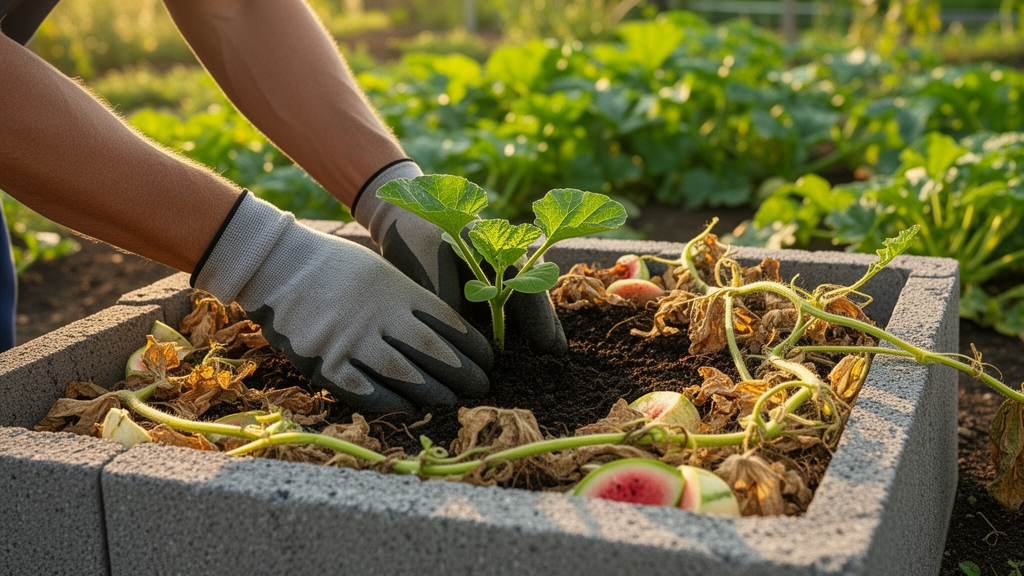
Watermelon vines, the tangled stems left behind after harvest in melon fields around the world, have long been treated as little more than agricultural refuse to be burned or discarded. A new study published in Scientific Reports suggests they could instead become an unlikely ingredient in one of humanity’s most ubiquitous materials: concrete. Researchers led by Yixuan Wang of Henan Institute of Science and Technology, working with Jingjing Zhuang of Xinxiang University, report that shredded watermelon vine can simultaneously strengthen a special plantable concrete and neutralize the harsh alkalinity that normally prevents plants from taking root in it.
The material in question is ecological porous concrete, a deliberately sponge-like formulation used in green infrastructure projects such as vegetated retaining walls, slopes, and pavements. Unlike conventional concrete, EPC contains interconnected voids that allow water, air, and roots to pass through. That porosity is its ecological selling point, but it also creates an engineering headache: the same connected pores that admit roots also expose them to the cement matrix, and cement chemistry is brutally hostile to plant life.
The problem stems from the fundamental reactions of cement hydration. When Portland cement reacts with water, it releases calcium hydroxide and other alkaline compounds that push the pore solution well above pH 11, sometimes approaching 13. At those levels, root cells are damaged, nutrient uptake collapses, and microbial communities essential for healthy soil struggle to survive. Meanwhile, the dense cementitious regions that give concrete its strength tend to clog the very pores that vegetation needs. The result is a persistent trade-off between mechanical performance and biological viability, a compromise that has limited EPC adoption despite growing demand for green urban infrastructure.
Wang and colleagues approached the problem by treating watermelon vine as what they call a dual-functional additive, meaning it works in two ways at once. Mechanically, the fibrous plant matter acts as reinforcement distributed through the matrix, helping to bridge microcracks and maintain strength even as the mix is engineered for high porosity. Chemically, the vine’s organic constituents interact with the alkaline pore environment. Watermelon plants are known to accumulate oxalates, and the researchers propose that organic acids from the vine neutralize hydroxide ions in situ, buffering the pore solution toward a pH plants can tolerate.
Determining the right recipe for such a multi-objective material is a genuine optimization challenge, because adding more vine lowers pH but can also compromise strength and porosity. The team therefore built an integrated statistical framework combining an orthogonal array design, response surface methodology, and entropy-weighted TOPSIS analysis. Orthogonal arrays allow many mix variables to be tested efficiently in a reduced number of experiments, response surface methodology then models how each factor influences the outcomes and locates optima in the multi-dimensional design space, and TOPSIS, a multi-criteria decision technique, ranks candidate mixes by their overall closeness to an ideal that balances strength, porosity, and pH simultaneously. Entropy weighting assigns objective importance to each criterion based on the spread of the experimental data rather than subjective assumptions.
This analysis yielded a clear verdict: watermelon vine content was the dominant factor controlling pore pH. At an optimal dosage of 3 percent by weight of binder, the pH dropped to 7.6 within 14 days, a value comfortably within the neutral range where roots and soil microbes can function. No conventional EPC formulation comes close to that figure without external chemical treatment, which makes the result striking given that the neutralizing agent is essentially farm waste.
The optimized mix itself was tailored for vegetation. The researchers specified coarse aggregate in the 16 to 20 millimeter range, which creates the large connected voids characteristic of porous concrete, supplemented with 20 percent fly ash replacing part of the cement. Fly ash, a byproduct of coal combustion, both reduces the carbon footprint of the binder and contributes to longer-term strength through pozzolanic reactions. The water-to-binder ratio was set at a low 0.26, alongside the 3 percent vine addition. Together these choices produced a compressive strength of 10.4 megapascals and an effective porosity of 27.7 percent, a combination that sits squarely in the useful window for load-bearing yet plantable concrete. Critically, the strength remained stable when tested at 60 days, indicating that the organic additive did not degrade the matrix over time, a common worry when biological materials are embedded in cement.
To understand what was happening at the microscopic scale, the team turned to scanning electron microscopy. The images revealed a dense interfacial transition zone, the region of cement paste that surrounds aggregate particles and typically represents the weakest link in concrete microstructure. Within this zone, the researchers observed crystalline products whose morphology is consistent with calcium oxalate, supporting the proposed acid-base neutralization mechanism in which oxalate-rich vine tissue reacts with the alkaline cement environment to form stable minerals. The formation of such crystals may even contribute to densifying the interface, helping explain how the material retains strength despite its open, porous architecture.
The biological endpoint was tested the most direct way possible: by planting seeds in the concrete and watching what happened. Germination trials confirmed that vegetation could establish itself on the optimized material, achieving greater than 80 percent coverage within 60 days. For applications such as vegetated slope stabilization, green walls, and ecological restoration of hardened landscapes, that figure translates into rapidly greening surfaces that can reduce erosion, moderate urban temperatures, and support biodiversity. The fact that this is achieved with a locally sourced waste stream rather than imported chemical additives strengthens the economic case, particularly in agricultural regions where watermelon cultivation generates vine residues seasonally and disposal is a recurring cost.
The broader significance of the work lies in its demonstration that industrial and agricultural waste streams can be paired in unexpected ways to solve structural problems. Porous, plantable concrete has existed for decades, but the alkalinity barrier has kept it confined to niche projects. If a dried, shredded vine can pull pore chemistry into the neutral range while reinforcing the matrix, the calculus for sustainable construction materials changes considerably. The researchers positioned watermelon vine as a viable, low-cost functional resource, and the convergence of their evidence, from statistical optimization to microscopy to living plants, offers a template for how future green building materials might be designed: not by adding functionality after the fact, but by building biology directly into the chemistry of the material itself.
Subject of Research: Use of watermelon vine agricultural waste as a dual-functional additive to strengthen and de-alkalinize ecological porous concrete for vegetation
Article Title: Watermelon vine as dual-functional additive in ecological porous concrete
Article References: Watermelon vine as dual-functional additive in ecological porous concrete. (n.d.). https://doi.org/10.1038/s41598-026-74981-8
Image Credits: AI Generated
DOI: 10.1038/s41598-026-74981-8
Keywords: watermelon vine, agricultural waste, ecological porous concrete, alkalinity reduction, compressive strength, porosity, fly ash, response surface methodology, TOPSIS, vegetation establishment, calcium oxalate, sustainable construction
Cite Scienmag News
Denise Maddox. (October 16, 2026). Watermelon Vine Waste Tames Alkaline Concrete to Let Plants Grow. Scienmag. https://scienmag.com/watermelon-vine-waste-tames-alkaline-concrete-to-let-plants-grow/
Denise Maddox. "Watermelon Vine Waste Tames Alkaline Concrete to Let Plants Grow." Scienmag, 16 October 2026, https://scienmag.com/watermelon-vine-waste-tames-alkaline-concrete-to-let-plants-grow/. Accessed 16 October 2026.
Denise Maddox. "Watermelon Vine Waste Tames Alkaline Concrete to Let Plants Grow." Scienmag. October 16, 2026. https://scienmag.com/watermelon-vine-waste-tames-alkaline-concrete-to-let-plants-grow/


