


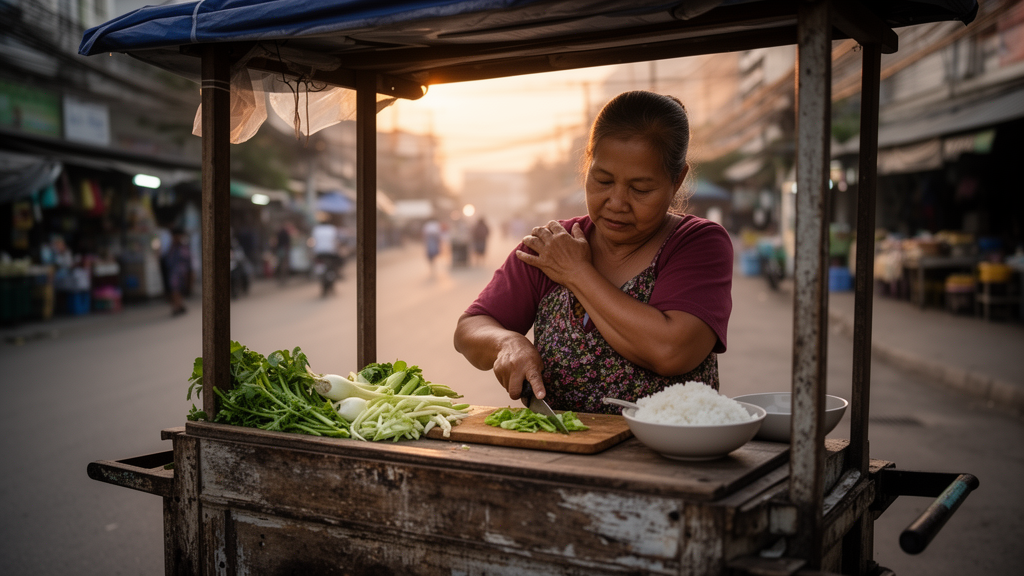
Being your own boss is often sold as the healthiest way to work: no demanding supervisor, flexible hours, the freedom to eat lunch when you choose. A new study from Thailand turns that promise on its head. Drawing on a nationally representative survey of more than 5,000 working-age adults, researchers report that self-employed people rate their own health worse than paid employees, eat a less varied diet, exercise less, and are more likely to smoke and drink alcohol. The picture is not uniformly bleak, however. Those who run businesses with employees tend to fare better than salaried workers, while the solo self-employed, street vendors, own-account traders, and gig workers without staff, emerge as the most vulnerable group.
The research, published in Frontiers in Nutrition, was led by Kai Yao of Xinjiang University of Science and Technology together with colleagues at Rattana Bundit University and INTI International University. The team analyzed the 2024 Thailand Health and Welfare Survey, a multi-stage stratified cluster sample covering education, employment, health, and insurance. After restricting the data to adults aged 18 to 65 and trimming outliers in income and working hours, the analytical sample comprised 5,287 observations. The authors frame their work around a simple but consequential idea: employment type is not merely a labor market label but a social determinant of health, shaping income stability, daily routines, stress exposure, and ultimately what people put on their plates.
Technically, the study leans on survey-adjusted ordered probit models, an appropriate choice for a dependent variable, self-rated health, measured on a five-point ordinal scale from very poor to very good compared with people of the same age. All estimates incorporated sampling weights, stratification, and primary sampling units, with standard errors obtained through Taylor-series linearization and clustered at the regional level. Control variables spanned gender, age group, years of education, urban residence, region, monthly income, weekly working hours, medical insurance, and healthcare utilization. The key exposure, self-employment, was coded as a binary indicator following OECD definitions, and then disaggregated into employer self-employment, meaning the respondent hired paid staff, and solo self-employment, meaning no employees.
The headline result is consistent: self-employment carries a negative and statistically significant association with self-rated health. In the fully adjusted model the coefficient was −0.061, significant at the ten percent level, and in the unadjusted regional specification −0.095, significant at one percent. Marginal effects translate this into intuitive terms: at sample means, being self-employed raises the probability of rating one’s health as fair by about 1.8 percentage points and lowers the probability of reporting good health by 0.9 points and very good health by 1.4 points. The subgroup analysis is where the story sharpens. Employer self-employment is associated with better health, pushing up the probability of good and very good ratings by roughly 1.7 and 2.6 percentage points, whereas solo self-employment does the opposite, raising the chances of fair or poor ratings by around 3.7 and 0.9 points respectively.
Because health could plausibly influence the choice to work for oneself, the healthier workers seizing opportunities, the sicker ones pushed into subsistence business, the authors ran an instrumental-variable sensitivity analysis. Their instrument was the regional urban registered unemployment rate, taken from the Thailand Statistical Yearbook, on the logic that weak wage employment pushes people into self-employment. The instrument is strong: first-stage F-statistics ranged from 72.89 to 88.64, far above the conventional threshold of 10, and the second-stage coefficient on predicted self-employment remained negative and significant at one percent. Crucially, the authors themselves caution that this exclusion restriction is likely violated, since regional unemployment may also affect health through local food prices, economic conditions, and healthcare infrastructure. They therefore present the IV results strictly as descriptive sensitivity checks, not causal estimates, a refreshingly honest move in a literature often tempted to overclaim.
Nutrition emerges as a central pathway. Dietary diversity was scored from 0 to 10 using a 24-hour dietary recall across ten food groups, an adapted version of the FAO Household Dietary Diversity Score framework widely validated in low- and middle-income countries as a proxy for micronutrient adequacy and overall diet quality. Self-employment was negatively associated with this score, with a coefficient of −0.037, indicating less varied diets among the self-employed. The authors connect this to food insecurity research: unstable income and precarious work are linked to reduced food security, irregular meal patterns, and greater reliance on cheap, energy-dense foods. They also stress the measure’s limits, noting that a single recall cannot capture energy intake, portion sizes, nutrient adequacy, or usual dietary habits.
The lifestyle picture reinforces the pattern. Self-employment was associated with lower physical activity (coefficient −0.045, significant at five percent), higher probability of current smoking (+0.032, significant at five percent), and higher probability of alcohol consumption (+0.028, significant at ten percent). The theoretical framing draws on Karasek’s Job Demand-Control Model: although the self-employed enjoy high decision latitude, they also shoulder high demands, working their own capital, bearing their own risks, and acting as price takers in competitive markets. That combination of high demand and high control can generate intense pressure. Meanwhile, irregular schedules crowd out leisure and exercise, and psychosocial stress from income volatility is a well-documented driver of smoking and drinking as coping behaviors. The authors emphasize that with cross-sectional data these lifestyle findings are exploratory correlates, not proven mediating mechanisms.
The descriptive statistics add texture to the divide within self-employment. Employers average 41.9 years of age and 1.61 more years of schooling than solo operators, who average 46.5 years and just 8.86 years of education. More than 80 percent of the self-employed live in rural areas, where entry barriers are low, and solo workers cluster in the north and west of the country. Solo workers also report more headaches, dizziness, and joint or muscle pain over the previous four weeks. The authors interpret this split through opportunity versus necessity: employers resemble modern entrepreneurs with better resources and working conditions, while solo workers are often pushed into self-employment by constrained job options, running subsistence businesses with lower earnings and harsher environments.
Robustness checks buttress the baseline finding. Re-estimating with ordinary least squares and IV two-stage least squares produced negative coefficients significant at ten percent, and replacing the outcome with five objective short-term morbidity indicators, fever or sore throat, diarrhea, stomachache, headache or dizziness, and joint or muscle pain over the past month, yielded mostly positive coefficients, with a composite morbidity indicator positively and significantly associated with self-employment at the five percent level. Limitations remain, and the authors catalog them candidly: the cross-sectional design cannot establish causation, residual confounding from personality traits or early-life conditions is possible, self-reported diet and behavior are subject to recall bias, and the IV exclusion restriction cannot be verified. Longitudinal data, they argue, will be needed to trace genuine causal pathways.
The policy implications reach beyond Thailand. If employment structure shapes what people eat, how much they move, and whether they smoke, then public health campaigns aimed only at individual behavior will keep missing the people most at risk. The authors call for integrating labor-market interventions with nutrition and lifestyle strategies: targeted dietary support for solo self-employed workers, community-based nutrition education and healthy food environments that reach people outside formal workplaces, and stronger social protection to blunt the economic insecurity that erodes health. As platform work and informality expand across developing economies, the solo self-employed, this study suggests, are the group most likely to fall through both the labor market’s cracks and the healthcare system’s safety net.
Subject of Research: Associations between self-employment type, dietary diversity, lifestyle behaviors, and self-rated health in Thailand
Article Title: Integrating nutrition and lifestyle: associations between employment type and health behaviors
Article References: Integrating nutrition and lifestyle: associations between employment type and health behaviors. (n.d.). https://doi.org/10.3389/fnut.2026.1889959
Image Credits: AI Generated
DOI: 10.3389/fnut.2026.1889959
Keywords: self-employment, dietary diversity, self-rated health, Thailand, lifestyle behaviors, nutrition, health inequalities, ordered probit model, instrumental variable, occupational health, social determinants of health, solo self-employed
Cite Scienmag News
Daisy Hatcher. (October 16, 2026). Working for Yourself May Cost You: Thai Study Links Self-Employment to Poorer Health and Diets. Scienmag. https://scienmag.com/working-for-yourself-may-cost-you-thai-study-links-self-employment-to-poorer-health-and-diets/
Daisy Hatcher. "Working for Yourself May Cost You: Thai Study Links Self-Employment to Poorer Health and Diets." Scienmag, 16 October 2026, https://scienmag.com/working-for-yourself-may-cost-you-thai-study-links-self-employment-to-poorer-health-and-diets/. Accessed 16 October 2026.
Daisy Hatcher. "Working for Yourself May Cost You: Thai Study Links Self-Employment to Poorer Health and Diets." Scienmag. October 16, 2026. https://scienmag.com/working-for-yourself-may-cost-you-thai-study-links-self-employment-to-poorer-health-and-diets/


