


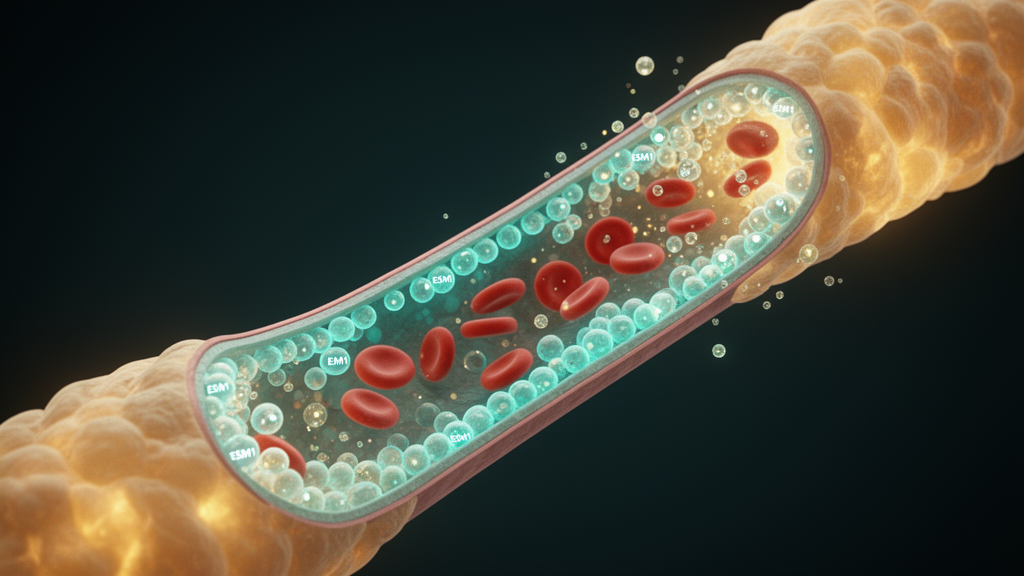
Deep inside the smallest blood vessels of the human lung, a single molecule may hold clues to some of medicine’s most stubborn respiratory diseases. Endothelial cell-specific molecule-1, better known as endocan or ESM1, is a soluble proteoglycan produced almost exclusively by the endothelial cells lining pulmonary arterioles, venules, and alveolar capillaries. A new review published in Frontiers in Physiology by researchers at Kunming Medical University pulls together decades of scattered evidence to argue that this enigmatic protein is not a bystander in lung disease but an active participant, sometimes driving pathology and sometimes protecting against it.
The story of ESM1 began in 1996, when researchers first identified the molecule in a cDNA library derived from human umbilical vein endothelial cells. The gene sits on chromosome 5q11.2, spans roughly 12 kilobases, and encodes a signal peptide of 19 amino acids followed by a mature polypeptide of 165 amino acids. After the signal peptide is cleaved in the endoplasmic reticulum, the core protein undergoes O-glycosylation, receiving a linear dermatan sulfate chain at the serine residue at position 137. The finished product is a cysteine-rich molecule of about 50 kilodaltons, carrying an N-terminal epidermal growth factor-like domain and a C-terminal phenylalanine-rich region, each with distinct biological jobs.
That structural architecture matters functionally. The cysteine-rich domain is involved in blocking leukocyte adhesion and activation, while the phenylalanine-rich region promotes cancer cell proliferation and invasion. The dermatan sulfate chain binds pro-angiogenic factors, tying ESM1 to embryonic development and tumor progression. Beyond its structural roles, ESM1 promotes cell proliferation by accelerating the G1/S transition of the cell cycle through cyclin D1 and CDK4, drives metabolic reprogramming by stimulating fatty acid synthesis and the Warburg effect, inhibits autophagy and apoptosis, and promotes both endothelial-to-mesenchymal transition and epithelial-mesenchymal transition, processes central to fibrosis and cancer spread.
Perhaps the most puzzling feature of ESM1 is its dual relationship with inflammation. On one hand, the protein stimulates endothelial secretion of interleukin-8 and monocyte chemoattractant protein, loosens tight junctions to increase vascular permeability, and enhances monocyte adhesion under chronic intermittent hypoxia. On the other hand, it directly binds the integrin LFA-1, preventing the leukocyte adhesion molecule from engaging ICAM-1 and thereby blocking white blood cell migration into tissue. The review suggests three possible explanations for this Jekyll-and-Hyde behavior: different molecular mechanisms may dominate in different settings, the glycanated and non-glycanated forms of the protein may carry opposite functions, and the disease context itself, whether sepsis or acute lung injury, may determine which face of ESM1 prevails.
Molecularly, ESM1 sits at the hub of an elaborate signaling web. It participates in positive feedback loops with the epidermal growth factor receptor, in which EGFR activation drives ESM1 expression and ESM1 in turn promotes EGF binding to EGFR. It forms similar self-reinforcing circuits with the HGF/c-MET pathway and the VEGF-A pathway, the latter through its ability to bind fibronectin in the extracellular matrix and release stored VEGF-A to activate VEGFR-2. Additional pathways involving NF-κB, mTOR, ZEB1/PI3K/AKT, DLL4/Notch, and Wnt/β-catenin connect ESM1 to proliferation, angiogenesis, drug resistance, and immune evasion. Under intermittent hypoxia, the HIF-1α/VEGF pathway ramps up ESM1 production, a mechanism with direct relevance to sleep-disordered breathing.
In lung cancer, the leading cause of cancer-related death worldwide, ESM1 behaves as a tumor promoter. It drives proliferation, invasion, epithelial-mesenchymal transition, and chemoresistance while reshaping the tumor microenvironment by boosting pro-angiogenic factors and promoting endothelial lipid synthesis. In non-small cell lung cancer, the most prevalent histological subtype, ESM1 activates both the EGFR/ESM1 loop and an ESM1/HGF/c-MET circuit that fuels angiogenesis. It may also enhance the stemness and drug resistance of cancer stem cells through HIF-1α signaling and elevate long non-coding RNAs such as H19 and HULC. The authors note that whether additional pathways, including Wnt/β-catenin and DLL4/Notch, contribute in lung cancer remains unresolved.
The picture shifts in obstructive sleep apnea hypopnea syndrome, the most common sleep disorder globally. Serum ESM1 rises in patients, partly through downregulation of microRNA-181a-1, and falls after treatment. Working through the HIF-1α/VEGF pathway under intermittent hypoxia, elevated ESM1 increases vascular permeability, stimulates expression of the adhesion molecules ICAM-1 and VCAM-1, and strengthens monocyte binding to endothelial cells, collectively amplifying vascular inflammation. In pulmonary arterial hypertension, ESM1 levels are likewise elevated and appear to promote disease by inducing endothelial-to-mesenchymal transition and entering a positive feedback loop with TNF-α, in which each molecule spurs production of the other, worsening endothelial injury and vascular remodeling. The review cautions, however, that most PAH evidence comes from animal models and cell experiments rather than patient studies.
In the starkest contrast, ESM1 appears protective in acute lung injury and acute respiratory distress syndrome. There, the protein reduces neutrophil infiltration by inhibiting LFA-1/ICAM-1-dependent leukocyte migration, dampens secretion of TNF-α, interferon-γ, and interleukin-1β, restores mitochondrial respiratory function by reversing lipopolysaccharide-induced overactivation of the mitochondrial unfolded protein response, and helps repair the endothelial glycocalyx that maintains the pulmonary vascular barrier. Elevated endocan has even been proposed as an early marker of disease severity in ARDS. Yet the authors acknowledge an unresolved tension: given ESM1’s documented pro-inflammatory actions elsewhere, whether it might also promote inflammation in some phases of ALI/ARDS is still unknown.
The remaining respiratory diseases occupy murkier territory. In COPD, evidence points in conflicting directions: some studies suggest ESM1 protects against emphysema by enhancing the protective effects of HGF and VEGF, while others indicate it accelerates lung tissue injury through Fas/FasL-mediated apoptosis of structural cells. In COVID-19, elevated ESM1 correlates with severity and may promote thrombosis by activating leukocytes and platelets, but the relationship remains poorly characterized. In pneumonia, ESM1 shows anti-inflammatory effects and holds promise for distinguishing bacterial from viral infections and predicting severity, including in Mycoplasma pneumoniae pneumonia. Its roles in asthma and sarcoidosis, likely tied to microvascular inflammation and endothelial dysfunction, await proper definition.
What emerges from this comprehensive synthesis is a molecule of remarkable complexity, one whose effects cannot be summarized as simply good or bad. ESM1’s impact depends on its structural state, the signaling environment, and the specific disease at hand, which is precisely what makes it both scientifically fascinating and clinically treacherous. The Kunming team argues that decoding the mechanism behind ESM1’s dual inflammatory roles, clarifying its function in COPD, asthma, and pneumonia, and mapping the specific pathways connecting it to TNF-α are the critical next steps. If those puzzles are solved, targeting ESM1, whether to amplify its protective or suppress its damaging activities, could open a new therapeutic frontier spanning lung cancer, pulmonary hypertension, sleep apnea, and the acute lung injuries that fill intensive care units worldwide.
Subject of Research: The role and signaling mechanisms of the endothelial proteoglycan ESM1 in respiratory diseases
Article Title: The role and mechanism of endothelial cell-specific molecule-1 in respiratory diseases
Article References: Huang, L., Liu, X., Rao, Q., Zou, Y., Wen, Y., Arif, T., Zheng, Y., & Sun, S. (2026). The role and mechanism of endothelial cell-specific molecule-1 in respiratory diseases. Frontiers in Physiology, 17, Article 1914718. https://doi.org/10.3389/fphys.2026.1914718
Image Credits: AI Generated
DOI: 10.3389/fphys.2026.1914718
Keywords: ESM1, endocan, endothelial cells, lung cancer, pulmonary arterial hypertension, ARDS, COPD, obstructive sleep apnea, inflammation, angiogenesis, signaling pathways, metabolic reprogramming
Cite Scienmag News
Nathaniel Bowman. (October 16, 2026). Endothelial Protein ESM1 Emerges as Dual Player Across Lung Diseases. Scienmag. https://scienmag.com/endothelial-protein-esm1-emerges-as-dual-player-across-lung-diseases/
Nathaniel Bowman. "Endothelial Protein ESM1 Emerges as Dual Player Across Lung Diseases." Scienmag, 16 October 2026, https://scienmag.com/endothelial-protein-esm1-emerges-as-dual-player-across-lung-diseases/. Accessed 16 October 2026.
Nathaniel Bowman. "Endothelial Protein ESM1 Emerges as Dual Player Across Lung Diseases." Scienmag. October 16, 2026. https://scienmag.com/endothelial-protein-esm1-emerges-as-dual-player-across-lung-diseases/


