


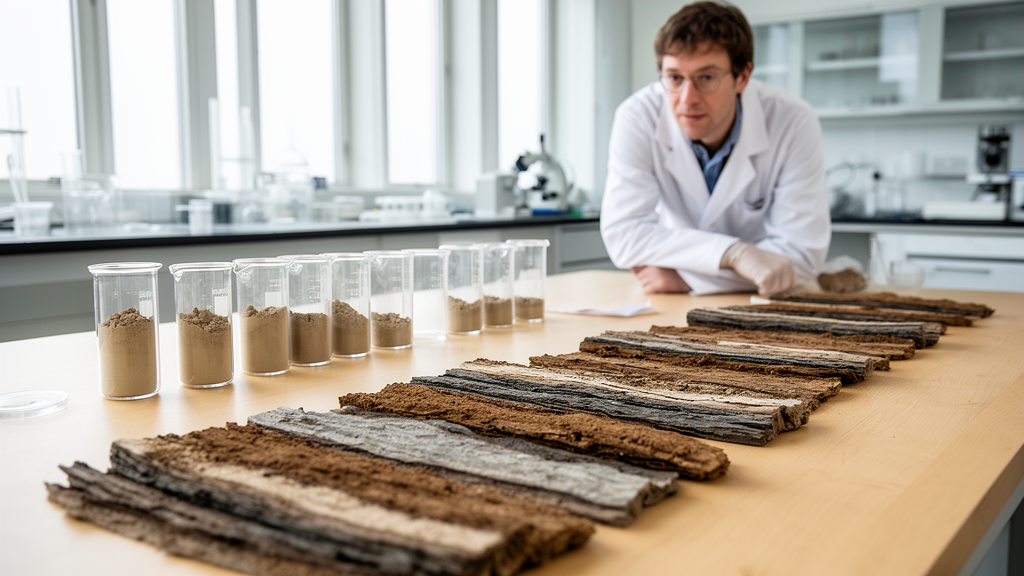
Geochemistry rarely makes headlines, yet the chemical fingerprints locked in rocks, rivers, and ancient soils are quietly reshaping how humanity confronts its most urgent problems, from climate change and battery supply chains to polluted urban waterways and the mysteries of early Buddhist worship. That breadth is on vivid display in a special collection marking the first anniversary of Frontiers in Geochemistry, a journal launched to give the field a dedicated home across five specialty sections: Biogeochemistry, Environmental Geochemistry, Mineral Geochemistry, Organic Geochemistry, and Solid Earth Geochemistry. The anniversary issue, assembled by editors Nadia Martínez-Villegas of IPICYT in Mexico, Jon Telling of Newcastle University, and Yiliang Li of the University of Hong Kong, gathers studies that span deep time and the present day, spanning karst rivers, lithium mine tailings, submarine volcanoes, and an archaeological site sacred to more than half a billion people.
The collection opens with a provocative rethinking of one of the planet’s most important carbon sinks. Shao and colleagues present a structured review of carbonate weathering in karst surface waters, the landscapes of dissolved limestone that underlie vast regions of the world. The traditional view holds that when rainwater dissolves carbonate rock, the resulting bicarbonate simply passes through rivers to the ocean. But the review emphasizes a critical biological twist: aquatic photosynthesis converts dissolved inorganic carbon into organic carbon produced within the water body itself, which can then be buried in sediments as a stable, long-term carbon sink. In other words, the humble algae and aquatic plants of karst rivers are partners in a geological sequestration machine.
Perhaps the most striking insight from that review is a historically underestimated factor: the limitation of aquatic primary production by carbon availability itself. Photosynthetic organisms in these waters can run short of dissolved carbon dioxide, capping how much organic carbon they can lock away. The authors therefore propose a nature-based intervention, adding dissolved CO2 to karst surface waters to fertilize aquatic photosynthesis. The benefits multiply beyond carbon. Enhanced photosynthesis also promotes the coprecipitation of soluble reactive phosphorus with calcium carbonate, pulling a key nutrient out of the water column. The result, the authors argue, is a dual win: carbon sequestration to mitigate atmospheric carbon levels and phosphorus removal to combat the eutrophication that chokes lakes and coastal seas with algal blooms.
From climate solutions the collection pivots to the raw materials of the energy transition. As demand for lithium-ion batteries soars, the extraction of lithium from granite-pegmatite deposits generates enormous volumes of mineral waste, and Karen Hudson-Edwards presents a timely review of the geochemistry and mineralogy of these tailings. Her analysis shows that the waste is far from worthless. It contains residual lithium, by-products such as quartz-feldspar sand suitable for ceramics and construction, and trace quantities of critical elements including rubidium, cesium, and beryllium. The review makes the case that mine tailings, typically treated as environmental liabilities, could be transformed into secondary resources, easing the pressure to open new mines even as the green economy accelerates.
That promise comes with cautionary notes. Hudson-Edwards underscores the importance of assessing the risks these wastes carry, particularly from uranium and thorium, which occur in pegmatite systems at generally low concentrations but are nonetheless radioactive. Responsible stewardship of the lithium supply chain, the review suggests, means characterizing tailings not only for what can be recovered but for what must be contained. It is a reminder that every stage of the clean energy economy leaves a geochemical signature, and that managing that signature well requires exactly the kind of rigorous mineralogical and geochemical assessment the anniversary collection champions.
Urban water chemistry takes center stage in a study by Smith and colleagues, who traced how surface water evolves as it flows from an agricultural landscape into an urban environment. By integrating analyses of major ions, nutrients, and stable water isotopes, the team disentangled the distinct chemical inputs that urban infrastructure imposes on a river. The water shifted decisively from a calcium carbonate type to a sodium chloride type, driven by subterranean stormwater outfalls delivering elevated concentrations of sodium, chloride, calcium, sulfate, and silica. The sources are as mundane as they are consequential: road de-icing salts, the weathering of concrete pipes, and treated municipal effluent all conspire to salt the river from below.
The study’s most alarming finding is clear evidence of emerging freshwater salinization syndrome, a growing concern for cities worldwide as rising salt concentrations degrade ecosystems, corrode infrastructure, and threaten drinking water supplies. Yet the urban signature does not simply overwrite the rural one. The river continues to transport higher concentrations of nitrate and phosphate from upstream agriculture, creating a complex downstream mixture of rural and urban geochemical fingerprints. By extending classical concepts of the geochemical evolution of natural waters to urban contexts, and by focusing on modification within an urban karst system, where underground conduits can rapidly channel contaminants, the work offers cities a conceptual framework for diagnosing and managing the chemical consequences of urbanization.
Innovation in geochemistry is also rewriting what is knowable about Earth’s deep and recent history alike. Sims and colleagues demonstrated a novel application of uranium-series disequilibria to date very young submarine volcanic rocks at unprecedented temporal resolution. Working on young oceanic basalts from an active hydrothermal vent field in the Lau Basin, the team measured short-lived isotopic ratios of lead-210 relative to radium-226 alongside longer-lived radium-226 to thorium-230 disequilibria. Excess lead-210 measurements yielded eruption ages on the order of decades, which model age calculations further refined: more than half of the sampled lava flows erupted within the past roughly 60 years, and some are likely only a few decades old.
The achievement matters because traditional radiometric methods simply cannot resolve ages this young in oceanic crust. The study provides the first high-resolution uranium-series chronology for an active mid-ocean ridge vent site and demonstrates the feasibility of dating recent oceanic crust on decadal scales, opening a window onto the pulses of volcanism that build the seafloor in near real time. Geochemical innovation reaches even further back in the companion study by Reay and colleagues, who carried organic geochemistry into archaeology to answer a question two and a half millennia old: which tree species were venerated at one of Buddhism’s most sacred sites? At Lumbini in Nepal, the birthplace of Buddha, an ancient temple complex preserves evidence of a tree shrine dating to the sixth century BCE. The team extracted and identified leaf wax lipids, specifically triterpenoid esters, preserved in the archaeological soils, then compared these molecular signatures with those of modern sacred trees. Chemical evidence for Ficus religiosa, the sacred fig, emerged within the oldest shrine levels and surrounding strata, confirming that the species occupied the central open space of the shrine and likely formed a grove at the site’s periphery.
Taken together, the studies gathered in the anniversary collection sketch a discipline expanding in every direction at once: toward nature-based climate solutions that exploit the chemistry of karst waters, toward circular economies that mine yesterday’s tailings for tomorrow’s batteries, toward cities learning to read the salt and nutrient signatures of their own rivers, toward decadal-scale dating of the volcanic seafloor, and toward a molecular archaeology that recovers the species ancient worshippers held sacred. What unites them is the conviction that chemical analysis, whether of isotopes, ions, or lipid biomarkers, can extract knowledge invisible to other instruments, bridging natural and social sciences and turning curiosity into societal benefit. As Frontiers in Geochemistry enters its second year, its editors express the hope that the community will find inspiration in these contributions, which reflect not only on the past and present chemistries of the planet but also issue an open invitation to the explorations still to come.
Subject of Research: The first anniversary Research Topic of Frontiers in Geochemistry, spanning carbon sequestration, lithium mining wastes, urban water chemistry, uranium-series dating, and archaeological biomarkers
Article Title: Editorial: Celebrating 1 year of Frontiers in geochemistry
Article References: Editorial: Celebrating 1 year of Frontiers in geochemistry. (n.d.). https://doi.org/10.3389/fgeoc.2025.1693318
Image Credits: AI Generated
DOI: 10.3389/fgeoc.2025.1693318
Keywords: geochemistry, carbon sequestration, karst, lithium mining, mine tailings, freshwater salinization, uranium-series dating, mid-ocean ridge, biomarkers, archaeology, Buddhism, eutrophication
Cite Scienmag News
Sloane Callahan. (October 16, 2026). One Year of Geochemistry: From Carbon Sinks to Buddha’s Sacred Tree. Scienmag. https://scienmag.com/one-year-of-geochemistry-from-carbon-sinks-to-buddhas-sacred-tree/
Sloane Callahan. "One Year of Geochemistry: From Carbon Sinks to Buddha’s Sacred Tree." Scienmag, 16 October 2026, https://scienmag.com/one-year-of-geochemistry-from-carbon-sinks-to-buddhas-sacred-tree/. Accessed 16 October 2026.
Sloane Callahan. "One Year of Geochemistry: From Carbon Sinks to Buddha’s Sacred Tree." Scienmag. October 16, 2026. https://scienmag.com/one-year-of-geochemistry-from-carbon-sinks-to-buddhas-sacred-tree/


