


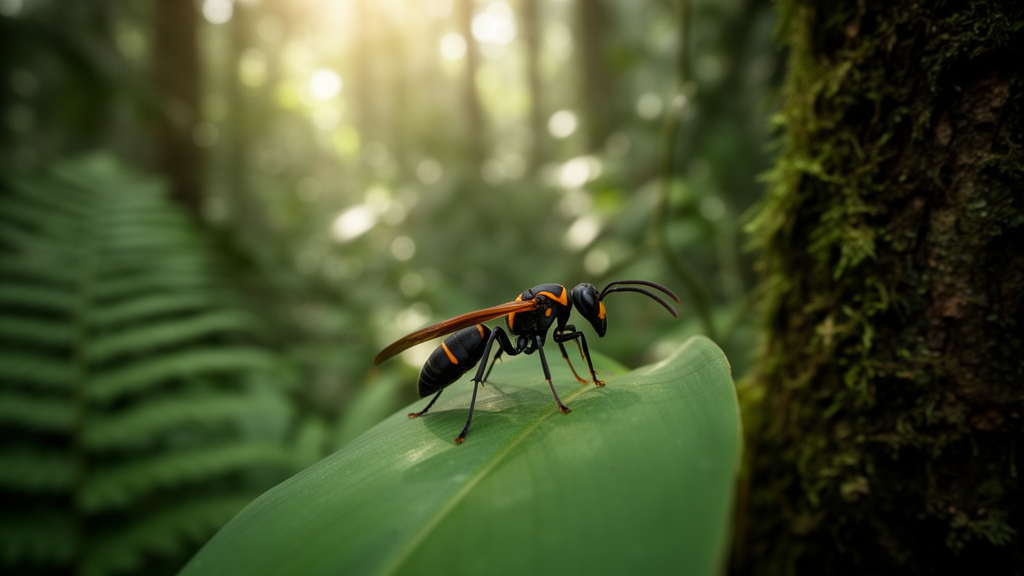
Deep in the mountain forests of northern Thailand, a slender black wasp with an orange abdomen and an ovipositor longer than its own body has been quietly drilling into wood, hunting for the beetle larvae that will feed its offspring. Scientists have now given this insect a name — Pristaulacus chiangmaiensis — and in doing so have opened a window onto one of the least-studied lineages of parasitoid wasps on Earth. The new species is the centerpiece of an integrative taxonomic review of the genus Pristaulacus in Thailand, published in the Journal of Hymenoptera Research, which also adds a newly recorded species to the country’s fauna and delivers the first-ever DNA barcode-based phylogenetic analysis of any group within the family Aulacidae.
Aulacids are among the most strikingly built wasps in the insect world. They belong to the superfamily Evanioidea and are instantly recognizable by a combination of odd proportions: a rounded, almost ball-like head; a heavily sculptured middle body section; and a laterally flattened abdomen that attaches bizarrely high on a pyramid-shaped propodeum, perched above the attachment point of the hind legs. Females wield long, sword-like ovipositors used to reach wood-boring larvae of longhorn beetles, jewel beetles, and wood wasps buried deep inside their host plants. These wasps are koinobiont endoparasitoids, meaning the female lays her egg inside a living host larva and the parasite develops alongside it before eventually killing it — a life strategy that makes them potentially valuable natural enemies of forestry pests, even though tropical host records remain frustratingly sparse.
Globally, the family Aulacidae comprises just 318 described species split between two genera, Aulacus with 111 species and Pristaulacus with 207, and researchers estimate the true total may approach 500. Both genera occur on every continent except Antarctica, although Aulacus is absent from the Afrotropics. Diversity peaks in the tropics, and the Oriental region — stretching from India through Southeast Asia — harbors a remarkably rich fauna that has only recently begun to receive serious attention. With the new study, the number of described Oriental Pristaulacus species climbs to 75, while the count for Thailand alone rises to 17 species of Pristaulacus plus a single species of Aulacus.
The new species, named after its type locality of Chiang Mai, was described from a female holotype collected in Huai Nam Dang National Park in 2008 using a pan trap, and a paratype captured in 2023 in a Malaise trap at 1,341 meters in Doi Phu Kha National Park, Nan Province. Measuring just 12 millimeters long, the wasp is mostly black with a yellowish-orange clypeus and first antennal segment, almost entirely orange legs, and a metasoma that glows orange except for a narrow black band running along the top. Its body carries a distinctive suite of morphological fingerprints: a head 1.2 times wider than long, a U-shaped median groove on the occipital margin, a single sharp tooth-like process on the lower margin of the pronotum, hind tarsal claws bearing four tooth-like processes, and an extremely elongate, slender petiole 4.8 times longer than wide.
What makes the description particularly robust is the integrative approach that underpins it. The researchers combined detailed morphology — examined under stereomicroscopes and photographed with multi-focus montage systems — with DNA barcoding of the mitochondrial COI gene. The paratype’s barcode differed by 12.95 percent from the closest Aulacidae sequence in the Barcode of Life Data System, which belonged to Pristaulacus vilhelmseni, and the team’s own genetic distance analysis confirmed a 14.3 percent divergence between the two species. Such large mitochondrial distances typically signal genuinely distinct lineages rather than mere population variation, and the molecular evidence meshed cleanly with the morphological diagnosis.
The phylogenetic component of the study is a genuine first. No molecular phylogenetic analysis of the family Aulacidae had ever been attempted before; all previous family-level work relied on morphology alone or addressed higher-level relationships within Evanioidea. The researchers assembled COI sequences of roughly 629 base pairs from 17 Pristaulacus specimens, drawing on both newly generated data — with GenBank accession numbers PX526003 to PX526010 — and published records from BOLD and GenBank. DNA was extracted from hind legs removed from both alcohol-preserved and dry-mounted specimens, amplified with standard LepF1 and LepR1 primers, and analyzed under a maximum likelihood framework in IQ-TREE with a million ultrafast bootstrap replicates and partitioned substitution models for the three codon positions.
The results revealed that all 12 morphologically recognized Pristaulacus species in the dataset are genetically very distinct, with the overall mean pairwise genetic distance reaching approximately 21 percent under the Kimura 2-parameter model. Some pairwise comparisons were enormous: the highest interspecific distance, 33.08 percent, separated the Nearctic species P. rufitarsis from the widespread Palaearctic P. gloriator. At the other end, the lowest interspecific distance, 13.14 percent, linked P. vilhelmseni from Thailand with P. intermedius from China. The new species P. chiangmaiensis grouped near P. vilhelmseni and P. intermedius, although the support for this trio of relationships was weak, and the authors caution that deeper branching patterns in a single-gene tree with limited sampling should not be over-interpreted.
The study also cleared up biogeographic mysteries hidden in museum drawers and national park traps. One Thai specimen of P. vilhelmseni, swept from vegetation in Doi Inthanon National Park in 2019, represents the first record of this species in Thailand, extending its known range from Laos. Meanwhile, P. erythrocephalus — a large, red-headed species up to 22 millimeters long — was confirmed from the southern provinces of Songkhla and Trang, part of a distribution that spans Indonesia, Malaysia, and the Philippines. Species identities were not always straightforward: one sequence labeled as the North American P. strangaliae showed a suspicious 7.9 percent divergence from Canadian specimens, well above normal intraspecific levels, and the phylogenetic analysis suggests the U.S. specimen is most likely a misidentification that may represent a separate, closely related species.
To make this diversity navigable, the authors organized the Thai Pristaulacus fauna into three species-groups. The dominant P. comptipennis group, with ten species including the new species, is endemic to eastern and southeastern Asia and is diagnosed by a deeply notched occipital margin. The P. rufipes group, marked by a straight or weakly concave hind head margin, includes two Thai species, while the orange-and-black P. flavipennis group accounts for two more, including P. erythrocephalus. The group placement of four remaining species remains uncertain pending a full revision of the Oriental fauna. An illustrated identification key, an updated Oriental checklist with full type and repository details, and a comprehensive distribution map of all Thai species now give the next generation of taxonomists the tools they need to build on this foundation.
Yet the study also underscores how much remains unknown. Host records are missing for every Thai species in the genus, leaving the ecology of these parasitoids in tropical forests essentially blank. Molecular data exist for only a small fraction of the world’s 318 aulacid species — just 90 sequences corresponding to 31 barcode index numbers were available in BOLD as of August 2025, and only a handful of Sequence Read Archive records exist for the entire family. The authors argue that expanding gene sampling, extracting DNA from nearly all described species, and gathering biological and host data would be needed to build a truly robust phylogeny. For now, the discovery of P. chiangmaiensis in two protected Thai national parks stands as vivid evidence that even iconic, dragonfly-sized parasitoid wasps can evade science for centuries in the canopy-rich forests of Southeast Asia — and that many more are still waiting.
Subject of Research: Integrative taxonomy and DNA barcoding of Pristaulacus aulacid wasps in Thailand
Article Title: Expanding knowledge of Oriental Aulacidae ( Hymenoptera , Evanioidea ): An integrative taxonomic approach of the genus Pristaulacus Kieffer from Thailand, with a new record and description of a new species
Article References: Expanding knowledge of Oriental Aulacidae ( Hymenoptera , Evanioidea ): An integrative taxonomic approach of the genus Pristaulacus Kieffer from Thailand, with a new record and description of a new species. (n.d.). https://doi.org/10.3897/jhr.99.174973
Image Credits: AI Generated
Keywords: Aulacidae, Pristaulacus, Thailand, new species, DNA barcoding, Hymenoptera, parasitoid wasps, taxonomy, phylogenetics, COI gene, Oriental region, biodiversity
Cite Scienmag News
Juliet Wilcox. (October 16, 2026). DNA Barcodes and a New Species Reveal Thailand’s Hidden Aulacid Wasps. Scienmag. https://scienmag.com/dna-barcodes-and-a-new-species-reveal-thailands-hidden-aulacid-wasps/
Juliet Wilcox. "DNA Barcodes and a New Species Reveal Thailand’s Hidden Aulacid Wasps." Scienmag, 16 October 2026, https://scienmag.com/dna-barcodes-and-a-new-species-reveal-thailands-hidden-aulacid-wasps/. Accessed 16 October 2026.
Juliet Wilcox. "DNA Barcodes and a New Species Reveal Thailand’s Hidden Aulacid Wasps." Scienmag. October 16, 2026. https://scienmag.com/dna-barcodes-and-a-new-species-reveal-thailands-hidden-aulacid-wasps/


