


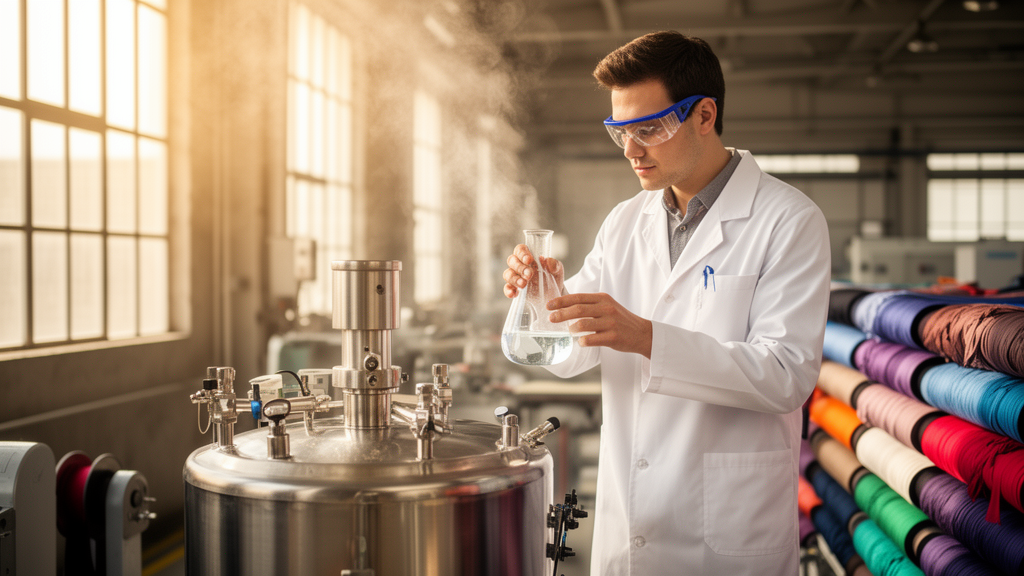
The textile industry has a dirty secret that few consumers ever see. Behind every t-shirt and pair of jeans lies a wet-processing chain of desizing, scouring, bleaching, dyeing, printing, washing and finishing that consumes staggering quantities of water, energy and chemicals. The global textile sector uses around 79 billion cubic metres of freshwater annually, placing it among the leading industrial consumers of water, while dyeing and finishing operations are estimated to be responsible for over 20% of the world’s industrial wastewater pollution. The textile and garment business accounts for roughly 8% to 10% of global carbon emissions, and textile production involves more than 8,000 commercial chemicals, from alkalis and oxidizing agents to surfactants, flame retardants and synthetic dyes. A new review published in Frontiers in Environmental Engineering argues that catalysis, a technology better known from oil refineries and car exhausts, could transform this resource-intensive industry from the inside out.
The review, led by Sheetal Kumari of the Harbin Institute of Technology Shenzhen together with Jyoti Chowdhry of Maharshi Dayanand University, takes an unusually holistic view. While previous evaluations have concentrated almost exclusively on catalytic dye degradation or the remediation of textile wastewater, the authors assess catalytic technologies along the entire textile value chain, from pretreatment and dyeing to finishing, wastewater treatment, catalyst regeneration and recyclable catalytic systems. Their central argument is that catalysts, which accelerate chemical reactions without being consumed, allow reactions to occur under far less severe conditions, meaning lower chemical consumption, lower energy demand and faster processing times. In an industry where wet processing traditionally demands highly concentrated sodium hydroxide, temperatures above 100 degrees Celsius and multiple energy-hungry washing steps, that shift in reaction conditions is nothing short of revolutionary.
The technical logic is elegant. By lowering the activation energy of a reaction, a catalyst lets chemistry happen at 30 to 70 degrees Celsius instead of 95 to 100, at near-neutral pH instead of pH 11 to 13, and under atmospheric pressure instead of harsh alkaline boiling. The review catalogues three main catalyst families used in textiles: biocatalysts such as enzymes, homogeneous catalysts such as the classic Fenton reagent, and heterogeneous solid catalysts that can be separated from the reaction medium and reused. Each family attacks a different stage of the production line, and the quantitative performance data the authors compile suggest the savings are real, not aspirational.
Consider pretreatment, the critical first stage that cleanses natural impurities from raw fibers before dyeing. Conventional desizing, scouring and bleaching rely on concentrated sodium hydroxide, hydrogen peroxide and synthetic stabilizers at temperatures of 95 to 100 degrees Celsius, producing wastewater with high chemical oxygen demand and potentially damaging cellulose fibers. The catalytic alternative is enzymatic. Amylases selectively break down the alpha-(1→4) glycosidic linkages of starch sizing agents into water-soluble sugars like maltose, without touching the cellulose structure of the cotton. Pectinases and cutinases remove pectins and waxy cuticles through beta-elimination reactions at around 50 degrees Celsius, achieving absorbency and wettability comparable to conventional alkaline scouring but with lower fabric weight loss and better softness. For bleaching, a manganese complex known as MnTACN activates hydrogen peroxide at temperatures as low as 30 degrees Celsius, producing fabrics as white as conventional high-temperature bleaching at a fraction of the energy cost. Research cited in the review suggests that cold bleaching and enzymatic polishing can raise the tear strengths of warp and weft by about 14% and 28% respectively over conventional bleaching, improvements that translate directly into fabric durability.
The numbers get more striking when processes are integrated. A UVC-assisted photocatalytic pretreatment combining desizing and scouring achieved 72% energy savings, 71% water savings and a 79% reduction in processing time compared with the conventional route. An enzyme-assisted one-bath process combining amyloglucosidase, glucose oxidase and catalase generated hydrogen peroxide in situ at concentrations of 765 milligrams per litre, sufficient for efficient bleaching without any external peroxide addition, while achieving a whiteness index of 71 with dye yield comparable to conventional processing. A bio-based peroxide activation system using sucrose octaacetate delivered a whiteness index of approximately 80.6 with less than 5% mechanical loss, alongside 35.5% energy savings and 36.4% water savings. Biocatalytic pretreatment has been shown to reduce chemical oxygen demand in textile wastewater by approximately 38.3% compared with conventional methods, and integrated one-bath systems that combine desizing, bleaching and dyeing eliminate several intermediate washing steps altogether.
Dyeing, the most polluting stage of the chain, is where catalysis may deliver its biggest environmental payoff. Reactive dyes for cotton traditionally require enormous quantities of electrolytes, up to 100 grams per litre of sodium chloride or sodium sulfate, to overcome the electrostatic repulsion between negatively charged dye molecules and cellulose fibers. Despite these additions, fixation rates remain suboptimal, releasing highly pigmented, salt-rich effluent that is difficult and costly to treat. Catalytic dyeing offers alternative mechanisms. In micellar catalysis, surfactant molecules spontaneously form micelles that encapsulate dye molecules and carry them closer to the fiber surface, raising the local dye concentration and boosting fixation efficiency while significantly cutting water and salt use. Plasma-assisted catalytic dyeing adds a dry, chemical-free surface modification that introduces polar functional groups and increases surface roughness, improving wettability and providing more active sites for dye adsorption. The result is darker tints, improved fastness to washing and greater dye utilization with less dye and catalyst. Enzyme-assisted dyeing goes further still: laccases from fungal species such as Pleurotus, Trametes and Cerrena oxidize compounds like gallic acid, producing colored polymers that form directly on the fiber surface, imparting gray tones on wool and silk without any synthetic dye, along with ultraviolet protection, antioxidant activity and deodorizing properties.
Wastewater treatment, the traditional stronghold of textile catalysis, has also advanced considerably. Advanced oxidation processes generate highly reactive radicals, primarily hydroxyl radicals with an oxidation potential of 2.80 volts and sulfate radicals, that rapidly oxidize complex aromatic dye molecules into less hazardous products and ultimately carbon dioxide and water. The classical Fenton process, which reacts ferrous ions with hydrogen peroxide under acidic conditions, achieves significant reductions in BOD5, COD and turbidity and enables complete decolorization of textile effluents. Heterogeneous versions solve the catalyst recovery problem: a Cu-Fe bimetallic grafted polytetrafluoroethylene fiber complex enabled reuse of treated dyeing effluents for subsequent dyeing cycles, while a heterogeneous photo-Fenton system with iron powder retained good performance for numerous batches and achieved complete decolorization for over 20 cycles with much reduced release of iron ions. A Fe3O4-coated granular activated carbon electrode for heterogeneous electro-Fenton achieved 98.97% dye removal and 66.66% COD removal, maintaining 98.56% of its initial efficiency after six reuse cycles. Photocatalysis adds a light-driven dimension: TiO2-coated fabrics degraded about 96% of methyl orange in only 3 hours of UV exposure, and TiO2/Ag/ZnO heterojunction systems reached about 93% degradation of methyl red under visible light, thanks to silver nanoparticles acting as electron sinks through the Schottky barrier effect.
Perhaps the most forward-looking section of the review concerns circular catalytic systems, which aim to move the textile industry from a linear take-make-dispose model toward a regenerative, resource-efficient one. Catalyst deactivation through surface fouling, poisoning, particle aggregation, active site blocking and metal leaching has long limited practical viability, so the authors evaluate regeneration strategies from thermal calcination at 400 to 800 degrees Celsius to milder chemical, electrochemical and photo-regeneration approaches. Magnetic catalysts are a standout: Fe3O4-coated granular activated carbon can be recovered rapidly by an external magnetic field, eliminating filtration entirely. Immobilized enzymes show equally impressive longevity, with laccase immobilized on Fe3O4@SiO2 nanoparticles exhibiting 109.7% activity recovery after ten reuse cycles in photothermal degradation of textile dyes, and laccase immobilized on magnetic metal-organic frameworks efficiently decolorizing Reactive Black 5 and Alizarin Red S for five regeneration cycles. Life cycle assessment suggests that regenerating old catalysts often has a lower environmental impact than manufacturing new ones, and techno-economic analysis shows regeneration is usually cheaper than full replacement, though the authors caution that a holistic framework considering cumulative energy consumption, greenhouse gas emissions and overall catalytic lifetime is needed to find the optimal replacement point.
The review is candid about the barriers between laboratory promise and industrial reality. Catalyst manufacturing costs, long-term stability and replacement frequency, reactor design, regulatory compliance and process integration must all be addressed through techno-economic assessments before widespread commercialization. Enzymatic systems offer excellent selectivity under mild conditions but can be limited by stability and reusability compared with inorganic catalysts, while nanocatalysts raise concerns about synthesis cost and nanoparticle recovery. Looking ahead, the authors point to visible-light-responsive photocatalysts, multifunctional catalytic systems, green synthesis approaches using renewable materials, and emerging tools such as artificial intelligence, machine learning and high-throughput computational screening to accelerate catalyst development. Pilot-scale demonstrations, continuous-flow catalytic reactors, life cycle assessment and integration within circular textile manufacturing will be essential to bridge the gap between laboratory research and industrial implementation. If those challenges are met, catalysis could quietly do for fashion what it did for fuels: make an enormous, polluting industry dramatically cleaner, one reaction at a time.
Subject of Research: Catalysis could clean up fashion's dirtiest secret
Article Title: Catalytic strategies for sustainable and efficient textile processing: a review
Article References: Kumari, S., & Chowdhry, J. (2026). Catalytic strategies for sustainable and efficient textile processing: a review. Frontiers in Environmental Engineering, 5, Article 1945148. https://doi.org/10.3389/fenve.2026.1945148
Image Credits: AI Generated
DOI: 10.3389/fenve.2026.1945148
Keywords: catalysis, textile industry, sustainable manufacturing, enzymes, photocatalysis, advanced oxidation processes, wastewater treatment, circular economy, Catalytic, strategies, sustainable, efficient
Cite Scienmag News
Bethany Barker. (October 16, 2026). Catalysis could clean up fashion’s dirtiest secret. Scienmag. https://scienmag.com/catalysis-could-clean-up-fashions-dirtiest-secret/
Bethany Barker. "Catalysis could clean up fashion’s dirtiest secret." Scienmag, 16 October 2026, https://scienmag.com/catalysis-could-clean-up-fashions-dirtiest-secret/. Accessed 16 October 2026.
Bethany Barker. "Catalysis could clean up fashion’s dirtiest secret." Scienmag. October 16, 2026. https://scienmag.com/catalysis-could-clean-up-fashions-dirtiest-secret/


