


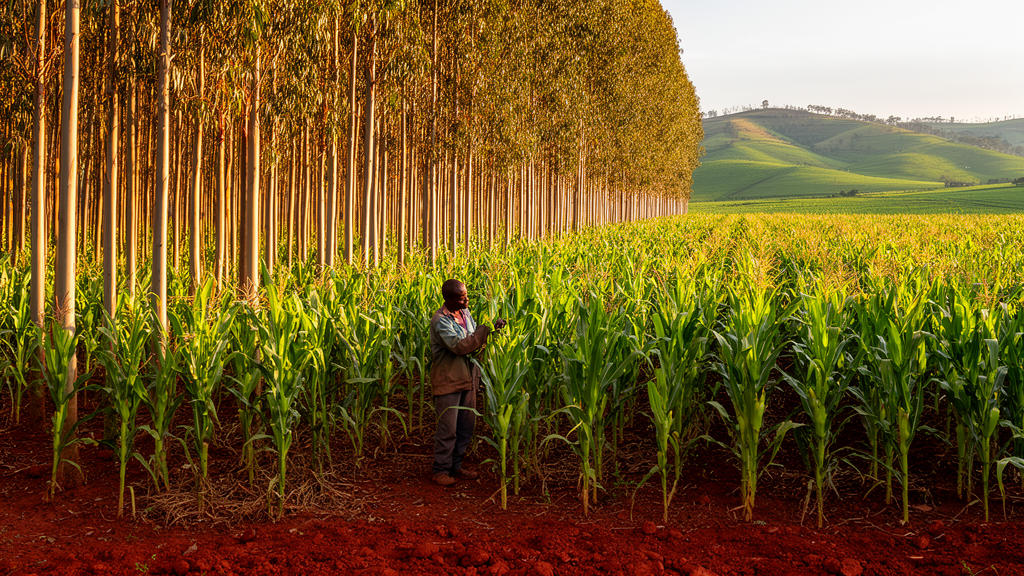
In the green highlands of southwest Ethiopia, farmers have long planted rows of Eucalyptus trees along the edges of their maize fields, hoping to harvest both timber and food from the same plot of land. A new three-year field experiment in the Kaffa Zone suggests that this gamble can pay off, but only if farmers choose the right tree species and give their crops enough room to breathe.
Researchers from Ethiopia set up their trial in Decha district, an area where eucalyptus-based agroforestry is widespread and maize is the dominant food and cash crop. The team planted four Eucalyptus species—river red gum (Eucalyptus camaldulensis), lemon-scented gum (Eucalyptus citriodora), flooded gum (Eucalyptus grandis), and Sydney blue gum (Eucalyptus saligna)—in hedgerows with 10-meter-wide alleys, then intercropped maize between the rows. A control treatment of sole maize mono-cropping allowed the scientists to measure exactly how much yield the trees cost, and how much they might contribute.
The results, published in the journal BioRisk, reveal a striking pattern that unfolded over three consecutive cropping seasons. In the first year, when the trees were still young, maize grain yield did not differ significantly among treatments, and plots under Eucalyptus camaldulensis hedgerows actually showed a yield advantage over mono-cropping. But as the trees grew taller and their canopies expanded, competition intensified. By the second and third seasons, grain yield differences became statistically significant, and maize grown under Eucalyptus hedgerows consistently declined compared with sole cropping.
The severity of that decline depended heavily on which species shaded the alleys. Eucalyptus saligna proved the most aggressive competitor, reducing maize grain yield by 49 percent in the second season and a dramatic 72 percent in the third season relative to mono-cropping. Eucalyptus grandis followed closely, cutting yields by 30.5 percent and then 57 percent across the same period. In contrast, Eucalyptus camaldulensis showed no significant effect on grain or biomass yield in any season, making it by far the most compatible companion for maize intercropping among the four species tested.
The explanation lies in the trees’ own growth performance. Measurements of diameter at breast height and tree height showed that Eucalyptus saligna and Eucalyptus grandis grew significantly faster than the other two species, reaching mean annual diameter increments of 3.48 and 3.44 centimeters and height increments of 3.78 and 3.65 meters respectively. Eucalyptus camaldulensis and Eucalyptus citriodora grew more slowly, with correspondingly gentler impacts on the crops below. The study also found that tree basal area—a simple measure of stand competitiveness—was negatively correlated with maize grain yield, confirming that as the trees thickened, the crops thinned.
Soil moisture measurements near the hedgerows added another layer of nuance. The four Eucalyptus species showed no significant effect on soil moisture content, though relatively higher soil moisture was consistently observed under Eucalyptus camaldulensis over three consecutive years. This finding challenges the widespread belief that eucalyptus trees inevitably dry out surrounding soils, and suggests that water competition may not be the primary driver of yield decline in this system. Instead, shading and above-ground competition for light likely played a larger role as canopies closed.
In a separate pot experiment at the Bonga Agricultural Research Center, the team tested the allelopathic potential of eucalyptus leaf extracts on maize germination and seedling growth. Contrary to expectations, the aqueous extracts of all four species stimulated seed germination, increasing germination percentages by 18 to 39 percent compared with water-only controls. Shoot length and shoot fresh weight also responded positively. However, the extracts of Eucalyptus camaldulensis, Eucalyptus grandis, and Eucalyptus saligna inhibited root length growth, while Eucalyptus saligna and Eucalyptus grandis reduced root fresh weight. These results suggest that allelochemicals from eucalyptus litter may affect below-ground processes differently than above-ground growth, and that low concentrations of certain compounds may even act as plant growth regulators.
The practical implications for smallholder farmers are significant. The study concludes that farmers practicing maize intercropping with Eucalyptus camaldulensis in a hedgerow arrangement with sufficient spacing—around 8 meters between hedgerows—can potentially obtain both wood and food from the same unit of land. For those prioritizing timber production over maize yields, Eucalyptus saligna and Eucalyptus grandis remain viable options, provided that appropriate management practices minimize above- and below-ground competition. After the third year of cropping, however, maize intercropping became impossible under all four species due to canopy closure, meaning the window for profitable intercropping is limited to the early growth phase of the trees.
The findings contribute to a broader scientific debate about the role of Eucalyptus in tropical agroforestry. Previous studies have reported everything from severe nutrient depletion and yield losses to neutral or even beneficial effects, depending on species, climate, soil type, and management. This study adds site-specific evidence from the Ethiopian highlands, showing that the impact of eucalyptus on crops is neither uniformly harmful nor harmless, but rather depends on tree age, size, and species identity. As eucalyptus plantings continue to expand across southern and southwestern Ethiopia, such evidence will be crucial for designing agroforestry systems that balance the livelihood needs of farmers with the ecological realities of tree-crop competition.
Subject of Research: Agroforestry
Article Title: Growth and yield of maize in Eucalyptus tree alley cropping agroforestry practice in Kafa Zone, Ethiopia
Article References: Growth and yield of maize in Eucalyptus tree alley cropping agroforestry practice in Kafa Zone, Ethiopia. (n.d.). https://doi.org/10.3897/biorisk.24.183097
Image Credits: AI Generated
DOI: 10.3897/biorisk.24.183097
Keywords: agroforestry, Eucalyptus, maize, Ethiopia, alley cropping, crop yield, tree-crop competition, Growth, yield, tree, alley, cropping
Cite Scienmag News
Alan Morgan. (October 16, 2026). Eucalyptus hedgerows test maize yields in Ethiopia. Scienmag. https://scienmag.com/eucalyptus-hedgerows-test-maize-yields-in-ethiopia/
Alan Morgan. "Eucalyptus hedgerows test maize yields in Ethiopia." Scienmag, 16 October 2026, https://scienmag.com/eucalyptus-hedgerows-test-maize-yields-in-ethiopia/. Accessed 16 October 2026.
Alan Morgan. "Eucalyptus hedgerows test maize yields in Ethiopia." Scienmag. October 16, 2026. https://scienmag.com/eucalyptus-hedgerows-test-maize-yields-in-ethiopia/


