


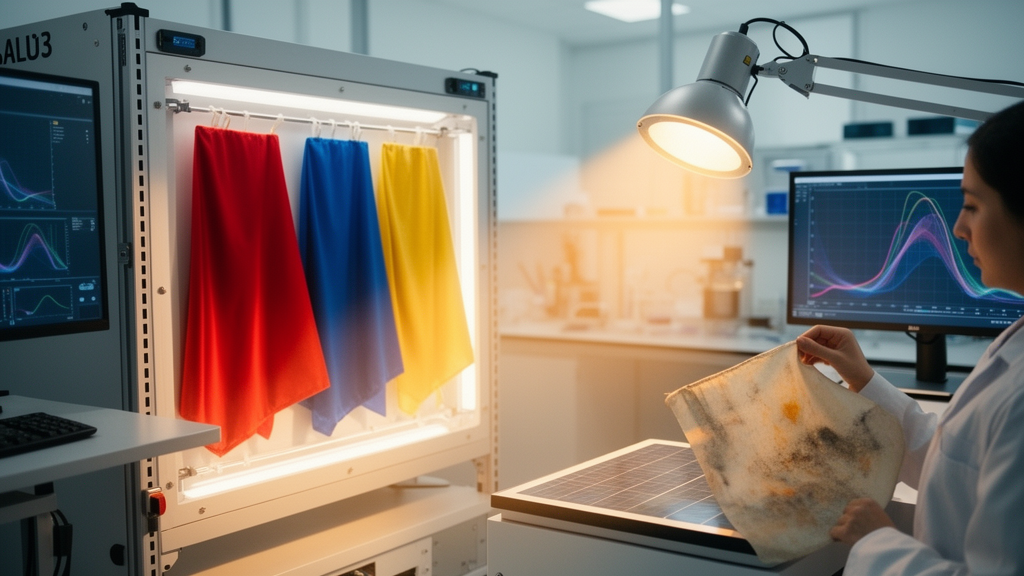
Every dyed fabric tells a story of slow defeat. Sunlight, moisture, and heat conspire to break the chemical bonds that give textiles their color, and the industry’s standard measure of that defeat — lightfastness — has long been determined the hard way: swatches are exposed to artificial light for hours or days, then compared against fading scales by trained eyes. Now a research team at Jeju National University in South Korea has shown that machine learning can predict lightfastness with near-perfect accuracy, provided the AI is smart enough to choose its own strategy depending on how similar its training data is to the material at hand.
The new framework, called AMS-LPP, is described in the Journal of Big Data by Murad Ali Khan, Muhammad Faseeh, Syed Shehryar Ali Naqvi, and Do-Hyeun Kim. Its central insight is deceptively simple: no single machine learning approach works best across all situations. When a new prediction task closely resembles previous ones, a pretrained model can be fine-tuned efficiently. When the task is genuinely different, starting fresh with automated machine learning (AutoML) generalizes better. AMS-LPP makes that choice dynamically, using a statistical measure of similarity between datasets to decide which path to take.
The similarity gauge is the Mahalanobis distance, a metric that accounts for correlations between features when measuring how far one dataset’s statistical distribution lies from another’s. When the distance is small — meaning the new material’s data looks statistically like data the model has already seen — AMS-LPP fine-tunes a pretrained TabNet model, a deep learning architecture designed for tabular data, using Bayesian hyperparameter optimization to squeeze out the best settings. When the distance is large, the framework abandons transfer learning and invokes AutoML pipelines instead, letting automated search build a model from scratch that is robust to the domain shift.
The results are striking. Under high and moderate similarity, transfer learning achieved a coefficient of determination (R²) above 0.99 while cutting training time by up to 35 percent compared with training from scratch. Under low similarity, AutoML took the crown, reaching R² = 0.998 — an almost perfect fit — on the most dissimilar domains. In practical terms, this means the framework adapts its approach the way an experienced human modeler would, but does so automatically and consistently.
Lightfastness prediction is a genuinely hard problem for machine learning. The property depends on complex interactions between dye chemistry, fiber structure, and optical characteristics, and datasets collected across different laboratories, material types, and measurement conditions are riddled with domain shifts — statistical discrepancies that degrade models trained on one set when applied to another. Conventional experimental determination remains costly and slow, and naive machine learning alternatives often collapse when confronted with heterogeneous data.
Transfer learning alone has a well-known weakness: it helps only when source and target domains are similar. AutoML, by contrast, ignores inter-domain relationships entirely, rebuilding models from zero each time. Neither approach alone adapts to varying domain similarity. AMS-LPP resolves this tension by quantifying similarity first and switching strategies second, ensuring that the efficiency of transfer learning is harvested when it is safe to do so and that the generalization strength of AutoML is deployed when it is not.
Crucially, the team did not treat the models as black boxes. Using SHAP (SHapley Additive exPlanations) analysis, they showed that the predictions are driven by physically meaningful optical and color-related features — the very properties that govern how fabrics fade in real life. This explainability matters for scientific acceptance: a model that predicts lightfastness for reasons that align with the physics of photochemical fading is far more trustworthy than one whose reasoning is opaque.
The implications reach beyond textiles. The framework’s architecture — measure domain similarity, then choose between fine-tuning and from-scratch automated modeling — is a general pattern for any materials informatics problem where data arrives from heterogeneous sources. Accurate property prediction can accelerate materials discovery, and the authors argue that AMS-LPP offers a scalable, efficient, and interpretable solution for similarity-aware model selection in material property prediction broadly.
The work was supported by the National Research Foundation of Korea and the Korea Institute of Energy Technology Evaluation and Planning. As datasets in materials science continue to grow and fragment across laboratories and material classes, frameworks that can automatically judge when to reuse knowledge and when to start fresh may become as essential to materials discovery as the experiments they are designed to replace.
Lightfastness itself is a standardized property in textile science, typically graded on blue wool scales or gray scales after controlled exposure to artificial light sources in weathering chambers. Because the grading process is inherently comparative and partly subjective, it has historically resisted automation, and the variability introduced by different dye classes, fiber chemistries, and finishing treatments makes any single predictive model fragile. The Jeju National University team’s decision to frame the problem as a multi-domain challenge, rather than a single regression task, reflects this underlying heterogeneity of real-world textile data.
The choice of TabNet as the transfer learning backbone is notable in this context. Unlike conventional deep networks designed for images or sequences, TabNet uses sequential attention to select which features to reason about at each decision step, making it well suited to the tabular measurement data that dominates materials informatics. Feature selection of this kind also pairs naturally with the SHAP analysis reported in the study, since both approaches operate on the level of individual input features, allowing the researchers to verify that the same optical and color-related variables the model exploits are the ones chemists would expect to govern fading behavior.
The Mahalanobis distance plays a similarly principled role. Unlike simpler metrics such as Euclidean distance, it rescales each feature by its variance and accounts for correlations among features, so a dataset that differs only along a well-characterized, low-variance direction can still register as distant. In domain adaptation settings this matters because what looks like a small shift in raw feature space may in fact represent a substantial change in the underlying data-generating process. By gating the transfer learning decision on this measure, AMS-LPP encodes a rule of thumb that experienced practitioners follow informally — reuse knowledge only when the new problem genuinely resembles the old one — into an explicit, reproducible criterion.
The Bayesian hyperparameter optimization component also deserves attention. Fine-tuning a pretrained network involves choices about learning rates, layer freezing, and regularization that interact in non-obvious ways, and grid or random search can waste considerable compute exploring poor regions of the configuration space. Sequential model-based optimization, the family of techniques behind Bayesian HPO, builds a probabilistic surrogate of the performance landscape and samples promising configurations preferentially, which is one reason the reported 35 percent reduction in training time under high and moderate similarity is plausible rather than optimistic.
The evaluation metrics reported in the study — R² alongside mean absolute error, mean squared error, root mean squared error, and mean absolute percentage error — provide complementary views of model behavior. R² captures the proportion of variance explained but can mask systematic biases at particular ranges of the lightfastness scale, while the error metrics reveal the magnitude of typical mistakes in units that matter for practical grading decisions. Reporting the full suite suggests the authors were attentive to the possibility that a near-perfect R² could coexist with meaningful errors in specific prediction regimes.
The funding context, including support from the National Research Foundation of Korea and the Korea Institute of Energy Technology Evaluation and Planning, situates the work within a broader Korean research push into energy and industrial applications of artificial intelligence. Textile manufacturing remains a significant industry in the region, and property prediction tools that reduce the need for physical weathering trials could shorten development cycles for dyed and finished fabrics considerably.
Methodologically, the study sits within the emerging field of materials informatics, which applies data-driven techniques to accelerate the discovery and optimization of materials. A recurring lesson in this field is that the bottleneck is often not model capacity but data logistics: datasets arrive from different instruments, laboratories, and material systems, each with its own biases and measurement conventions. Frameworks that explicitly model these domain relationships, rather than assuming data are drawn from a single distribution, address a central pain point. The adaptive selection strategy demonstrated here — switching between transfer learning and AutoML based on quantified similarity — offers a template that could be applied to other properties where heterogeneous data are the norm, from corrosion resistance to thermal stability.
The explainability findings carry particular weight for industrial adoption. Regulatory and quality-control environments in textiles often require that decisions be auditable, and a model whose feature attributions align with known photochemistry — the roles of dye chromophores, fiber morphology, and optical scattering in fading — can be more readily integrated into existing certification workflows than an opaque predictor, however accurate. The alignment between SHAP-derived feature importance and physically meaningful optical and color-related variables suggests the models learned genuine structure rather than dataset artifacts, which is precisely the kind of evidence needed to trust predictions on materials not represented in the training data.
Looking forward, the framework’s reliance on a distance threshold to trigger the switch between strategies raises questions the authors’ results begin to answer but that future work could refine: how the threshold should be calibrated across different material families, how the approach behaves with very small target datasets, and whether the same similarity measure remains informative as feature representations evolve. The study was received in April 2025 and accepted in September 2026, and it is published open access under a Creative Commons Attribution 4.0 license, making the full methodological detail available to practitioners who wish to adapt the approach to their own property prediction problems.
Subject of Research: AMS-LPP: adaptive model selection for lightfastness property prediction in textile materials using similarity-guided transfer learning and AutoML
Article Title: AMS-LPP: adaptive model selection for lightfastness property prediction in textile materials using similarity-guided transfer learning and AutoML
Article References: Khan, M. A., Faseeh, M., Naqvi, S. S. A., & Kim, D.-H. (2026). AMS-LPP: adaptive model selection for lightfastness property prediction in textile materials using similarity-guided transfer learning and AutoML. Journal of Big Data. https://doi.org/10.1186/s40537-026-01585-4
Image Credits: AI Generated
DOI: 10.1186/s40537-026-01585-4
Keywords: machine learning, materials science, textiles, transfer learning, AutoML, AMS-LPP, adaptive, model, selection, lightfastness, property, prediction
Cite Scienmag News
Denise Maddox. (October 16, 2026). AI Chooses Its Own Strategy to Predict How Fabrics Fade in Sunlight. Scienmag. https://scienmag.com/ai-chooses-its-own-strategy-to-predict-how-fabrics-fade-in-sunlight/
Denise Maddox. "AI Chooses Its Own Strategy to Predict How Fabrics Fade in Sunlight." Scienmag, 16 October 2026, https://scienmag.com/ai-chooses-its-own-strategy-to-predict-how-fabrics-fade-in-sunlight/. Accessed 16 October 2026.
Denise Maddox. "AI Chooses Its Own Strategy to Predict How Fabrics Fade in Sunlight." Scienmag. October 16, 2026. https://scienmag.com/ai-chooses-its-own-strategy-to-predict-how-fabrics-fade-in-sunlight/


