


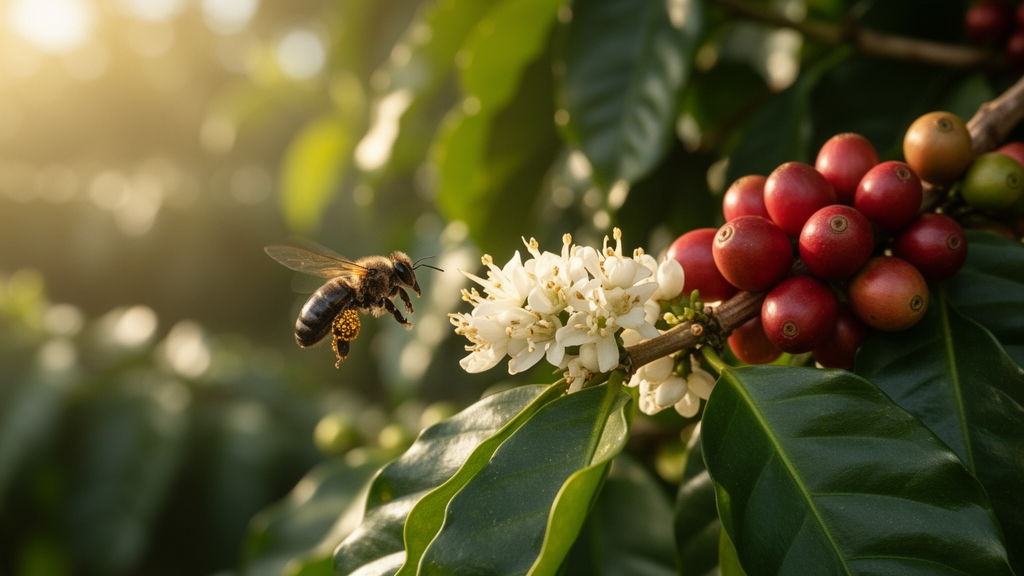
On coffee farms in southeastern Brazil, a tiny stingless bee has just rewritten the arithmetic of one of the world’s most valuable crops. Researchers deployed managed colonies of the stingless bee Scaptotrigona depilis across arabica coffee farms in Minas Gerais and São Paulo and found that branches located within 50 meters of the colonies produced 67 percent more coffee than branches roughly 250 meters away, where the bees’ short foraging flights could not reach as effectively. The finding, published in Frontiers in Bee Science, lands with particular force because Coffea arabica has long been dismissed as a self-pollinating crop that farmers believed needed no insect help at all.
The yield numbers are striking. In the study, conducted between 2022 and 2023, ripe berries were manually harvested from 360 branches across six farms supplemented with stingless bee colonies. Branches close to the colonies averaged 0.50 kilograms of coffee each, while branches far from the colonies averaged 0.30 kilograms. The researchers analysed these data with linear mixed-effects models that accounted for the spatial non-independence of sampling sites, nesting plots within farms and treating farm identity as a random effect. The 67 percent gain survived all statistical scrutiny, confirming that supplemental pollination by a native bee can transform productivity in a crop once thought immune to pollinator deficits.
Why would a self-pollinating plant respond so dramatically to bee visits? The answer lies in the subtle biology of arabica coffee. Although the species does not require pollen transfer between different plants to set fruit, decades of research worldwide have shown that flowers isolated from visiting insects form about 28 percent fewer fruits than flowers open to natural pollinators. Bees appear to enhance fruit set even in self-compatible flowers, likely through more efficient pollen deposition on stigmas. Scaptotrigona depilis brings a suite of traits that make it unusually effective at this job: a small body of roughly 5.5 millimeters, short foraging trips of about 4.2 minutes, constant activity from morning to early afternoon, mass-recruitment foraging using scent trails to rapidly mobilize nestmates, and colonies of around 10,000 workers.
There is also a mechanical quirk that may give stingless bees an edge over honeybees. Like Apis mellifera, S. depilis foragers moisten collected coffee pollen with nectar and pack it into their metatibial pollen baskets. But apparently they carry more free pollen grains incidentally attached to their bodies, and those loose grains are the ones most likely to be available for pollination as bees move from flower to flower. Add the fact that stingless bees lack a functional sting, posing less hazard to farm workers, and their well-developed colony management protocols, and the case for renting them out to coffee growers becomes compelling. Bee rental is already routine for apples and melons in Brazil, and the authors expect arabica coffee to follow the same trajectory.
But the study was designed to answer a second, more contentious question: does thiamethoxam, a neonicotinoid insecticide widely used against the coffee leaf miner and coffee leaf rust, harm stingless bee colonies under real farming conditions? Neonicotinoids are systemic, meaning they are absorbed by the treated plant and translocated to all organs, including nectar and pollen in flowers. Laboratory studies have documented lethal and sublethal effects on social bees, including impaired foraging, learning and memory, colony development and disease resistance. Yet field-realistic colony-level studies on stingless bees have been scarce, and most regulatory ecotoxicology relies on honeybees as the model species.
The researchers installed thiamethoxam-based products, Verdadero 600 WG and Actara 250 WG, by soil drenching during the berry expansion stage of the 2021 season, following label recommendations at field rates of 1 kilogram per hectare. Colonies were introduced the following season, roughly 10 to 18 days before coffee blooming in September and October 2022, so that residues from the previous application could be assessed. Three colony strength parameters were tracked according to international standardized protocols: brood production, counted in pre-provisioning and oviposition stages; brood mortality, calculated as the percentage of empty pupal cells; and foraging activity, counted as foragers leaving the colony during 3-minute observation windows. Measurements were taken before and after blooming and again at 45, 75 and 105 days post-exposure, spanning approximately three complete generations of stingless bees.
The residue analysis told a nuanced story. Using liquid chromatography tandem mass spectrometry, the team detected thiamethoxam and its metabolite clothianidin in all coffee leaves sampled at conventional farms, with leaf concentrations ranging from 0.0093 to 0.1071 milligrams per kilogram. Low but detectable residues also appeared in nectar and pollen stored within the stingless bee nests, generally below 0.02 milligrams per kilogram. At the two organic control farms, residues were below the limit of quantification. Critically, these levels sat well beneath thresholds known to affect honeybee colonies: continuous feeding with 100 parts per billion thiamethoxam for six weeks impaired colony development in prior research, with no adverse effects at 50 parts per billion and a no-observed-effect concentration of 37.5 parts per billion, roughly 1.8 to 2-fold higher than the residues found in the stingless bee food stores.
The colony health data matched the residue picture. Brood production and brood mortality were statistically indistinguishable between colonies on conventional and organic farms, with no significant interaction between farming system and sampling period. Foraging activity did differ between farm types, but the lower baseline activity at conventional farms was observed before coffee flowering began, before foragers had any exposure to coffee nectar or pollen, pointing instead to pre-existing differences in floral resource availability in the surrounding landscape. Both systems showed similar proportional increases in foraging activity once blooming started, and the temporary difference normalized in subsequent assessments. The authors argue that thiamethoxam exposure should not be considered the primary cause of the foraging difference, and that transient effects on foraging do not threaten colony viability when they recover without translating into brood impacts.
Why do laboratory findings of neonicotinoid harm so often fail to materialize in the field? The study explores several explanations. Coffee flowers remain open for only 3 to 4 days and open synchronously in brief but intense flowering periods driven by rainfall, which concentrates foraging into narrow windows and limits exposure duration. Stingless bees visit a wide array of flowering plants, mixing pollen and nectar from treated crops with resources from untreated plants and diluting residue levels. Applications made an average of 8 months before blooming, as the label requires, leave systemic residues on flowers very low, a pattern also seen in apple orchards where fall foliar sprays produced no detectable spring residues. Social bee colonies also possess recovery mechanisms and nutritional buffers that can compensate for some sublethal costs of losing foragers.
The implications ripple outward from the farm gate. Introducing stingless bee colonies gives farmers a direct method to increase coffee yield and generate sustainable profit, which the authors suggest can be invested in native forest restoration, creating a synergistic loop between agriculture and conservation. Brazil produces a record forecast of 178.7 million bags of coffee for 2025/26 across 2.25 million hectares, 82 percent of it arabica, so even modest pollination gains scale into enormous volumes. The study is among the first to combine a pollinator abundance manipulation with a higher-tier colony strength assessment for a non-Apis bee under field-realistic pesticide exposure, and the authors caution that different application timings or rates could yield different results. Still, the message is clear: with responsible label-compliant pesticide use, native stingless bees can markedly boost coffee production while remaining healthy themselves, offering a practical template for sustainable intensification in the tropics.
Subject of Research: Crop pollination and pesticide risk assessment in Brazilian arabica coffee
Article Title: Stingless bees in coffee: yield gains and assessing neonicotinoid impact
Article References: Ramos, J. D., Santos, G. S., dos Santos, C. F., De Oliveira Kaminski, T. S., Cione, A. P., Alves, D. A., Quenzer, F. C. L., Campbell, A. J., Pereira, A. M., Thompson, H., Martins de Queiroz, A. C., Bento, J. M. S., & Menezes, C. (2026). Stingless bees in coffee: yield gains and assessing neonicotinoid impact. Frontiers in Bee Science, 3, Article 1644205. https://doi.org/10.3389/frbee.2025.1644205
Image Credits: AI Generated
DOI: 10.3389/frbee.2025.1644205
Keywords: stingless bees, Scaptotrigona depilis, coffee pollination, Coffea arabica, thiamethoxam, neonicotinoids, clothianidin, colony strength, Brazil, sustainable agriculture, crop yield, pesticide residues
Cite Scienmag News
Alan Morgan. (October 16, 2026). Stingless Bees Deliver a 67 Percent Coffee Yield Boost While Shrugging Off Neonicotinoid Residues. Scienmag. https://scienmag.com/stingless-bees-deliver-a-67-percent-coffee-yield-boost-while-shrugging-off-neonicotinoid-residues/
Alan Morgan. "Stingless Bees Deliver a 67 Percent Coffee Yield Boost While Shrugging Off Neonicotinoid Residues." Scienmag, 16 October 2026, https://scienmag.com/stingless-bees-deliver-a-67-percent-coffee-yield-boost-while-shrugging-off-neonicotinoid-residues/. Accessed 16 October 2026.
Alan Morgan. "Stingless Bees Deliver a 67 Percent Coffee Yield Boost While Shrugging Off Neonicotinoid Residues." Scienmag. October 16, 2026. https://scienmag.com/stingless-bees-deliver-a-67-percent-coffee-yield-boost-while-shrugging-off-neonicotinoid-residues/


