


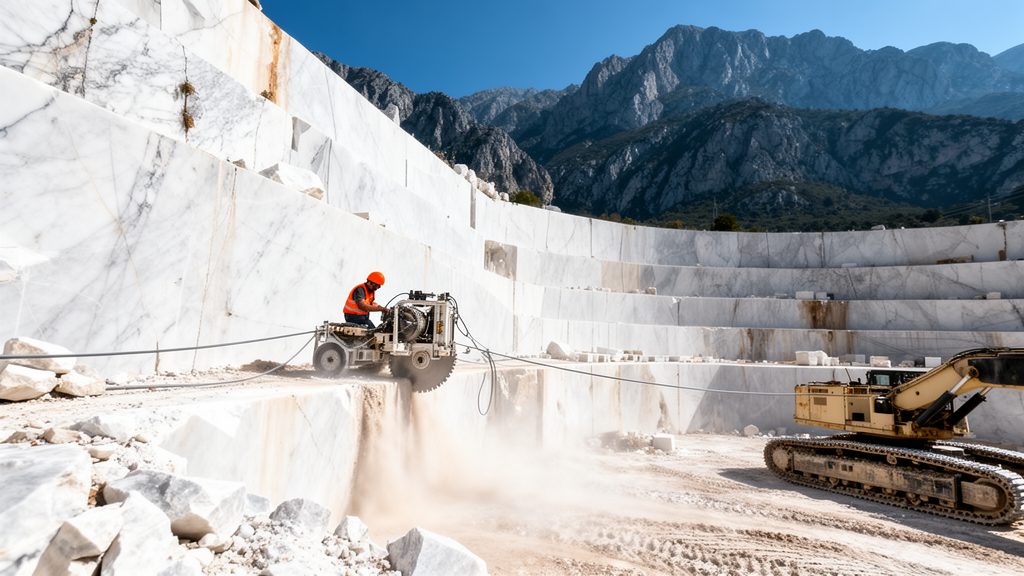
For more than two millennia, the marble of the Apuan Alps has adorned palazzos, cathedrals and sculptures, and for most of that time the quarries above Carrara seemed, on any human timescale, inexhaustible. A new study published in Frontiers in Sustainable Resource Management now argues that the real story is not how much marble remains in the mountains, but how much of it can still be reached under favorable energetic, technological and economic conditions. The research, by Luciano Celi of Italy’s National Research Council, reconstructs nearly two centuries of marble production in the Massa-Carrara district, from 1830 to 2021, and reaches a conclusion that will surprise many: the mountains are not running out of marble, but the era of cheap marble may be ending.
The term cheap here does not refer to market price. Celi borrows a distinction made famous by the 1998 Scientific American article The End of Cheap Oil, where cheap described the relative ease of accessing and extracting a resource under prevailing technological, energetic, infrastructural and economic conditions. Applied to stone, this leads to the concept of easy marble: the progressive reduction of deposits that can be exploited with limited overburden removal, modest infrastructure and relatively low energy inputs. What gradually declines, in this framework, is not the total amount of marble contained within the massif but the proportion that can be extracted under favorable conditions.
The historical record assembled by Celi is striking. For most of the two-thousand-year history of Apuan quarrying, the basic methods of detaching, shaping and transporting large stone blocks remained fundamentally unchanged from classical antiquity until the nineteenth century, as the archaeologist J. B. Ward-Perkins noted. Quarrying relied on manual labor, wedges, simple iron tools, ropes and gravity-assisted transport, demanding considerable practical skill but comparatively little external energy. Even after the helicoidal wire saw appeared in the nineteenth century, Carrara was still employing methods that differed only marginally from those used in antiquity.
Everything changed after World War II. The introduction of diesel-powered machinery, diamond-wire cutting systems, pneumatic drilling equipment and increasingly mechanized transport, combined with the growing availability of low-cost fossil fuels, profoundly altered the sector’s operating conditions. The numbers tell the story: although the postwar period from 1950 to 2002 represents only about 31 percent of the total 173-year calendar span, it accounts for approximately 69 percent of cumulative production. The preceding 120 years account for the remaining 31 percent. This acceleration coincided with the broader Great Acceleration observed across many environmental and socioeconomic indicators in the second half of the twentieth century.
Labor productivity data reinforce the picture of an energy-intensive industrial transformation. Between 1980 and 1992, productivity across the four principal quarrying districts rose from about 510 to more than 1,080 tons per worker, reflecting the combined effects of technological innovation, greater capital intensity and larger external energy inputs. Notably, this pattern is compatible with a rebound mechanism: improvements in extraction efficiency were accompanied not by a reduction in resource use but by substantially higher extraction rates and a remarkable increase in output per worker. Increasing quantities of external energy progressively replaced human labor, allowing extraction volumes to rise while the workforce declined dramatically.
To test whether the production trajectory follows the dynamics of non-renewable resource exploitation, Celi applied the Hubbert Linearization method, a technique developed for oil depletion analysis, to the cumulative production series. Applied to the complete historical record from 1858 to 2002, the method fails to provide a satisfactory representation, with a low coefficient of determination of 0.168. But over the more recent 1970 to 2002 interval, the linearization becomes substantially more coherent, with R² = 0.883 and an estimated asymptotic cumulative production of 82.112 million tons, within a 95 percent confidence interval of 74.317 to 89.908 million tons. Celi calls this quantity the easy-marble recoverable resource, emphasizing that it represents an estimate associated with the extraction regime prevailing during 1970 to 2002, not an estimate of the total geological resource.
Sensitivity analyses confirm the robustness of this estimate. Testing three interpolation schemes for the pre-1950 production series, linear, PCHIP and modified Akima, while constraining the reconstruction to reproduce an independent estimate of 20 million tons of marble produced between 1830 and 1930, the estimated easy-marble recoverable resource falls within a narrow range of 77.9 to 82.8 million tons. A deliberately conservative cubic spline stress test yields substantially lower estimates of 51.3 to 52.7 million tons with markedly poorer fits, and is retained only as a stress test. The agreement between the constrained reconstructions and the independent postwar Hubbert Linearization provides an additional consistency check.
Energy assessments of modern marble production chains elsewhere in the Mediterranean provide an indication of the magnitude of the energy requirements involved. Cutting and finishing account for more than 80 percent of the energy demand in the production chain, whereas the three quarry extraction operations considered, drilling, diamond-wire sawing and excavator operation, account for only about 8 percent, with transportation accounting for a further roughly 7 percent. As an order-of-magnitude calculation, the 1995 production peak of approximately 1.66 million tons corresponds to roughly 0.615 million cubic meters of marble, which at an indicative energy requirement of 1.7 gigajoules per cubic meter implies an energy demand of about 1.05 petajoules. Celi is careful to note that these calculations do not demonstrate that quarrying energy in the Apuan Alps has increased over time because of declining accessibility; rather, abundant external energy should be understood primarily as an enabling factor that expanded the technical capacity to exploit increasingly complex resources.
The production decline observed after the mid-1990s, when output peaked around 1.66 million tons, cannot be explained by geological factors alone. Economic reports published by the local Chamber of Commerce document a prolonged restructuring of the marble sector, characterized by declining local employment, increasing concentration of quarrying activities, a growing share of raw stone exports and a progressive weakening of local processing industries. During the early 2000s, the sector experienced a marked economic contraction, with reductions in production, turnover, investment and export revenues. Institutional and spatial constraints also shaped accessibility: the Apuan Alps Regional Park was established in 1985 with an area of approximately 54,000 hectares, and in 1997, only two years after the production peak, its perimeter was substantially reduced to 20,598 hectares, with quarrying areas incorporated into the regulatory framework as contiguous quarry areas.
The broader significance of the study extends well beyond the Apuan quarries. The case illustrates how abundant external energy can profoundly modify the relationship between industrial society and geological resources, progressively relaxing the physical constraints that historically limited extraction while continuously redefining the concept of economically recoverable reserves. Within this framework, reaching a production peak does not imply the physical depletion of the resource but signals the beginning of a phase in which increased technical and energy efforts can no longer compensate for the progressive deterioration of extraction conditions. The Apuan marble district appears to have undergone a gradual transition from a predominantly quarry-based industry toward a mining-like production system, with larger excavation fronts, extensive stabilization works, longer access roads and underground operations becoming integral components of extraction. As with many other non-renewable resources, the limiting factor increasingly becomes not the physical availability of the material itself but the growing quantity of energy, capital and technological complexity required to transform that resource into economically recoverable reserves. Celi proposes that this framework may also help interpret the long-term evolution of other mature mineral districts, offering a valuable perspective on how energy, technology and resource quality interact in the history of extractive industries.
Subject of Research: Non-renewable resource economics and energy constraints in marble quarrying
Article Title: The end of cheap Italian marble. Long-term production dynamics and energy constraints in the Apuan marble district (1830–2021)
Article References: The end of cheap Italian marble. Long-term production dynamics and energy constraints in the Apuan marble district (1830–2021). (n.d.). https://doi.org/10.3389/fsrma.2026.1947607
Image Credits: AI Generated
DOI: 10.3389/fsrma.2026.1947607
Keywords: Apuan Alps, Carrara marble, resource depletion, Hubbert peak, energy intensity, quarrying, labor productivity, easy marble, non-renewable resources, Great Acceleration, mineral economics, Italy
Cite Scienmag News
Sloane Callahan. (October 16, 2026). The end of cheap Italian marble: Carrara’s two-century production story reveals energy constraints, not depletion. Scienmag. https://scienmag.com/the-end-of-cheap-italian-marble-carraras-two-century-production-story-reveals-energy-constraints-not-depletion/
Sloane Callahan. "The end of cheap Italian marble: Carrara’s two-century production story reveals energy constraints, not depletion." Scienmag, 16 October 2026, https://scienmag.com/the-end-of-cheap-italian-marble-carraras-two-century-production-story-reveals-energy-constraints-not-depletion/. Accessed 16 October 2026.
Sloane Callahan. "The end of cheap Italian marble: Carrara’s two-century production story reveals energy constraints, not depletion." Scienmag. October 16, 2026. https://scienmag.com/the-end-of-cheap-italian-marble-carraras-two-century-production-story-reveals-energy-constraints-not-depletion/


