

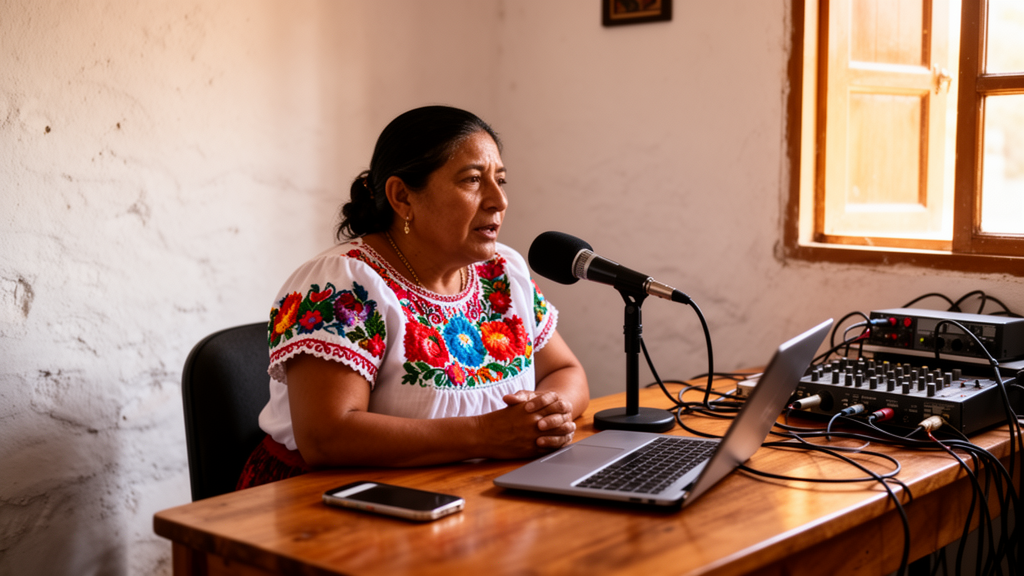
In the mountains of Puebla and the valleys of Oaxaca, a quiet experiment in media power is unfolding. Community radio stations and audiovisual collectives are telling their own stories in their own languages, yet much of what they produce now travels through digital systems they do not govern, from streaming servers to video platforms operated by distant corporations. A new study argues that this does not mean these organizations have lost their voice. Instead, it proposes that narrative sovereignty, the authority to decide who speaks, in which language, and from what perspective, is best understood as layered: it can remain substantial even when the pipes that carry the stories belong to someone else.
The research, published in Frontiers in Communication by Alma Delia Zamorano-Rojas of Universidad Panamericana, examines three Mexican media organizations: Radio Tosepan Limakxtum, rooted in the Tosepan cooperative movement of the northeastern Sierra of Puebla; Radio Tsinaka, based in San Miguel Tzinacapan in Cuetzalan; and Ojo de Agua Comunicación, a long-standing audiovisual organization in Oaxaca that works primarily with Indigenous and Afro-descendant peoples. Through a comparative qualitative content analysis of 24 publicly accessible communication units, eight from each organization, the study maps how language, community voice, cultural identity, territory, memory, collective action, gender, and collaboration are configured across very different institutional settings.
The conceptual starting point is a distinction that has shaped Indigenous media scholarship for decades. Faye Ginsburg’s early work rejected the idea that technological mediation automatically produces either cultural contamination or uncomplicated empowerment, arguing instead that the meaning of media practice depends on the social relations and political projects in which it is embedded. Terence Turner’s research with Kayapó video makers in Brazil reached a similar conclusion: media production is itself a site where identity and representational conventions are negotiated. Michelle Raheja later sharpened the point with the concept of visual sovereignty, emphasizing intervention within visual regimes historically organized by colonial and ethnographic representation. Visibility, in other words, is not the same as authority over the terms of representation.
Building on this tradition, the study defines narrative sovereignty in a deliberately bounded sense: the observable capacity of Indigenous and community media actors to exercise authority over the construction and articulation of narratives about their communities, identities, territories, histories, and collective concerns. Crucially, the definition centers authority rather than cultural presence. An Indigenous language, a ritual, or a landscape on screen does not by itself establish who controls a narrative. Evidence comes from institutional authorship, speaking positions, linguistic choices, narrative framing, and documented relationships between producers and represented communities. Collaboration can coexist with narrative authority, while Indigenous subject matter alone cannot establish it.
Methodologically, the study is careful to a degree that will interest anyone who follows debates about platform power. The corpus was balanced at eight units per organization to prevent differences in the volume of publicly available material from producing artificial imbalances. Each unit had to meet a strict evidentiary threshold: an individually identifiable media item, such as a radio program, interview, audio feature, or audiovisual production, supported by a dedicated page or technical record. Materials identifiable only through archive-level metadata were excluded from thematic analysis. A code was assigned only when explicit item-level evidence supported it; ambiguous or insufficiently documented attributes were recorded as not documented rather than inferred. Narrative authority itself was never reduced to a numerical score but assessed through four observable criteria: speaking position, linguistic choice, institutional authorship, and narrative framing.
The results reveal three distinct configurations rather than one uniform pattern. Across the 24 units, community voice was coded in 11, resistance or collective action in 9, cultural identity in 9, territory in 8, and inter-organizational collaboration in 9. Explicitly documented Indigenous-language use appeared in four units, all from the two radio cases. At Radio Tosepan Limakxtum, programs such as Pipil Wetskanih, Niños que ríen include capsules in Nahuatl, while the program Xochipitzahuak is hosted entirely in Nawat, with language tied to Masewal music and community life rather than isolated as a marker of difference. Radio Tsinaka’s evidence includes EJEKATANAUATILMEJ in Nahuatl and X TACHUWIN UN in Tutunaku.
Territory, meanwhile, takes on different narrative functions in each case. In Tsinaka’s selected materials, territorial concerns are articulated through concrete conflicts involving mining, water, displacement, pollution, and waste-disposal projects, narrated through relations among community life, environmental conditions, and political organization. Tosepan embeds territory more in everyday community programming, connecting buen vivir, local events, and the strengthening of Masewal and Tutunaku life. Ojo de Agua’s works, such as Magdalena Teitipac: Pueblo libre de minería, which links mining and water with territorial defense, and Abuelo Jaguar, which brings territory into relation with memory and conservation, show the same thematic category assuming yet another configuration. The same is true of memory and gender: Ojo de Agua’s corpus concentrates most heavily on collective action and women’s organization, with works like Mujeres del mismo valor and Mujeres de Naxií positioning women in relation to organization, rights, and knowledge rather than merely as subjects.
Collaboration provides the clearest distinctive pattern. Six of Tsinaka’s eight selected units contain identifiable inter-organizational collaboration, compared with one Tosepan unit and two Ojo de Agua units. Tsinaka’s public communication incorporates material involving other Indigenous and community radios and communicators, and two units provide direct evidence of translocal circulation beyond the station’s immediate locality. Tosepan participates in networked communication through Canto de Cenzontles, a program connecting community, Indigenous, and Afro-descendant communicators. These networks matter because they show that digital circulation cannot be reduced to the relationship between a single community producer and a corporate platform. Networks among community media themselves constitute an additional layer of distribution.
On the infrastructural question, the study documents hybrid arrangements rather than a single model. Tosepan combines an institutional radio website with an online stream and a programming grid. Tsinaka maintains its own web presence with hosted audio and item pages alongside its dense collaborative activity. Ojo de Agua keeps an institutional audiovisual archive while at least one selected item also circulates through an externally operated digital service. The author is explicit about the limits of what this evidence can show: the corpus does not permit conclusions about how algorithms rank these materials, whether platform systems amplify or suppress them, or how audiences encounter them. Three claims, the study insists, require separate evidence: observable platform use, dependence on external infrastructure, and algorithmic marginalization. Only the first two can be established from public materials; the third would demand platform data, organizational testimony, or longitudinal research.
The conceptual payoff is a layered account of media sovereignty that separates three analytically distinct but related dimensions: narrative authority, which concerns storytelling, speakers, language, and framing; organizational media capacity, which concerns production, programming, archiving, and collaboration; and infrastructural configuration, which concerns the technical arrangements through which communication is stored and distributed. Keeping these dimensions apart prevents two errors. Requiring control over every stage from storytelling to servers would make substantial forms of Indigenous communicative authority disappear from view. Conversely, describing any Indigenous-authored digital content as sovereign would obscure the material conditions of circulation. The study’s formulation is deliberately modest: narrative sovereignty is situated and relational authority over storytelling, able to coexist with collaboration, technological interdependence, and platform use while remaining distinct from authority over platform governance, data infrastructures, or ranking systems. The findings also continue a longer Mexican history documented by scholars such as Erica Wortham, in which video indígena and community radio developed through activism, alternative public spheres, and movements for autonomy. What changes today is the layering of circulation systems, with terrestrial radio coexisting alongside websites, streaming, archives, and collaborative networks. Future research, the author suggests, should work directly with media makers and communities, attend to how they distinguish public circulation from ethically appropriate reuse, and trace how materials move across platforms over time, always under appropriate Indigenous governance and consent.
Subject of Research: Narrative sovereignty and hybrid media infrastructures in Mexican Indigenous and community media
Article Title: Layered narrative sovereignty: communicative authority and hybrid infrastructures in Mexican Indigenous and community media
Article References: Layered narrative sovereignty: communicative authority and hybrid infrastructures in Mexican Indigenous and community media. (n.d.). https://doi.org/10.3389/fcomm.2026.1995028
Image Credits: AI Generated
DOI: 10.3389/fcomm.2026.1995028
Keywords: Indigenous media, community radio, narrative sovereignty, platformization, Mexico, hybrid infrastructures, media sovereignty, self-representation, Oaxaca, Puebla, collaborative networks, digital circulation
Cite Scienmag News
Scienmag. (October 16, 2026). Mexican Indigenous Media Keep Control of Their Stories Across Hybrid Digital Platforms. https://scienmag.com/mexican-indigenous-media-keep-control-of-their-stories-across-hybrid-digital-platforms/
Scienmag. "Mexican Indigenous Media Keep Control of Their Stories Across Hybrid Digital Platforms." Scienmag, 16 October 2026, https://scienmag.com/mexican-indigenous-media-keep-control-of-their-stories-across-hybrid-digital-platforms/. Accessed 16 October 2026.
Scienmag. "Mexican Indigenous Media Keep Control of Their Stories Across Hybrid Digital Platforms." Scienmag. October 16, 2026. https://scienmag.com/mexican-indigenous-media-keep-control-of-their-stories-across-hybrid-digital-platforms/


