


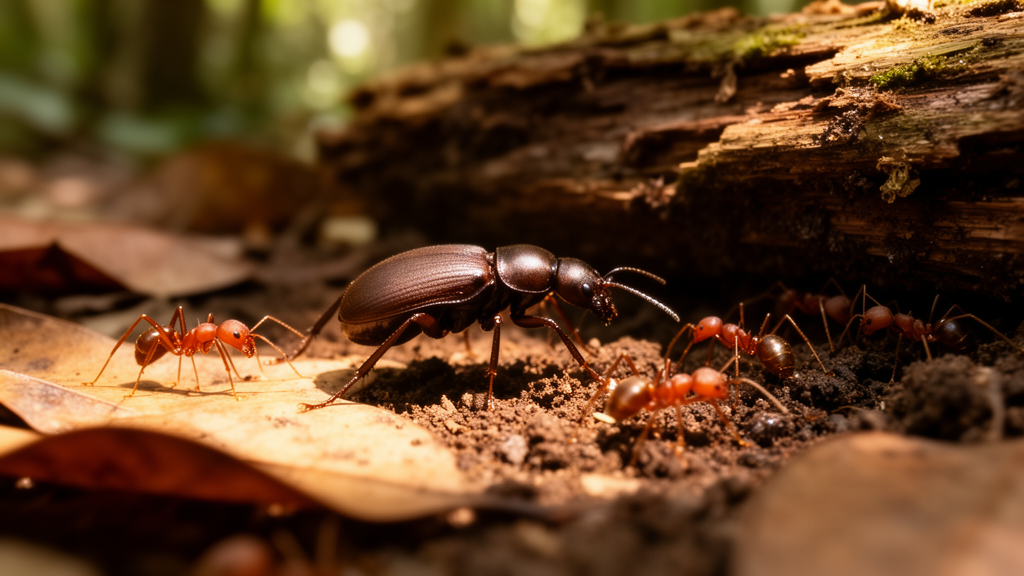
Deep in the forests of southern Cambodia, a beetle that looks less like a ground beetle and more like a living pebble has turned out to be a species new to science. Researchers describe Cryptocephalomorpha thom in the Deutsche Entomologische Zeitschrift, based on a male collected in Kep National Park and a female found more than a decade earlier in Kaeng Krachan National Park in western Thailand. The discovery is more than a taxonomic formality: it marks the first confirmed record of the beetle tribe Pseudomorphini in Cambodia, extending the known footprint of one of the strangest lineages of carabid beetles in the Oriental region.
Pseudomorphini, often called ant-like flower beetles by enthusiasts though they are true ground beetles, are instantly recognizable once you know what to look for. Their bodies are strongly convex and nearly oval, their outline smooth and continuous from head to elytra, and their mouthparts, antennae, and legs are almost entirely tucked out of sight beneath the body. To a casual observer, they could pass for aquatic diving beetles or bark-dwelling colydiids rather than carabids. This radical departure from the typical ground beetle body plan is not accidental. Scientists interpret it as an adaptation to life inside ant colonies, where a compact, smooth, armored profile and concealed appendages are advantages in cramped nest galleries patrolled by formidable hosts.
The myrmecophilous lifestyle of these beetles has been pieced together over decades. Early notes recorded specimens of Cryptocephalomorpha papua collected in association with ants, and Cryptocephalomorpha gaverei was later found under bark within an actual ant nest, providing the first field evidence of the behavior. The decisive proof came in 2016, when researchers described Cryptocephalomorpha siamensis from specimens taken directly from a nest of the ant Pheidole singaporensis in Thailand, establishing the first exact host record for the genus. Several genera in the tribe also show reduced flight ability and larviparous or ovoviviparous reproduction, a strategy so rare among carabid beetles that it is considered a hallmark of their protected, nest-dwelling existence.
The genus Cryptocephalomorpha itself is especially remarkable. Its species are among the most convex and smooth-bodied members of the tribe, with appendages hidden to a degree interpreted as protective in confined or ant-nest environments. Most species occur in South and Southeast Asia, New Guinea, and northeastern Australia, with a single relict species in South Africa. Within the Indochinese Peninsula, the genus was previously known from Thailand, Laos, Vietnam, and Malaysia, but never from Cambodia or Myanmar, leaving a conspicuous gap in the map of its distribution.
Cambodia sits within the Indo-Burma biodiversity hotspot, a region defined by exceptional concentrations of endemic species and severe habitat loss. Yet compared with neighbors such as Thailand, Vietnam, and Laos, the country remains poorly surveyed, and its faunal diversity is far from completely documented. The new species was uncovered during lawful surveys conducted under a bilateral academic research agreement between the Republic of Korea and the Kingdom of Cambodia, with the Thai paratype collected in 2012 under the supervision of the Thai National Park Authority. All specimens will be deposited in their respective institutional collections.
The holotype, a male, was collected at night on 6 May 2018 using a 15-watt UV fluorescent lamp trap placed on the ground along a narrow forest path regularly used by walkers and motorbikes in Kep National Park, Kep Province, at an elevation of 71 meters. The paratype, a female, was taken on 21 March 2012 at the 17-kilometer point in Kaeng Krachan National Park, western Thailand, at 313 meters, using a portable Nakase-system light trap with a 4-watt UV lamp hung about five meters up on a tree and recovered the following morning. Intriguingly, no host ant association could be confirmed for either specimen, so the species’ exact ant partner remains unknown.
Morphologically, Cryptocephalomorpha thom is a large species for the genus, with a body length exceeding six millimeters from head to visible abdominal segment. Its ground color is almost uniformly dark brown, with a small, narrow reddish patch near the subapex of each elytron. The pronotal lateral margin is distinctly flattened and visible from above, while the elytral lateral margin is incurved beneath the body and not distinctly visible in dorsal view. Among its known relatives, the new species most closely resembles Cryptocephalomorpha maxima, but it differs in the incurved elytral margin, the small elytral patches, the absence of the elytral lateroapical seta, and details of female gonocoxite II setation. Notably, it combines the large body size of C. maxima and C. gigantea with the reduced elytral chaetotaxy characteristic of smaller Oriental congeners.
The two specimens, though collected from geographically separated localities and representing opposite sexes, agree closely in all major external diagnostic characters, including body shape, coloration, elytral lateral structure, chaetotaxy, and the absence of the lateroapical seta. In previously described Oriental species of the genus represented by both sexes, the external diagnostic characters used in identification have not been observed to vary sexually, so the researchers interpret the observed differences between the two specimens as sexual dimorphism and regard them as conspecific. Detailed measurements support this: the holotype measures 6.3 millimeters in body length including the abdomen, with a pronotal width of 2.7 millimeters and an elytral length-to-width ratio of about 1.17, while the paratype measures 6.7 millimeters with a pronotal width of 2.9 millimeters and an elytral ratio of 1.25.
Under the microscope, the species reveals a suite of adaptations consistent with its presumed ant-nest lifestyle. The head is small, transverse, and orthognathous, with reduced mouthparts, a reduced labrum, very small mandibles lacking any lateral excision or spine, and short cylindrical maxillary palpi whose terminal segment is longer than all preceding segments combined. The labial palpi are short, with a strongly dilated terminal segment. The elytra bear no discal setigerous punctures and only a humeral marginal series, with the subapical marginal series absent. The legs are short and flattened, with enlarged femora each bearing a deep tibial cavity-like groove, and the abdominal sterna I through III are fused with only faintly impressed sutures. Males carry two rows of transverse adhesive setae on pro- and mesotarsomeres II and III and a dense pubescent pad on abdominal sternite VI, while females show spatulate adhesive setae on more tarsomeres and four setae on sternite VI. The aedeagus is relatively short, gently curved ventrally, and widely rounded at the apex, with markedly asymmetrical parameres.
The species name thom derives from the Khmer word for large or big, a nod to the beetle’s comparatively large size within the genus. Beyond the description itself, the study provides a reconstructed key to the Oriental genera of Pseudomorphini and an updated key to the Oriental species of Cryptocephalomorpha, tools that will help future surveys place specimens quickly and accurately. As Cambodia’s forests continue to face pressure across the Indo-Burma hotspot, finds like this one underscore how much undocumented life persists in the region, and how even a beetle that spends its life hidden among ants can rewrite the map of Oriental biodiversity.
Subject of Research: Description of Cryptocephalomorpha thom, a new myrmecophilous ground beetle species from Cambodia and Thailand, with taxonomic keys for Pseudomorphini.
Article Title: A new species of the myrmecophilous genus Cryptocephalomorpha Ritsema, 1875, from the Indochinese Peninsula ( Coleoptera , Carabidae , Pseudomorphini )
Article References: A new species of the myrmecophilous genus Cryptocephalomorpha Ritsema, 1875, from the Indochinese Peninsula ( Coleoptera , Carabidae , Pseudomorphini ). (n.d.). https://doi.org/10.3897/dez.73.192635
Image Credits: AI Generated
Keywords: Cryptocephalomorpha thom, new species, Pseudomorphini, Carabidae, ground beetles, myrmecophily, ant association, Cambodia, Thailand, Kep National Park, Kaeng Krachan National Park, taxonomy
Cite Scienmag News
Gavin Prescott. (October 16, 2026). A new species of the myrmecophilous genus Cryptocephalomorpha Ritsema, 1875, from the Indochinese Peninsula (Coleoptera, Carabidae, Pseudomorphini). Scienmag. https://scienmag.com/a-new-species-of-the-myrmecophilous-genus-cryptocephalomorpha-ritsema-1875-from-the-indochinese-peninsula-coleoptera-carabidae-pseudomorphini/
Gavin Prescott. "A new species of the myrmecophilous genus Cryptocephalomorpha Ritsema, 1875, from the Indochinese Peninsula (Coleoptera, Carabidae, Pseudomorphini)." Scienmag, 16 October 2026, https://scienmag.com/a-new-species-of-the-myrmecophilous-genus-cryptocephalomorpha-ritsema-1875-from-the-indochinese-peninsula-coleoptera-carabidae-pseudomorphini/. Accessed 16 October 2026.
Gavin Prescott. "A new species of the myrmecophilous genus Cryptocephalomorpha Ritsema, 1875, from the Indochinese Peninsula (Coleoptera, Carabidae, Pseudomorphini)." Scienmag. October 16, 2026. https://scienmag.com/a-new-species-of-the-myrmecophilous-genus-cryptocephalomorpha-ritsema-1875-from-the-indochinese-peninsula-coleoptera-carabidae-pseudomorphini/


