


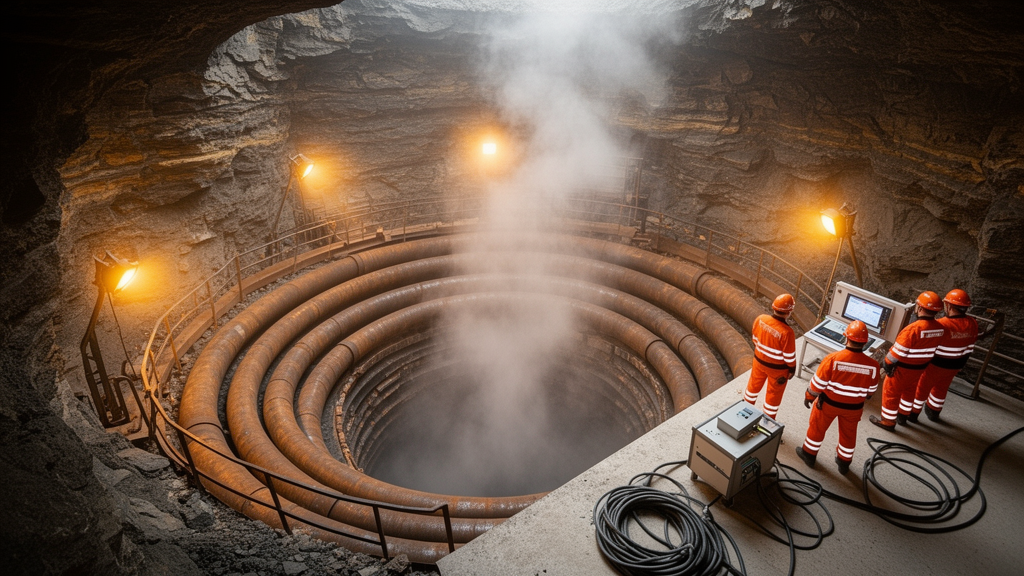
Half a kilometer beneath a quiet corner of the Delft University of Technology campus, a team of Dutch researchers has quietly built one of the most instrumented windows into the shallow subsurface anywhere in Europe. The borehole, known as DAPGEO-02, was drilled between February and May 2022 as part of an ambitious geothermal energy project centered on the TU Delft campus, and a new progress report published in the journal Scientific Drilling now lays out in unprecedented technical detail what the team found, how they sampled it, and why they believe the installation could reshape how scientists study everything from earthquake monitoring to underground heat storage and even radioactive waste disposal.
The project is part of a broader effort to tap an Early Cretaceous sandstone reservoir lying far below the campus, with a geothermal doublet producing heat while generating an extraordinary trove of scientific data. But rather than confining all the coring and logging work to the two geothermal production wells themselves, the researchers moved a substantial portion of the sampling programme to a separate monitoring station, DAPGEO-02, achieving significant cost and risk efficiencies while keeping the horizontal offset from the main wells limited. The borehole was originally conceived as a seismic-monitoring station, and because Delft is a relatively noisy urban environment, the team pushed it as deep as legally and practically possible — just under 500 meters — to escape the constant rumble of surface noise.
DAPGEO-02 is not a single hole but a carefully orchestrated constellation of four boreholes and a fiber-optic sensing network. The deepest borehole reaches 499 meters below ground level and was drilled in four phases by the Belgian SMET Group using rotary direct circulation drilling, with progressively narrower diameters from 450 millimeters at the top to 146 millimeters at the bottom. A 200-meter-deep companion borehole was drilled nearby by Rossingh Drilling, and two shallower 50-meter holes were placed 100 meters laterally offset from the central location. All the boreholes were grouted to surface after the research activities and geophone installation were complete, with the surface equipment housed in a small cabinet.
The coring programme is arguably the most technically inventive aspect of the project. The unconsolidated sands of the Maassluis Formation and the poorly indurated plastic clays of the Cenozoic sequence could both be badly disturbed by conventional rotary coring, so the team used a push-and-over-drill system called the SMET coring system. This technique pushes either a thin-walled steel Shelby tube, 0.55 meters long, or a steel core barrel with an internal PVC tube, 1.0 meters long, directly into the formation before drilling around it to relieve stress and allow wireline removal. Both sampling tubes had an internal diameter of 100 millimeters, with a thicker-than-standard 3-millimeter wall on the Shelby tubes to prevent mechanical deformation at depth. Around 75 meters of core were recovered in total, with 18 cores taken between 115 and 226 meters in the Maassluis Formation and 69 cores collected between 362 and 415 meters in the Neogene and Paleogene clays.
The number of pushes required to core a single meter proved extraordinarily sensitive to lithology. In the clayey Diessen Formation, one push often sufficed, whereas the sandy Oosteind Member demanded an average of 36 pushes per meter, and in one coarse sandy interval at 166 meters depth the rig needed a staggering 262 pushes before coring was halted at 72 percent recovery. Some cores showed recovery of up to 20 percent more than the cored length — a counterintuitive result attributed to stress relief causing grain reorganisation in sandy samples and to mechanical deformation below the sampler in clays, where a larger zone of formation can be displaced into the tube than its internal area strictly allows. All cores were sealed with inert sand, low-melting-temperature paraffin, end caps, and a stronger higher-melting-temperature polymer, then transported vertically and stored at 4 degrees Celsius to limit oxidation, microbial activity, and drying.
Every core was scanned at TU Delft using a macro-CT scanner, producing slices perpendicular to the core axis with 512-by-512 voxels covering a 120-by-120-millimeter area, each voxel measuring 0.234 by 0.234 millimeters with 0.6-millimeter spacing between slices. Because some sediments exceeded the standard medical scanner greyscale of −1000 to +3000 Hounsfield units, the team produced an extended scale ranging from −10,000 to +30,000 Hounsfield units in steps of 10. The scans revealed compressive wedges of higher density at the edges of cores where the drilling rig pushed, gravel and shell debris that had fallen down the borehole before coring began, coring-induced shear zones roughly a centimeter wide around the tube in the clays, and symmetrically distributed bubbles in the lower cores pointing to degassing of pore fluids — possibly methane or carbon dioxide formation gas — during or after lifting to the surface.
The wireline logging programme was equally comprehensive, carried out by Deltares across three drilling phases and covering depths between 230 and 495 meters. The suite included spectral and total gamma ray, normal resistivity at four spacings, spontaneous potential, single-point resistance, induced polarisation, sonic P-wave velocity, PS suspension logging yielding both P- and S-wave velocities, nuclear magnetic resonance, borehole deviation, an acoustic borehole imager, and electromagnetic induction. The PS suspension tool was deployed specifically because shear-wave velocity data are so scarce in this depth domain, and the nuclear magnetic resonance was used to probe the properties of the Cenozoic clays. Notably, the team reports this is the first use of PS suspension logging in the Dutch subsurface, and the logs correlate well with the core data, capturing heterogeneities in lithology and detailed sedimentology with combined logging data.
Dinoflagellate biostratigraphy on 11 core shoe samples from the Neogene–Paleogene interval, analysed by TNO, revealed that the borehole passes through the Neogene Upper North Sea Group — including the Waalre, Maassluis, Oosterhout, Diessen, and Groote Heide formations — before encountering a stratigraphic gap between the late Miocene Diessen and the middle Miocene Groote Heide formations, and a much larger hiatus between the Groote Heide and the lower Eocene Dongen formations corresponding to both the Savian and Pyrenean tectonic phases. In that time gap, the entire Veldhoven and Rupel formations as well as large parts of the Dongen Formation appear to be absent. Below, biostratigraphic constraints indicate the presence of the earliest Eocene and even the Palaeocene–Eocene Thermal Maximum, signalled by an acme of the dinoflagellate cyst genus Apectodinium. The borehole ultimately ends in marl of the Danian to possibly Upper Cretaceous Ommelanden Formation.
The seismic-monitoring layout exploits the full geometry of the site. In the deep borehole, the lower 70 meters were left uncased and equipped with three-component geophones at 440 and 490 meters depth to maximise sensitivity for detecting induced seismicity from nearby geothermal operations. The 200-meter borehole carries four geophones spaced 50 meters apart vertically, the two 50-meter offset holes each carry a single geophone at full depth, and a surface accelerometer sits above the central location. All nine sensors are connected to the Royal Netherlands Meteorological Institute national seismic network as station ZH08, with live data streaming openly available in standard seismological mseed format. Fiber-optic cables were installed in an L-shaped geometry across the site, with one straight fibre and one helically wound fibre in the 200-meter borehole — the latter designed to investigate whether winding could enable detection of longitudinal P-waves from multiple directions — and the fibres looped at the bottom to form a single continuous fibre for distributed acoustic sensing.
The scientific ambitions extend well beyond seismicity. The borehole is intended to improve characterisation of formation properties — particularly geomechanical and thermal properties — for geo-energy applications such as high-temperature aquifer thermal energy storage, where the Maassluis Formation is the primary target, and to provide material for investigating the hydro-chemo-mechanical properties of the Neogene and Paleogene clays that could act as cap rocks or host formations for radioactive waste disposal. The team stresses that the drilling location was known in advance to be unsuitable for actual waste disposal because of the thin clay formations present, and was targeted only to provide material at a representative depth for high-level waste. All data from the campaign are archived in the 4TU repository under a Creative Commons Attribution licence, the relational database linking drilling records, mud logging, core inventories, CT scans, wireline logs, and lithology descriptions is publicly downloadable, and requests for access to the limited and valuable core material can be submitted through TU Delft, where an evaluation committee assesses proposals based on scientific relevance and material availability.
Subject of Research: A 500 m deep multipurpose research borehole and monitoring station in Delft, the Netherlands
Article Title: A 500 m deep multipurpose research borehole and monitoring station in Delft, the Netherlands
Article References: Vardon, P. J., Abels, H. A., Barnhoorn, A., Beernink, S., Bruhn, D., van den Berg, J., Daniilidis, A., Dieudonné, A.-C., Drijkoningen, G., Geris, P., de Jong, T., Kruiver, P., Laumann, S., Munsterman, D., Neeft, E., Pauw, P., Schmiedel, T., Slob, E., Vargas Meleza, L., … Wapenaar, K. (2026). A 500 m deep multipurpose research borehole and monitoring station in Delft, the Netherlands. Scientific Drilling, 35(2), 211-227. https://doi.org/10.5194/sd-35-211-2026
Image Credits: AI Generated
Keywords: deep, multipurpose, research, borehole, monitoring, station, Delft, Netherlands, scientific research
Cite Scienmag News
Violet Maxwell. (October 16, 2026). Deep beneath Delft, a 500-meter borehole becomes an open laboratory for geothermal science. Scienmag. https://scienmag.com/deep-beneath-delft-a-500-meter-borehole-becomes-an-open-laboratory-for-geothermal-science/
Violet Maxwell. "Deep beneath Delft, a 500-meter borehole becomes an open laboratory for geothermal science." Scienmag, 16 October 2026, https://scienmag.com/deep-beneath-delft-a-500-meter-borehole-becomes-an-open-laboratory-for-geothermal-science/. Accessed 16 October 2026.
Violet Maxwell. "Deep beneath Delft, a 500-meter borehole becomes an open laboratory for geothermal science." Scienmag. October 16, 2026. https://scienmag.com/deep-beneath-delft-a-500-meter-borehole-becomes-an-open-laboratory-for-geothermal-science/


