


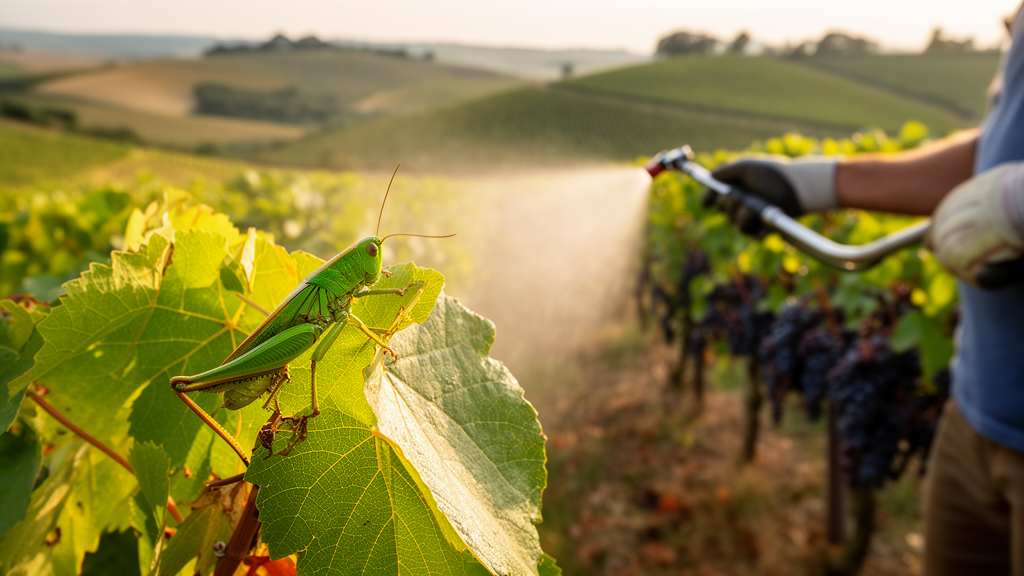
In the rolling hills of northeastern Italy, an unassuming flightless insect has become one of the region’s most stubborn agricultural headaches. The bush-cricket Barbitistes vicetinus, a species endemic to a handful of isolated hilly areas including the Euganean and Berici Hills, has repeatedly surged to outbreak densities since 2008, stripping forests of foliage and spilling into vineyards, olive groves, streets, and gardens. Because the insect climbs into the upper canopy to feed on leaves, flowers, and fruits, and because it readily colonizes neighboring crops from adjacent woodland and hedgerows, growers have had few options beyond broad insecticide sprays. A new study published in the Journal of Orthoptera Research now offers the first systematic evaluation of both conventional and organic insecticides against this emerging pest, and the results point toward a more sustainable toolkit for farmers, landscape managers, and homeowners alike.
The research team, led by Giacomo Ortis and colleagues, set out to compare six active ingredients representing the two main camps of chemical pest control. On the organic side, they tested spinosad, natural pyrethrins, azadirachtin, and three entomopathogenic fungi: Metarhizium anisopliae, Metarhizium acridum, and Beauveria bassiana. For comparison, they included two conventional compounds, the pyrethroid deltamethrin and the neonicotinoid thiamethoxam. The emphasis on organically permissible products reflects a dual reality: vineyards affected by B. vicetinus often sit within high-value natural habitats and protected areas, and there is growing pressure to reduce synthetic chemical inputs in European agriculture. Until now, only preliminary observations had suggested that pyrethroid-based products or natural pyrethrins might work against this species, leaving a significant gap in evidence-based guidance.
The experimental design was elegantly simple but rigorous. In semi-field trials conducted in a vineyard in the Euganean Hills, the researchers sleeved individual vine shoots, each 50 centimeters long, in fine tulle cage bags and introduced ten bush-cricket nymphs or six adults into each cage before spraying. Wild insects were collected by hand from plants along the site margins immediately before each experiment, ensuring that the test animals reflected the natural population. Treatments were applied with a manual sprayer held at a consistent pressure of 2 bar, a uniform distance of roughly 30 centimeters, and a standardized three-second spray per side of the shoot, so that the insecticide directly contacted the insects. Each treatment, including an untreated control, was replicated four times, with replicates spaced at least 10 meters apart along the vineyard row. Mortality was then counted at one, three, and seven days after treatment.
To analyze the results, the team turned to survival analysis, estimating Kaplan-Meier survival curves and fitting marginal Cox proportional hazards models that accounted for the clustering of insects within individual cages. This statistical framework allowed them to compare the lifetime of insects across treatments while respecting the structure of the experimental design. Five separate models were built, one for each experiment on nymphs and adults, and pairwise comparisons were carried out to identify which treatments differed significantly from one another and from the untreated control. All analyses were performed in R, and the data underpinning the study have been made openly available in the Dryad repository, a welcome gesture toward transparency and reproducibility.
The headline finding is that two compounds stood out decisively. Deltamethrin, a conventional pyrethroid, killed nearly 100 percent of nymphs within a single day, while the organic insecticide spinosad achieved similarly near-total mortality within seven days. Both compounds were effective under all experimental conditions, against nymphs and adults alike. This is particularly significant for spinosad, a fermentation-derived product derived from the soil bacterium Saccharopolyspora spinosa that is widely approved for organic farming. Its performance matched that of the most effective conventional insecticide in the trial, echoing earlier studies on grasshoppers and other short-horned orthopterans and suggesting that growers need not sacrifice efficacy to adopt a softer chemistry.
Perhaps the most striking result concerns dose reduction. When the researchers progressively diluted deltamethrin by factors of two, four, eight, and beyond, they found that doses as low as one-quarter of the standard application rate still caused complete mortality of adult bush-crickets within three days. Even far lower doses, down to one-sixty-fourth of the reference concentration, produced roughly 50 percent mortality. Because deltamethrin is a broad-spectrum insecticide with well-known risks to non-target organisms, the demonstration that a quarter dose suffices against an insect of this size carries real practical weight: it promises lower environmental burden, reduced purchase costs for growers, and a template for dose optimization against other ensiferan pests of similar body size.
The organic compounds showed a more nuanced picture. Natural pyrethrins exhibited moderate insecticidal activity that improved markedly when the standard dose was doubled, with significantly higher mortality by the third day and near-total mortality by the seventh day, and with stronger effects against nymphs than against adults. The authors attribute the gap between natural pyrethrins and their synthetic analogues to the faster environmental degradation and greater metabolic breakdown of the natural extracts, a pattern documented in other insect taxa. Azadirachtin, the neem-derived limonoid, showed no significant difference from the control within the seven-day observation window, although the researchers note that its effects on molting, development, and feeding can manifest slowly and may require longer observation periods to detect. Thiamethoxam, surprisingly, also failed to differ significantly from the control in the nymph trials.
The fungal entomopathogens added an intriguing biological dimension. In semi-field trials against adults, Metarhizium anisopliae drove high mortality within seven days at both the standard and doubled application rates, effectively achieving near-complete kill after a prolonged incubation period. The same effect was not observed against nymphs in the field, however, and laboratory experiments confirmed that both M. anisopliae and M. acridum can kill insects but only after a similarly extended incubation, with performance known to vary with temperature. Beauveria bassiana, by contrast, caused little to no mortality within the six-day laboratory observation period, which the authors suggest was likely too short to capture its full potential. These results position fungal agents as promising complementary tools whose success depends on precise timing and direct exposure of the pest, while potentially allowing better conservation of natural enemies than broad-spectrum sprays.
Translated into management practice, the study sketches an integrated strategy for dealing with B. vicetinus outbreaks. Spinosad could be deployed for rapid suppression of outbreak foci, with pyrethrins at doubled doses as an organic alternative, particularly against nymphs. The fungus M. anisopliae offers a slower-acting but more ecologically gentle option for adult control. In severe infestation or reinfestation scenarios, especially when adults are highly mobile during the June and early July mating period, reduced doses of deltamethrin could be reserved as a last resort, minimizing chemical input without compromising efficacy. The authors stress that these low-selectivity insecticides should be applied only where strictly necessary and combined with biological control, habitat management, and the conservation of the parasitoids and natural enemies that help regulate bush-cricket populations in the long term.
Beyond the immediate practical guidance, the study carries broader significance for how agriculture copes with native species that tip into pest status under favorable conditions. B. vicetinus is not an invader; it is an endemic forest insect whose outbreaks have progressively expanded since 2008, causing defoliation of up to 80 percent in trees such as hop hornbeam, manna ash, and chestnut. Its eggs lie dormant in the soil, sometimes overwintering for several years, making population dynamics difficult to predict and control. By providing the first systematic, dose-resolved evaluation of environmentally compatible control options, the research gives growers in Veneto and beyond an evidence base they previously lacked, and it demonstrates that even in outbreak crises, the choice of active ingredient, dose, and timing can be tuned to protect both crops and the fragile hillside ecosystems that surround them.
Subject of Research: Efficacy of conventional and organic insecticides against the outbreak bush-cricket Barbitistes vicetinus in vineyards
Article Title: Testing the efficacy of conventional and organic insecticides against an outbreak bush-cricket colonizing vineyards
Article References: Testing the efficacy of conventional and organic insecticides against an outbreak bush-cricket colonizing vineyards. (n.d.). https://doi.org/10.3897/jor.35.182212
Image Credits: AI Generated
Keywords: Barbitistes vicetinus, bush-cricket, vineyards, insecticides, spinosad, deltamethrin, pyrethrins, Metarhizium anisopliae, entomopathogenic fungi, organic farming, pest management, Orthoptera
Cite Scienmag News
Alan Morgan. (October 16, 2026). Spinosad and Cut-Price Deltamethrin Emerge as Top Weapons Against Vineyard-Invading Bush-Cricket. Scienmag. https://scienmag.com/spinosad-and-cut-price-deltamethrin-emerge-as-top-weapons-against-vineyard-invading-bush-cricket/
Alan Morgan. "Spinosad and Cut-Price Deltamethrin Emerge as Top Weapons Against Vineyard-Invading Bush-Cricket." Scienmag, 16 October 2026, https://scienmag.com/spinosad-and-cut-price-deltamethrin-emerge-as-top-weapons-against-vineyard-invading-bush-cricket/. Accessed 16 October 2026.
Alan Morgan. "Spinosad and Cut-Price Deltamethrin Emerge as Top Weapons Against Vineyard-Invading Bush-Cricket." Scienmag. October 16, 2026. https://scienmag.com/spinosad-and-cut-price-deltamethrin-emerge-as-top-weapons-against-vineyard-invading-bush-cricket/


