


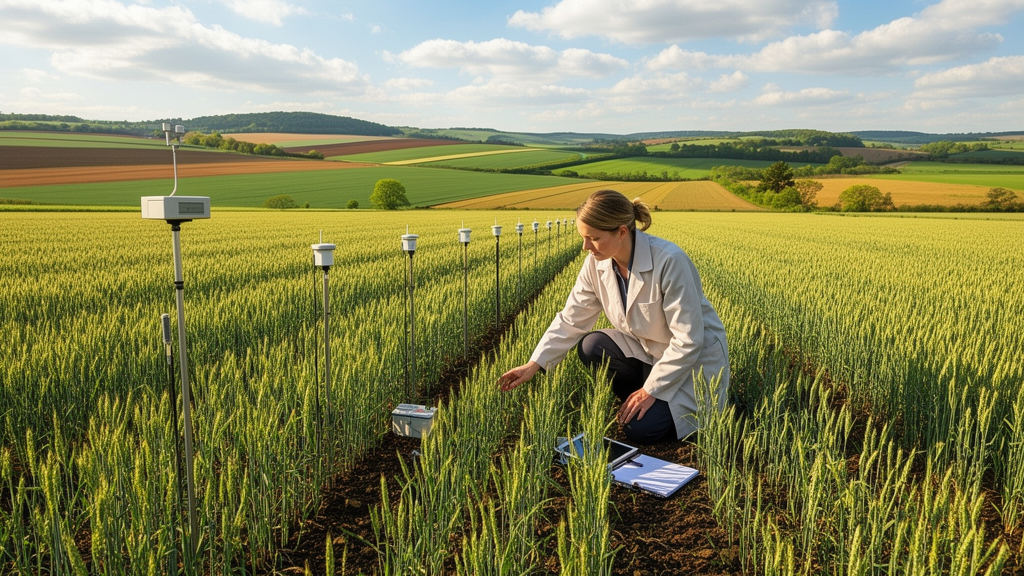
Crop breeders have long relied on two pillars of modern plant science: genotyping, which reads the genetic makeup of a plant, and phenotyping, which measures the traits that result. A new review published in Innovations in Agriculture argues that a third pillar, enviro-typing, deserves equal billing. By systematically measuring every environmental factor that influences plant growth and yield, enviro-typing promises to transform how scientists develop crops that can withstand the mounting pressures of climate change. The approach, first framed conceptually by plant geneticist Yong Suk Xu in 2016, treats the environment not as background noise but as a quantifiable, predictable dimension of crop performance that can be captured, modeled, and exploited in breeding decisions.
The core idea is deceptively simple. A plant’s observable characteristics, its phenotype, are the product of its genotype interacting with its environment. Yet for decades, breeding programs have measured genetics with increasing precision while treating environmental variation as an inconvenient confound. Enviro-typing flips that logic. It calls for high-resolution profiling of climate variables, soil properties, crop canopy architecture, agronomic management practices, and even companion organisms such as microbes, pests, and weeds. When these data are collected across multiple locations and seasons, researchers can partition crop phenotypes into distinct contributions from genetic effects, environmental effects, genotype-by-environment interactions, and experimental error. That decomposition is what allows breeders to predict, rather than merely observe, how a given variety will perform in a specific field.
The technical machinery behind this vision draws on several converging technologies. Geographic Information Systems integrate trial coordinates with layered datasets spanning weather records, vegetation cover, and soil types. Global soil databases, including the World Soil Information Service run by ISRIC and the European Soil Data Centre, now provide standardized, quality-controlled soil profiles, and machine learning approaches such as digital soil mapping are sharpening spatial predictions. Remote sensing platforms, from satellites to drones fitted with thermal and multispectral cameras, capture canopy characteristics across thousands of field plots in a single flight. Internet of Things sensors stream real-time soil moisture and microclimate data. Together, these tools convert what was once descriptive environmental profiling into a predictive framework that feeds directly into statistical models of crop performance.
Managing genotype-by-environment interaction remains the central statistical challenge. The same genotype can excel in one field and fail in another, and this interaction has historically muddied selection decisions. Tools such as the GGE biplot allow breeders to visualize performance and stability across environments, but enviro-typing goes further by supplying the environmental covariates that explain why a variety succeeds or struggles. In multi-environment trials, where diverse genotypes are evaluated across locations and seasons with replications, comprehensive environmental characterization strengthens phenotypic predictions and reduces confounding. Practical steps also matter: selecting trial sites with uniform soil texture and fertility, maintaining consistent crop rotations, and applying precise management practices all raise the signal-to-noise ratio so that observed differences more faithfully reflect true genetic responses.
The urgency of this work is underscored by the trajectory of global climate. Erratic rainfall, heatwaves, droughts, frosts, rising pest pressure, and shifting atmospheric carbon dioxide and ozone levels are already degrading agricultural productivity through direct physiological effects, indirect damage to soil fertility, and socioeconomic disruption of food systems. Agriculture itself contributes to the problem through emissions of carbon dioxide, methane, and nitrous oxide, creating a feedback loop that climate-smart agriculture seeks to break. That framework, promoted by the Food and Agriculture Organization of the United Nations, pursues three objectives: sustainably increasing productivity and incomes, building resilience to climate change, and reducing greenhouse gas emissions where possible. Enviro-typing aligns squarely with these goals, enabling breeders to select genotypes that perform reliably under extreme and variable conditions.
The review documents striking real-world successes across major crops. In the United States, sorghum breeding programs have combined genomic prediction models with enviromic data drawn from weather records, soil maps, and unmanned aerial vehicles, improving hybrid yield prediction and defining production zones. European soybean researchers analyzed more than 600 growing environments using climate data during key phenological stages, identifying five distinct environment types that explained nearly 88 percent of the yield variation attributable to environment. In Brazil, maize scientists generated over 10,000 digital environmental markers from satellite, soil, and weather information to match specific genotypes to the most suitable regions, accelerating hybrid selection. Upland rice studies in Brazil revealed adaptation gaps by elevation, showing that many varieties were better suited to high altitudes than the zones where they are currently grown.
Wheat breeding in Brazil’s Cerrado region offers perhaps the most vivid illustration of enviro-typing’s diagnostic power. By characterizing temperature stress across trial environments, researchers pinpointed the threshold at which yields begin to decline: flowering-season temperatures above 30 degrees Celsius, even under irrigation. That insight led to the identification of heat-tolerant varieties producing up to 32 percent more grain under stress. Beyond cereals, chickpea, groundnut, and common bean programs are pairing enviro-typing with genomic selection and high-throughput phenotyping to accelerate climate-resilient breeding in resource-limited settings. Global initiatives such as Genomes to Fields, which has assembled more than 70,000 phenotypic records across maize, wheat, soybean, and legumes, demonstrate how large-scale integration of genetic, environmental, and performance data can power the next generation of variety development.
Crop modeling is where these data streams ultimately converge. Physiologically based models such as EPIC and AQUACROP simulate photosynthesis, nutrient uptake, and water use with biological realism, though they demand detailed inputs. Genomic prediction models estimate genetic values and can be coupled with ecophysiological models to capture genotype-specific parameters. Machine learning and deep learning approaches excel at handling the non-linear relationships embedded in massive datasets, while ensemble methods that combine multiple model types have delivered superior maize yield predictions. The frontier lies in integration: frameworks that merge crop growth models with whole-genome prediction, augmented by high-throughput enviro-typing and convolutional neural networks, are improving yield forecasts across environments. Challenges persist, including heavy computational demands, the difficulty of interpreting model parameters in genetic terms, and the risk of overfitting, but the review argues that standardized data protocols, ontology-controlled vocabularies, and interoperable query systems are the keys to unlocking this potential.
The authors also frame the work through a four-dimensional profile of crop breeding that unites genotype, phenotype, envirotype, and time. The spatial dimensions capture a plant’s genetic makeup, its observable traits, and the environmental conditions shaping them, while the temporal dimension tracks development from germination to maturity. This G-by-E-by-T framework allows breeders to follow how genetic potential unfolds across developmental stages under real-world conditions, opening the door to precision breeding systems tailored to specific crops and growing environments. Realizing it will require high-throughput phenotyping and genotyping platforms, dense enviro-typing sensor networks, artificial intelligence, and high-performance computing infrastructure capable of analyzing the resulting data torrents.
Equity is a recurring theme in the review’s outlook. In developing regions, adopting enviro-typing will require far more than new tools: sustained, context-specific training for farmers and extension workers, supportive policies that offer accessible credit rather than free inputs, and strong community institutions such as farmer cooperatives. Promoting low-external-input farming can make these approaches safer and more cost-effective, while addressing structural barriers, including unequal access to resources and decision-making for women and marginalized groups, is essential for lasting change. The authors conclude that enviro-typing is not a luxury for well-funded programs in wealthy countries but a critical resource for anyone seeking sustainable crop improvement. As environmental variability intensifies, the ability to measure, model, and predict the environment may prove as important to food security as reading the genome itself.
Subject of Research: Enviro-typing as a framework for environmental characterization in crop improvement and climate-resilient breeding
Article Title: Harnessing enviro-typing for the development of resilient crops: advancing environmental characterization in crop improvement strategies
Article References: Harnessing enviro-typing for the development of resilient crops: advancing environmental characterization in crop improvement strategies. (n.d.). https://doi.org/10.3897/ia.2025.157255
Image Credits: AI Generated
Keywords: enviro-typing, crop breeding, genotype-by-environment interaction, climate-smart agriculture, multi-environment trials, genomic prediction, remote sensing, soil data, crop modeling, precision agriculture, food security, phenotyping
Cite Scienmag News
Alan Morgan. (October 16, 2026). Enviro-typing: the third pillar reshaping climate-resilient crop breeding. Scienmag. https://scienmag.com/enviro-typing-the-third-pillar-reshaping-climate-resilient-crop-breeding/
Alan Morgan. "Enviro-typing: the third pillar reshaping climate-resilient crop breeding." Scienmag, 16 October 2026, https://scienmag.com/enviro-typing-the-third-pillar-reshaping-climate-resilient-crop-breeding/. Accessed 16 October 2026.
Alan Morgan. "Enviro-typing: the third pillar reshaping climate-resilient crop breeding." Scienmag. October 16, 2026. https://scienmag.com/enviro-typing-the-third-pillar-reshaping-climate-resilient-crop-breeding/


