


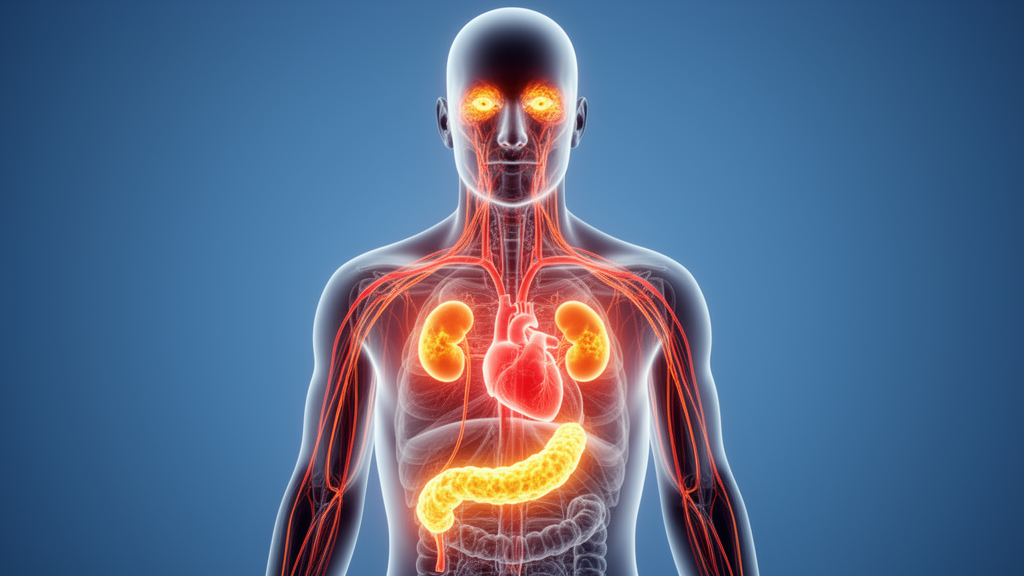
Type 2 diabetes has long been described, in clinics and in the popular imagination, as a disease of blood sugar. Yet a growing body of research argues that this framing is far too narrow. A new Research Topic published in Frontiers in Clinical Diabetes and Healthcare, assembled by an editorial team led by Toshiki Otoda of Nihon University School of Medicine, gathers ten studies that together paint type 2 diabetes mellitus as a systemic disease in which metabolic overload, oxidative stress, inflammation, hypoxia, and mitochondrial dysfunction interact to drive progressive injury to the kidneys, nerves, blood vessels, and heart. The collection’s central message is striking: diabetic complications are not the product of any single molecular villain, but of an interconnected network of stress responses that can either adapt to damage or accelerate it.
The clearest thread running through the collection concerns inflammation, and in particular whether modern diabetes drugs do more than lower glucose. In one of the largest analyses included, Alrasheed and colleagues pooled evidence from 40 randomized controlled trials covering 6,029 participants and found that glucagon-like peptide-1 receptor agonists, the drug class behind blockbuster therapies such as semaglutide, significantly reduced major inflammatory biomarkers, most notably C-reactive protein and tumor necrosis factor-alpha. That effect was observed beyond the drugs’ established glycemic control, supporting the idea that part of their cardiovascular benefit may stem from dampening chronic low-grade inflammation rather than from sugar lowering alone. The finding adds mechanistic weight to clinical observations that these agents protect organs in ways that glucose numbers cannot fully explain.
Inflammation in diabetes is not uniform, however, and a second study underscored just how heterogeneous the immune landscape can be at the moment of diagnosis. Tleumagambetova and colleagues examined the balance between interleukin-1beta, a potent pro-inflammatory cytokine, and its natural brake, the interleukin-1 receptor antagonist, in adults newly diagnosed with diabetes. They found lower circulating levels of the receptor antagonist and a higher pro- to anti-inflammatory ratio in individuals who tested positive for islet autoantibodies, markers more often associated with autoimmune forms of the disease. The result suggests that immunometabolic heterogeneity exists right from disease onset, meaning that two patients with identical glucose profiles may sit on very different inflammatory trajectories and may require different therapeutic strategies.
Hypoxia, the cellular response to low oxygen, provides another critical link between metabolic stress and organ damage. In a systematic review and meta-analysis, Su and colleagues examined peripheral blood levels of hypoxia-inducible factor-1alpha, or HIF-1alpha, a master transcriptional regulator switched on when cells sense oxygen deprivation. They found associations between elevated circulating HIF-1alpha and adverse metabolic indices reflecting pancreatic beta-cell dysfunction and insulin resistance. In a companion meta-analysis, the same team extended the analysis to HIF-1alpha alongside sirtuin 1, an NAD-dependent deacetylase central to cellular stress resistance, and vascular endothelial growth factor, the principal driver of new blood vessel formation, revealing altered hypoxic and vascular adaptive responses across diabetic complications.
The authors of the editorial caution, however, that these findings must be interpreted carefully. Circulating markers of hypoxic signaling do not necessarily mirror what is happening inside target tissues, where HIF-1alpha may behave very differently depending on cell type and disease stage. Distinguishing blood-borne signals from tissue-specific signaling is, they argue, an essential next step if researchers hope to understand whether the hypoxic response in diabetes is a protective adaptation that has gone awry or a direct contributor to pathology. The distinction matters enormously for drug development, because blindly activating or suppressing HIF-1alpha could do harm if the biology is misread.
At the cellular level, the collection homes in on mitochondria, the power plants whose dysfunction sits at the intersection of metabolic stress and organ injury. Tamaki and colleagues investigated bone morphogenetic protein 4, or BMP4, a signaling molecule previously associated with scarring and extracellular matrix production in diabetic nephropathy, the kidney complication that remains a leading cause of dialysis worldwide. They demonstrated that BMP4 stimulation led to downregulation of Parkin, a protein responsible for tagging damaged mitochondria for removal, and to impaired mitochondrial homeostasis in mesangial cells, the support cells of the kidney’s filtering units. Crucially, both ALK inhibition and Parkin overexpression ameliorated several of these mitochondrial abnormalities, extending BMP4’s role beyond matrix production into the realm of mitochondrial quality control.
Not every intervention tested in the collection produced clean answers, and that may be its most scientifically honest feature. Kubo and colleagues compared the selective lipid-lowering agent pemafibrate against the omega-3 fatty acid eicosapentaenoic acid in patients with both type 2 diabetes and hypertriglyceridemia. Pemafibrate achieved a greater reduction in malondialdehyde-modified low-density lipoprotein, a chemically altered cholesterol particle implicated in atherosclerosis. Yet urinary 8-hydroxy-2′-deoxyguanosine, a marker of oxidative damage to DNA, and high-sensitivity C-reactive protein did not differ significantly between the two treatments. The takeaway, according to the editors, is that oxidative stress is biologically heterogeneous, and that reading a single biomarker as a proxy for the body’s entire redox state invites misleading conclusions.
Nutrition and environment also emerge as modifiable levers. Wang and colleagues applied machine-learning approaches to dietary oxidative balance, the ratio of antioxidant to pro-oxidant components in the diet, and identified vitamin E, magnesium, and beta-carotene among the factors associated with renal impairment defined by the urinary albumin-to-creatinine ratio, a standard clinical measure of kidney damage. Exploratory experiments implicated AKT-related signaling, a central growth and survival pathway, as a possible mechanistic mediator. On the environmental front, Zhang and colleagues reported interactions between temperature, humidity, and tongue color in patients with diabetes, with the associations particularly pronounced among individuals with cardiovascular complications, hinting that environmental stress may interact with impaired microcirculatory adaptation in measurable ways.
The clinical stakes of these molecular networks are laid bare in two studies of established complications. Rashwan and colleagues, studying 387 patients with diabetic peripheral neuropathy, identified smoking, a history of foot ulceration or amputation, and advanced chronic kidney disease as the factors most strongly associated with loss of protective sensation, the deficits that precede the foot ulcers and amputations that make diabetes one of the leading causes of limb loss worldwide. Meanwhile, Srithongchai and colleagues reviewed the advanced glycation end-product and its receptor, the AGE-RAGE axis, as a pathogenic signaling network. Membrane-bound RAGE, they argue, serves as an interface connecting carbonyl and oxidative stress with inflammatory activation, while soluble RAGE isoforms may act as decoy receptors that blunt the damage. Importantly, the review reframes RAGE’s physiological function as the selective modulation of pathogenic signaling rather than indiscriminate receptor activity, suggesting that future therapies should aim for precision rather than blanket blockade.
Taken together, the ten contributions portray diabetic complications as products of an interconnected network operating across tissues and disease stages rather than the work of any single pathway. Metabolic overload, oxidative and carbonyl stress, inflammation, hypoxic responses, mitochondrial dysfunction, environmental influences, and impaired adaptive mechanisms all feed into one another, which is why changes in any individual molecular marker cannot be interpreted in isolation. The editors argue that future research should focus on defining the molecular switches that determine whether stress responses remain adaptive or turn pathogenic, on integrating complementary biomarkers across biological compartments, and on testing whether selective modulation of these pathways can translate into genuine prevention of organ injury. If successful, such mechanism-based strategies could move the management of type 2 diabetes beyond the glucose meter, toward treating the web of stress and inflammation that ultimately destroys organs.
Subject of Research: Oxidative stress and inflammatory pathways driving organ complications in type 2 diabetes
Article Title: Editorial: Oxidative stress and inflammation in type 2 diabetes: pathways to organ complications
Article References: Editorial: Oxidative stress and inflammation in type 2 diabetes: pathways to organ complications. (n.d.). https://doi.org/10.3389/fcdhc.2026.1976753
Image Credits: AI Generated
DOI: 10.3389/fcdhc.2026.1976753
Keywords: type 2 diabetes, oxidative stress, inflammation, GLP-1 receptor agonists, HIF-1alpha, mitochondrial dysfunction, diabetic nephropathy, RAGE, diabetic neuropathy, biomarkers, AGEs, diabetic complications
Cite Scienmag News
Ophelia Keating. (October 16, 2026). Diabetes Damages Organs Through a Web of Stress and Inflammation, Landmark Collection Shows. Scienmag. https://scienmag.com/diabetes-damages-organs-through-a-web-of-stress-and-inflammation-landmark-collection-shows/
Ophelia Keating. "Diabetes Damages Organs Through a Web of Stress and Inflammation, Landmark Collection Shows." Scienmag, 16 October 2026, https://scienmag.com/diabetes-damages-organs-through-a-web-of-stress-and-inflammation-landmark-collection-shows/. Accessed 16 October 2026.
Ophelia Keating. "Diabetes Damages Organs Through a Web of Stress and Inflammation, Landmark Collection Shows." Scienmag. October 16, 2026. https://scienmag.com/diabetes-damages-organs-through-a-web-of-stress-and-inflammation-landmark-collection-shows/


