


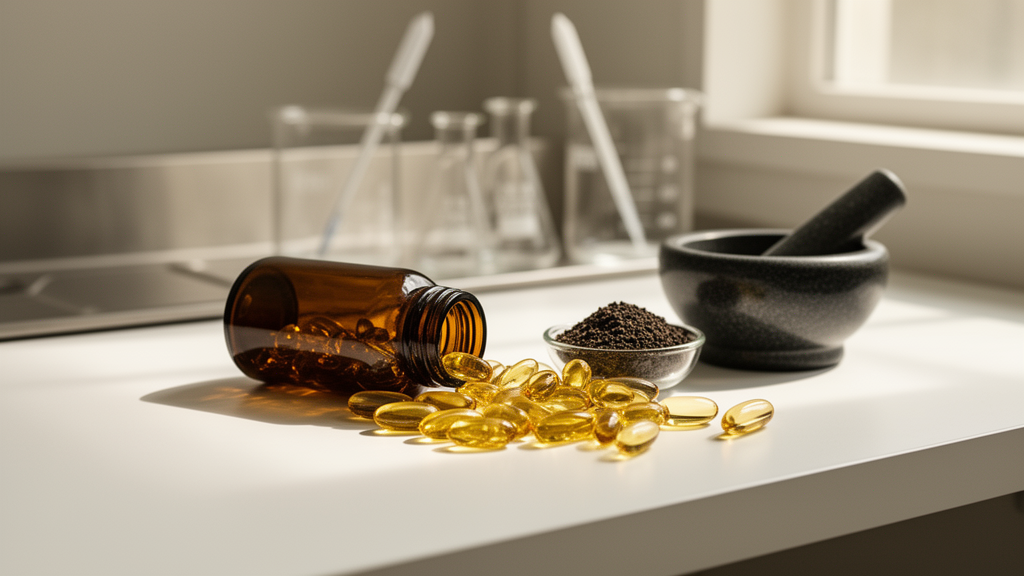
Black pepper extract has become one of the most fashionable ingredients in the dietary supplement industry, appearing on labels as a guarantee of “enhanced absorption” and “improved bioavailability.” Its active alkaloid, piperine, is marketed as a bioenhancer, and the most famous statistic in the field comes from a widely cited 1998 study reporting that just 20 milligrams of piperine increased systemic exposure to curcumin, the yellow pigment in turmeric, by roughly 2,000 percent. On the surface, adding piperine to a multivitamin or herbal blend looks like clever formulation. A new Perspective published in Frontiers in Nutrition argues that, in most cases, the opposite is true: piperine is being added to supplements without any defensible scientific rationale, while carrying a well-documented capacity to interfere with prescription drugs.
The core of the problem lies in how piperine actually works. It does not primarily help nutrients cross the intestinal wall. Instead, it inhibits the body’s machinery for eliminating foreign compounds, including the liver enzyme CYP3A4, the related enzyme CYP2C9, and the efflux transporter P-glycoprotein. These systems act as shared metabolic gatekeepers for a large fraction of orally administered drugs. When piperine blocks them, co-administered substances accumulate in the bloodstream, whether or not they are the intended target. The author, Masaki Kaneko of KYB Medical Service and KYB Orthogenics in Tokyo, compares the mechanism to the well-known food–drug interactions caused by grapefruit juice and St. John’s wort, both of which also modulate CYP3A4 activity.
The clinical consequences are not hypothetical. In controlled human pharmacokinetic studies, ten days of piperine at 20 milligrams per day increased the area under the concentration–time curve of the anticonvulsant carbamazepine by about 48 percent. In patients with epilepsy, single doses of piperine significantly raised carbamazepine concentrations and prolonged its half-life, and piperine also increased exposure to the anticonvulsant phenytoin. For the anti-inflammatory drug diclofenac, co-administration increased drug exposure by roughly 66 percent and extended its half-life by 34 percent, consistent with CYP2C9 inhibition. Physiologically based pharmacokinetic modeling predicts that 20 milligrams of piperine daily would raise exposure to several CYP3A4 substrates by more than 25 percent, including increases of about 34 percent for nifedipine, 35 percent for cyclosporine, and 59 percent for simvastatin. The greatest concern involves narrow-therapeutic-index drugs such as phenytoin and carbamazepine, where even modest increases in blood levels can trigger toxicity, including nystagmus and ataxia. Similar caution applies to anticoagulants, digoxin, and immunosuppressants.
Of the 14 tabulated drug-interaction studies, 12 showed increased exposure to the co-administered medication, spanning rifampicin, propranolol, theophylline, nevirapine, midazolam, chlorzoxazone, and fexofenadine. Two exceptions are instructive. A two-day course of a combined curcuminoid–piperine preparation did not alter the pharmacokinetics of midazolam, flurbiprofen, or paracetamol, whereas three days of piperine alone increased midazolam exposure, a discrepancy that remains unexplained. And in breast cancer patients, curcumin plus piperine reduced exposure to endoxifen, the active metabolite of tamoxifen, by 12.4 percent, showing that the direction of an interaction cannot be assumed to be an increase.
The nutrient side of the evidence tells a strikingly different story. Kaneko compiled a structured summary of 22 human pharmacokinetic studies and classified them by funding and affiliation. Nearly all the studies reporting enhanced absorption of nutrients or phytochemicals were conducted or funded by the manufacturer of the piperine ingredient, enrolled small numbers of healthy volunteers, and used plasma concentration as a surrogate endpoint. The celebrated 2,000 percent curcumin figure was calculated against a baseline so low that curcumin given alone was barely detectable in the assay. For beta-carotene, a 14-day crossover study in men with low baseline values showed a greater serum response with piperine, and for coenzyme Q10 only the 21-day, 120-milligram arm showed an increase of about 30 percent, with shorter comparisons showing no significant effect. For vitamin B6, selenium, and vitamin C, the human evidence exists, as far as the author could determine, only in manufacturer summaries or conference abstracts rather than peer-reviewed reports.
Independent trials have largely failed to confirm the enhancement claims. In three crossover studies of curcumin formulations involving 12, 30, and 9 healthy adults, piperine-containing preparations did not differ significantly from native curcumin or standard extract. Solubility-based approaches performed far better: in one trial, micellar formulations achieved 57-fold higher curcumin exposure and gamma-cyclodextrin complexes 30-fold higher, without any piperine at all. When researchers measured unconjugated curcumin separately, it remained below 2 nanomolar in most participants even after 2,280 milligrams of curcumin with 20 milligrams of piperine, suggesting that earlier studies measuring total curcumin, conjugated and unconjugated together, may have overstated the effect. For resveratrol, 20 milligrams of piperine left plasma concentrations of the parent compound and its metabolites unchanged. A 2025 three-arm study drove the point home: curcuminoid exposure rose dramatically when the proportion of long-pepper extract increased from 1 to 10 percent, yet the high-piperine arm still did not outperform a piperine-free comparator extract given at less than half the curcuminoid dose.
Beyond drug interactions, a subtler hazard arises from inadvertent supplement–supplement combinations. Curcumin appears in small amounts in many blended products marketed for joint, skin, gut, or liver support, so consumers may ingest it without considering themselves turmeric users. If they separately take a piperine-containing supplement, they unknowingly recreate the turmeric–piperine combination that has been linked to liver injury. In a United States registry series of ten adjudicated cases of turmeric-associated liver injury, five patients were hospitalized and one died; three of the seven products analyzed also contained piperine, and the investigators raised the possibility that the combination contributes to rising case numbers, though causation is unproven and absolute incidence appears low. Rising supplement-associated liver injury was highlighted at the 2026 Congress of the European Association for the Study of the Liver, and for context, supplement-related liver failure leading to liver transplant waitlisting in the United States has increased roughly eightfold over the past quarter century.
Kaneko is careful to note that piperine is not inherently a problem ingredient. Its inclusion is scientifically defensible when several conditions are met together: the target ingredient should have a documented bioavailability limitation that is mechanistically addressable by inhibiting first-pass metabolism or efflux, rather than poor solubility; enhancement should have been demonstrated in humans for the specific chemical form and dose used, preferably by independent investigators and, for heavily conjugated compounds, using the unconjugated fraction as the endpoint; the intended population should be defined and should not include people likely to be taking narrow-therapeutic-index drugs metabolized by CYP3A4, CYP2C9, or transported by P-glycoprotein; and the piperine dose should be the lowest shown to be effective, with clear label disclosure. On the evidence reviewed, few current products satisfy the second condition.
The Perspective also challenges assumptions about premium distribution channels. Labels such as “practitioner-exclusive” or “physician-dispensed” are marketing designations, not regulatory categories, and in the author’s observation piperine has now entered Japan’s clinic-dispensed supplement market, where users are especially likely to be taking prescription medications. Japan’s Foods with Function Claims framework operates on a notification system without pharmaceutical-style premarket evaluation, and the good manufacturing practice requirements that became mandatory on 1 September 2026, following the 2024 health-damage cases linked to a functional food product, address manufacturing quality rather than formulation appropriateness. A product can be manufactured to a high standard, free of contamination and accurately labeled, while still being formulated in a scientifically questionable way.
The practical implications reach clinicians, consumers, and industry alike. Clinicians should routinely ask about supplement use, including practitioner-exclusive products, when reviewing medications. Consumers can check labels for “black pepper extract,” “Piper nigrum extract,” “piperine,” or branded piperine ingredients, and should avoid unintentionally combining a piperine-containing supplement with a separate curcumin product. Label warnings advising people on anticonvulsants, anticoagulants, or immunosuppressants to consult a clinician are endorsed as necessary but insufficient, since a warning on one product cannot address risk created by combining two individually innocuous products, and cannot predict whether an interaction will raise or lower drug exposure. Regulators, the author suggests, could require that any “enhanced absorption” claim be backed by human data for the specific form and dose in the product, and pharmacovigilance systems should capture supplement–drug and supplement–supplement co-exposures. The broader message is that supplement formulation should be a deliberate, expert-driven discipline grounded in nutritional science and pharmacology, rather than an accumulation of trending ingredients, and that the ability to explain the rationale for every component is what separates a thoughtfully formulated product from one that is merely well manufactured.
Subject of Research: Piperine as a bioavailability enhancer in dietary supplements and its drug interaction risks
Article Title: Enhancement without a rationale? Black pepper extract (piperine) in dietary supplements and the future of formulation: a perspective from Japan
Article References: Kaneko, M. (2026). Enhancement without a rationale? Black pepper extract (piperine) in dietary supplements and the future of formulation: a perspective from Japan. Frontiers in Nutrition, 13, Article 1981406. https://doi.org/10.3389/fnut.2026.1981406
Image Credits: AI Generated
DOI: 10.3389/fnut.2026.1981406
Keywords: piperine, black pepper extract, dietary supplements, bioavailability, CYP3A4, P-glycoprotein, drug interactions, curcumin, turmeric, liver injury, formulation, Japan
Cite Scienmag News
Daisy Hatcher. (October 16, 2026). Black Pepper Extract in Supplements Boosts Drug Levels, Not Nutrient Absorption, Review Warns. Scienmag. https://scienmag.com/black-pepper-extract-in-supplements-boosts-drug-levels-not-nutrient-absorption-review-warns/
Daisy Hatcher. "Black Pepper Extract in Supplements Boosts Drug Levels, Not Nutrient Absorption, Review Warns." Scienmag, 16 October 2026, https://scienmag.com/black-pepper-extract-in-supplements-boosts-drug-levels-not-nutrient-absorption-review-warns/. Accessed 16 October 2026.
Daisy Hatcher. "Black Pepper Extract in Supplements Boosts Drug Levels, Not Nutrient Absorption, Review Warns." Scienmag. October 16, 2026. https://scienmag.com/black-pepper-extract-in-supplements-boosts-drug-levels-not-nutrient-absorption-review-warns/


