


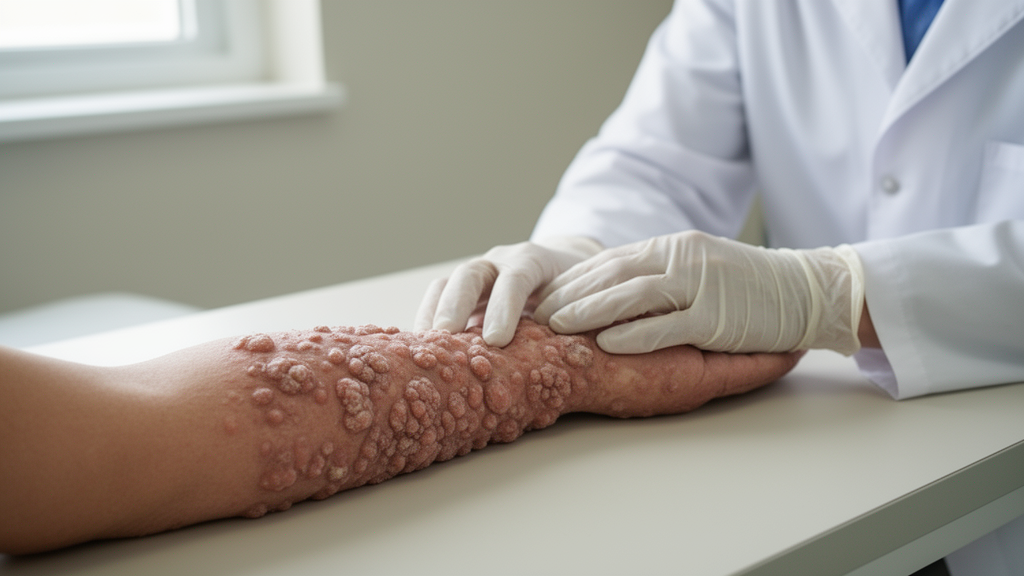
For millions of people living with prurigo nodularis, a chronic skin disease defined by relentlessly itchy, hard nodules, the arrival of targeted systemic therapies has felt like a turning point. Yet a fundamental question has lingered behind the clinical excitement: when, exactly, do these drugs start to work, and how solid is the evidence behind each one? A new systematic review and meta-analysis published in Frontiers in Medicine offers the most time-resolved answer to date, pooling direct placebo-controlled randomized data from eleven trials and 1,623 participants across six experimental therapies.
The research team, led by Yue Yu and colleagues at Guangzhou University of Chinese Medicine, took an unusually disciplined approach. Rather than collapsing all follow-up periods into a single estimate, they prespecified five time points—weeks 4, 8, 12, 16, and 24—and analyzed each outcome separately at each interval. They also refused to treat incompatible scales or analysis populations as interchangeable. The goal was not simply to ask whether targeted therapy works, but to distinguish replicated phase 3 evidence from preliminary signals and to pinpoint the moments at which different domains of benefit first become measurable.
The primary outcome was demanding: a drop of at least four points on the weekly average Worst Itch or Peak Pruritus Numerical Rating Scale, validated patient-reported instruments in which patients rate their most intense itch on a scale from zero to ten. Across the trials contributing to each time point, active treatment outperformed placebo at week 4 with a risk ratio of 4.76, meaning treated patients were nearly five times as likely to achieve the itch-response threshold. The benefit persisted at week 12 (risk ratio 2.67), week 16 (3.32), and week 24 (3.09), with tight confidence intervals and negligible statistical heterogeneity at weeks 4, 16, and 24.
One result stood out for its ambiguity. At week 8, the pooled estimate—drawn from just two early-phase trials with 72 participants—favored treatment but its confidence interval crossed the null (risk ratio 1.73, 95% CI 0.94–3.21). The authors attribute this imprecision to limited statistical power and the information lost when continuous itch scores are dichotomized into responders and non-responders. Continuous measures told a more consistent story: percentage change from baseline in itch intensity favored active treatment at every analyzed time point, with reductions of roughly 30 to 34 percentage points relative to placebo.
Lesion healing followed a slower trajectory. Investigator’s Global Assessment success—clear or nearly clear skin by trial-defined criteria—was statistically imprecise at week 4 but became robustly supported from week 8 onward, with risk ratios between 2.84 and 3.85 across weeks 8 through 24. This temporal gap between symptom relief and visible skin improvement is one of the review’s most clinically interesting findings. In the better-developed trial programs, patients felt better before their skin looked better, a pattern the authors say should inform how clinicians and patients set expectations during the early weeks of treatment.
Two therapies dominated the evidence hierarchy. Dupilumab, which blocks the interleukin-4 receptor alpha subunit, and nemolizumab, which targets the interleukin-31 receptor alpha, were each backed by replicated phase 3 programs. In two dupilumab phase 3 trials, 54 of 153 treated participants achieved a same-patient dual response at week 24—simultaneous itch reduction and lesion clearance—compared with 14 of 158 on placebo, a risk ratio of 3.98. Nemolizumab, meanwhile, produced the broadest time-resolved dataset, with consistent benefits across itch, lesions, sleep, and quality of life, and the largest safety dataset in the review.
The patient-reported outcomes revealed benefits that extend beyond the skin. Nemolizumab improved sleep—measured as a four-point or greater drop on the Sleep Disturbance Numerical Rating Scale—as early as week 4, with the effect sustained at week 16. Quality of life, captured by the Dermatology Life Quality Index, improved significantly at weeks 16 and 24, with pooled mean differences of roughly seven points, a magnitude dermatologists consider clinically meaningful. Small but consistent improvements also appeared on the anxiety and depression subscales of the Hospital Anxiety and Depression Scale at week 24, though the authors caution these psychological findings remain exploratory and cannot establish a direct psychotropic effect.
Safety data were reassuring in the short term but incomplete. Treatment-emergent adverse events were modestly more frequent with active treatment (risk ratio 1.14), yet serious adverse events and discontinuations showed no clear increase, and a single death occurred in a placebo group. Estimates for specific events—conjunctivitis, headache, edema, and eczematous reactions—all had confidence intervals crossing the null. The authors note biologically plausible patterns: conjunctivitis clustered in the interleukin-4 blockade program, while headache and eczematous events appeared more often in some interleukin-31 trials. But with randomized follow-up of only 8 to 24 weeks, rare, delayed, and cumulative harms remain invisible.
The review is equally candid about what it cannot say. Because most pooled analyses included only two to four trials, heterogeneity estimates were unstable, and because different therapies informed different time points, the apparent early-symptom-late-lesion sequence cannot be generalized as a class effect. No head-to-head trials exist, so the data do not support ranking one drug above another. Vixarelimab, which blocks the oncostatin M receptor beta, showed promising preliminary signals across multiple domains but lacks phase 3 confirmation. Barzolvolimab, an anti-KIT antibody, rests on a single 23-participant proof-of-concept trial. Serlopitant showed antipruritic benefit in one phase 2 study, and extended-release nalbuphine failed its primary intention-to-treat analysis, with favorable signals confined to a high-dose completer subset.
For a disease long dismissed as treatment-refractory, the message is nonetheless striking. Replicated randomized evidence now confirms that dupilumab and nemolizumab deliver clinically meaningful relief from itch, lesions, sleep disruption, and degraded quality of life—and that relief may begin within a month. The authors call for future trials to harmonize outcome definitions, report same-patient multidomain responses, incorporate active comparators, and extend safety follow-up well beyond two years. Until then, this analysis provides clinicians with something they have rarely had in prurigo nodularis: a transparent map of what the evidence shows, when it shows it, and how much confidence each finding deserves.
Subject of Research: Systematic review and meta-analysis of systemic targeted therapies for prurigo nodularis
Article Title: Direct randomized evidence for systemic targeted therapies in prurigo nodularis: a systematic review and meta-analysis
Article References: Yu, Y., Li, S., Chen, W., & Chen, X. (2026). Direct randomized evidence for systemic targeted therapies in prurigo nodularis: a systematic review and meta-analysis. Frontiers in Medicine, 13, Article 1942040. https://doi.org/10.3389/fmed.2026.1942040
Image Credits: AI Generated
DOI: 10.3389/fmed.2026.1942040
Keywords: prurigo nodularis, dupilumab, nemolizumab, meta-analysis, randomized controlled trials, itch, chronic pruritus, sleep disturbance, quality of life, drug safety, dermatology, targeted therapy
Cite Scienmag News
Ophelia Keating. (October 16, 2026). Itch Relief Arrives Before Skin Healing in Prurigo Nodularis, Landmark Analysis of 11 Trials Finds. Scienmag. https://scienmag.com/itch-relief-arrives-before-skin-healing-in-prurigo-nodularis-landmark-analysis-of-11-trials-finds/
Ophelia Keating. "Itch Relief Arrives Before Skin Healing in Prurigo Nodularis, Landmark Analysis of 11 Trials Finds." Scienmag, 16 October 2026, https://scienmag.com/itch-relief-arrives-before-skin-healing-in-prurigo-nodularis-landmark-analysis-of-11-trials-finds/. Accessed 16 October 2026.
Ophelia Keating. "Itch Relief Arrives Before Skin Healing in Prurigo Nodularis, Landmark Analysis of 11 Trials Finds." Scienmag. October 16, 2026. https://scienmag.com/itch-relief-arrives-before-skin-healing-in-prurigo-nodularis-landmark-analysis-of-11-trials-finds/


