


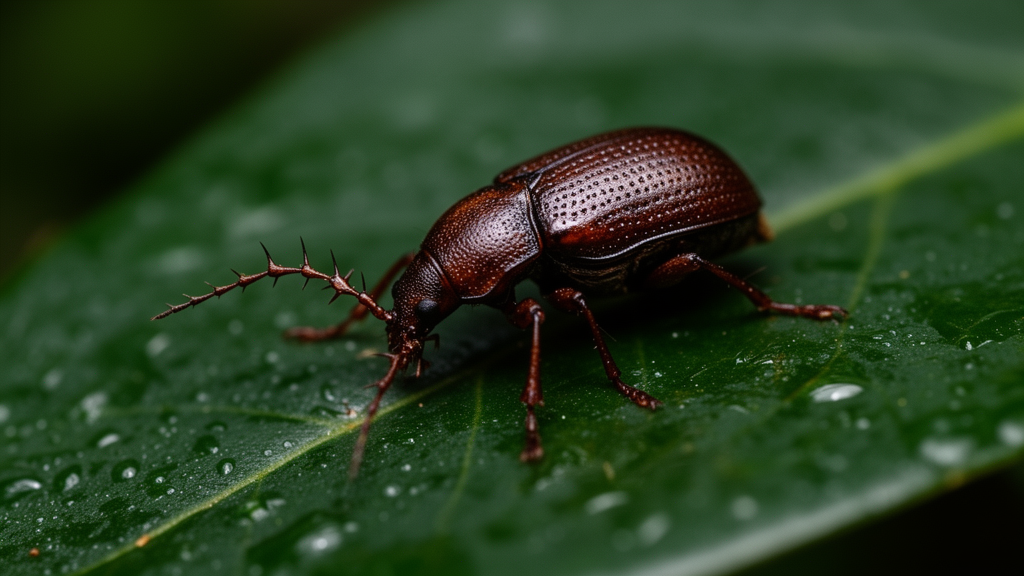
Deep in the rainforests of Northern Sumatra, a tiny beetle has been quietly defying everything entomologists thought they knew about its family. Described in the Deutsche Entomologische Zeitschrift, the new species Sundaloma seideli represents not just a new species but an entirely new genus within the beetle family Discolomatidae, a group so neglected by modern taxonomy that many regions of the world remain virtually unexplored with respect to its diversity. The discovery, based on a single female specimen collected in 1990 near Bukit Lawang and housed in the Naturhistorisches Museum Wien, reveals an insect so morphologically unusual that its external appearance has no parallel among Asian discolomatids.
Discolomatidae is a small family of beetles within the superfamily Coccinelloidea, comprising nearly 500 valid species names grouped into 16 genera, seven tribes, and five subfamilies according to the most recent world checklist. These beetles are mycophagous, feeding on fungi, and have a primarily tropical and subtropical distribution. The current classification of the family was proposed by John in 1954, but researchers have long suspected it to be highly artificial, with definitions of subfamilies and tribes not based on morphological characteristics that define higher taxa in modern taxonomy. Since John’s intensive studies in the 1930s through the 1960s, the family has attracted little interest among entomologists, leaving vast gaps in knowledge about its true diversity and evolutionary relationships.
The newly described beetle measures just 2.33 millimeters in length and 1.54 millimeters in width, with a black body that is elongate and broadly oval with subparallel sides. What makes Sundaloma seideli so extraordinary is its dorsal surface, which appears distinctly spherical and convex, giving the insect an almost hemispherical profile from the side. The body is black, with only the anterolateral margins of the pronotum light brown, and the dorsal vestiture is white. Only the lateral margins of the pronotum and elytra bear very short, sparse hairs, making the dorsal body surface appear essentially glabrous.
The most striking feature of this new genus is that the anteriorly extended pronotum entirely covers the head from above, rendering it completely invisible from a dorsal view. In similar-looking genera such as Cassidoloma from Africa and Discoloma from the Americas, the anterior prosternal margin is always deeply emarginate, and at least the anterior portion of the head remains visible. Sundaloma is the only taxon in the entire family with a completely arcuate anterior margin of the prosternum that entirely conceals the head. This feature alone distinguishes it from every other known discolomatid beetle.
Equally unusual are the legs of Sundaloma seideli. The femora are distinctly flattened and broadly expanded, together with the trochanter forming a broad sub-oval outline. The tibiae are broad and flattened, with patches of stiff and long bristles in their apical parts, and tibial spurs are absent. The tarsi follow a 3-3-3 formula, with the first and second tarsomeres bearing small rounded ventral lobes. This broadened and flattened leg morphology is a unique feature among discolomatids, setting the new genus apart from all other members of the family, where legs are generally more slender.
The elytra, or wing covers, also display remarkable modifications. Their lateral margins are broadly explanate and upturned in frontal view, well visible throughout from above, with a broad lateral bead. The elytral disc bears irregular punctation with punctae of double size intermixed, and the lateral edge carries six glandular pores, four of which are more or less visible from above while two distal ones are placed on the margin and not visible from above. The epipleura, the folded inner portions of the elytra, are very broad and complete. SEM imaging conducted at the Laboratory of Scanning Microscopy in Warsaw using a Hitachi S-3400N under low vacuum conditions revealed these structures in extraordinary detail, including the outlets of glandular pores indicated by arrows in the published micrographs.
The head itself, though deeply retracted into the prothorax and concealed from above, bears small elliptical eyes with coarse facets and no interfacetal setae. The antennae are nine-segmented with a one-segmented club, and the ventral antennal grooves are very deep, extending well beyond the posterior margin of the eyes. The mouthparts show a distinctive arrangement, with bidentate apically mandibles and maxillary palps of four palpomeres where the second is large and inflated while the third is reduced and ring-like. The labial palp has three palpomeres with a similar pattern of reduction and inflation.
Despite its unusual morphology, other features allow the new genus to be placed in the tribe Aphanocephalini. The anterior corners of the pronotum are acute, fitting into oblique depressions on the elytra, the prosternal process is broad, and the mesoventral process has a broadly rounded anterior margin. These characters show similarities with the genus Aphanocephalus, supporting the tentative placement within Aphanocephalini. However, the author notes that the current classification proposed by John in 1954 appears to be artificial, and the definitions of subfamilies and tribes are not based on morphological characteristics that define higher taxa in modern taxonomy.
The generic name Sundaloma is derived from the Sunda Islands, to which Sumatra belongs, combined with the suffix -loma frequently used in discolomatid generic names such as Cassidoloma and Discoloma. The specific epithet seideli honors Matthias Seidel, an expert in Scarabaeidae: Rutelinae and curator of Coleoptera at the Naturhistorisches Museum Wien, who provided the opportunity to study the discolomatid material from the Wien collection. The holotype, a single female, bears the label N-Sumatra, 1990, Bukit Lawang, leg. Jäch, and is deposited in the Naturhistorisches Museum Wien.
The discovery of Sundaloma seideli raises important questions about the evolutionary relationships within Discolomatidae. The new genus is the first discolomatid taxon from Asia with such an extraordinary external appearance characterized by broadly expanded and upturned lateral margins. While it superficially resembles Cassidoloma and Discoloma, both placed in the tribe Discolomatinae sensu John 1954, the differences are substantial enough to call into question the placement of those two genera within a single tribe. In Cassidoloma the prosternal process is rather narrow, whereas in Discoloma it is broad, and the legs, especially the tibiae, are slender in Cassidoloma while slightly broadened in Discoloma, though not to the extent observed in Sundaloma. This brief synopsis of characters shows that a modern revision of the entire family is necessary, and the description of this single female may accelerate the discovery of similar taxa in other collections around the world.
Subject of Research: Taxonomy
Article Title: A new unusual discolomatid beetle from the Northern Sumatra ( Coccinelloidea , Discolomatidae )
Article References: Szawaryn, K. (2026). A new unusual discolomatid beetle from the Northern Sumatra (Coccinelloidea, Discolomatidae). Deutsche Entomologische Zeitschrift, 73(2), 315-321. https://doi.org/10.3897/dez.73.198901
Image Credits: AI Generated
Keywords: Discolomatidae, Sumatra, beetle taxonomy, new species, Coleoptera, Aphanocephalini, entomology, biodiversity, unusual, discolomatid, beetle, Northern
Cite Scienmag News
Gavin Prescott. (October 16, 2026). New Beetle Species from Northern Sumatra Boasts Fully Hidden Head and Unique Leg Morphology. Scienmag. https://scienmag.com/new-beetle-species-from-northern-sumatra-boasts-fully-hidden-head-and-unique-leg-morphology/
Gavin Prescott. "New Beetle Species from Northern Sumatra Boasts Fully Hidden Head and Unique Leg Morphology." Scienmag, 16 October 2026, https://scienmag.com/new-beetle-species-from-northern-sumatra-boasts-fully-hidden-head-and-unique-leg-morphology/. Accessed 16 October 2026.
Gavin Prescott. "New Beetle Species from Northern Sumatra Boasts Fully Hidden Head and Unique Leg Morphology." Scienmag. October 16, 2026. https://scienmag.com/new-beetle-species-from-northern-sumatra-boasts-fully-hidden-head-and-unique-leg-morphology/


