


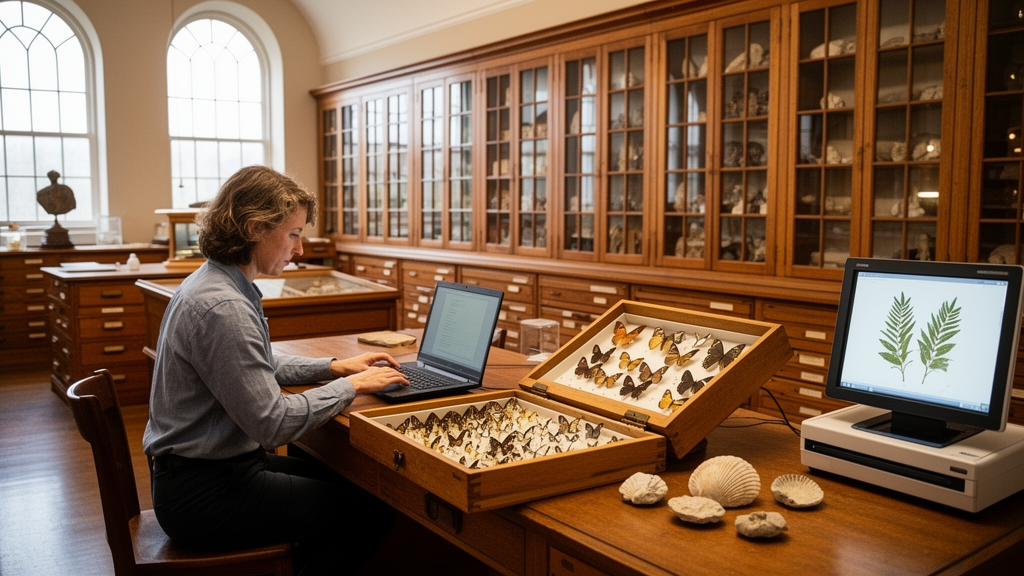
Natural history collections hold some of the most valuable biological data on Earth, yet many of the institutions that steward them lack the programming expertise and infrastructure to build their own digital tools. A new study published in Natural History Collections and Museomics shows that artificial intelligence can close that gap dramatically. Using an AI coding model, a researcher built two fully functional web applications for the Cornell University Museum of Vertebrates in under 30 minutes each, demonstrating that museum staff without formal software engineering training can now create tailored tools for searching, visualizing, and sharing their specimen data.
The research, led by Victor de Brito of the Cornell University Museum of Vertebrates, addresses a persistent problem in the museum world. Collections serve research, education, conservation, and public outreach, and a central goal is making their growing volumes of data accessible to researchers, educators, and the public. In most cases that access happens through institutional websites and web applications, but limited access to programming expertise, dedicated personnel, and large-scale data management infrastructure remains a major challenge for many collections.
Large-scale aggregators such as the Global Biodiversity Information Facility, VertNet, and MorphoSource have substantially improved data availability across institutions. However, the study notes that these platforms often lack the most up-to-date information, because collections upload their data in episodic batches. They are also vulnerable to shifts in funding policies that may limit hosted data or impose new fees on partner institutions. Aggregators are generally not tailored to the specific needs of individual collections, and the hosting institutions are often overlooked in acknowledgments by authors of downstream analyses.
Recent advances in generative artificial intelligence, particularly large language models that understand and generate human-like text, have transformed how developers create, maintain, optimize, and test code. The scale of adoption is striking: GitHub, the largest repository for software development projects, added more than 36 million developers in 2025 and reached over 180 million users, a surge largely attributed to AI coding tools. A survey found that 90 percent of software developers at Google reported using AI in their work, and 71 percent of those who write code used AI-assisted coding. By translating natural language instructions into executable code, these systems substantially lower the technical barrier to software creation.
To test whether that barrier has fallen far enough for museum professionals, the researcher developed two applications using GPT-5.3-Codex on Windows 11 through Visual Studio Code, with a medium reasoning effort setting. Both were built from .csv files exported from the museum’s Specify 7 database, tested locally, and then deployed online using GitHub Pages. The repositories included an AI-generated code disclosure statement and an MIT License file clarifying usage and distribution permissions.
The first application is a specimen search portal for the museum’s ichthyology collection. Built with React, TypeScript, Vite, Tailwind CSS, Leaflet for mapping, and PapaParse for CSV parsing, it allows users to filter specimen records by order, family, genus, species, catalog number, preparation type, date, and geography. Filters support dropdown lists with autocomplete, multi-select, and dynamic interdependence, meaning that selecting one value updates all other dropdowns to show only compatible options. Users can export filtered results as a new .csv file and view an interactive map of sampling localities that updates live as filters change, with clicking a map point highlighting the corresponding table row.
The second application is an interactive visualization of sampling localities across the museum’s four vertebrate collections, covering mammals, birds, reptiles and amphibians, and fishes. Color-coded, semi-transparent points distinguish the collections so overlap density remains visible, and an animated timeline makes points appear year by year from earliest to latest. Playback controls include play and pause, speed settings, year navigation, a loop toggle, and a draggable year slider. Below the map, a Plotly line chart displays cumulative specimen and lot counts over time, with one line per collection and a black total line, updating dynamically as the selected year changes.
Validation showed the tools perform accurately. The specimen search portal produced results consistent with the museum’s existing Specify Web Portal across all 50 randomly selected genus and species combinations tested, with query results exported as .csv files and compared in R to identify any catalog numbers present in one portal but absent in the other. The interactive map accurately reproduced specimen localities when visually compared with coordinates exported from the Specify database and plotted in QGIS. Once the data structure was exported, functional applications were generated and tested in less than 30 minutes, allowing staff to rapidly test different ways of presenting and exploring their data.
The study also weighs alternatives and caveats. Low-code and no-code platforms allow tool development with minimal programming, but they constrain customization, lock users into platform-specific architectures, and carry subscription costs. AI-assisted coding instead generates fully editable source code, offering greater adaptability as taxonomies, digitization priorities, and data standards evolve. However, large language models are stochastic by design, sampling from probability distributions, so results varied with each execution even when the same prompt was repeated. Clearly structured prompts describing interface elements, functionality, data structure, and outputs in detail greatly improve code quality, and multi-step refinement remains essential for producing fully functioning applications.
Several practical considerations accompany adoption. AI-assisted coding works best when users have some programming knowledge, since they remain responsible for troubleshooting, maintenance, and deployment, effectively acting as their own technical support. Complexity raises the skill requirement: both applications here operate from exported .csv files and are tightly coupled to the original data structure, so connecting to a live server or database would require substantial refactoring. Data security is critical, and sensitive information should never appear in publicly accessible applications or connect directly to live institutional databases; exported datasets or copies reduce breach risks. Access to AI platforms may require paid subscriptions, though applications can be developed quickly and maintained independently afterward, minimizing long-term expense. The broader challenge now shifts from implementation to identifying meaningful tools and sharing them in standardized ways across institutions, since rapidly generated customized tools risk fragmenting database ecosystems. With careful prompt design and attention to interoperability standards such as Darwin Core, the approach could transform collection staff from end-users of pre-built systems into active designers of their own digital infrastructure.
Subject of Research: AI-assisted coding for developing digital tools in natural history collections
Article Title: Using AI-assisted coding to build digital tools for natural history collections
Article References: Using AI-assisted coding to build digital tools for natural history collections. (n.d.). https://doi.org/10.3897/nhcm.3.191202
Image Credits: AI Generated
Keywords: AI-assisted coding, natural history collections, large language models, GPT-5.3-Codex, Cornell University Museum of Vertebrates, specimen data, digitization, web applications, data visualization, GBIF, Specify, museum informatics
Cite Scienmag News
Margaret Porter. (October 16, 2026). AI-assisted coding lets natural history museums build custom digital tools in minutes. Scienmag. https://scienmag.com/ai-assisted-coding-lets-natural-history-museums-build-custom-digital-tools-in-minutes/
Margaret Porter. "AI-assisted coding lets natural history museums build custom digital tools in minutes." Scienmag, 16 October 2026, https://scienmag.com/ai-assisted-coding-lets-natural-history-museums-build-custom-digital-tools-in-minutes/. Accessed 16 October 2026.
Margaret Porter. "AI-assisted coding lets natural history museums build custom digital tools in minutes." Scienmag. October 16, 2026. https://scienmag.com/ai-assisted-coding-lets-natural-history-museums-build-custom-digital-tools-in-minutes/


