


In the dusty border town of Kousseri, on the banks of the Logone River in Cameroon’s far north, the tiny flies that carry visceral leishmaniasis never really take a break. A new year-long study, published in African Invertebrates, has mapped the monthly rhythms of phlebotomine sandflies in this confirmed endemic focus of the deadly parasitic disease, and the results offer the most detailed picture yet of when and where the vectors are most active in a region that still has no sandfly control programme.
Between September 2020 and August 2021, researchers deployed six miniature CDC light traps each month across urban, peri-urban and rural ecotopes of Kousseri County, running the traps from dusk to dawn over 30 trapping nights per month. The effort yielded 4,214 sandfly specimens, of which 51.02 percent were females, the sex responsible for transmitting Leishmania parasites to humans and animals. Rural sites accounted for the largest share of captures at 43.43 percent, followed by peri-urban areas at 33.38 percent, while the urban environment produced just 22.69 percent of the total.
Seasonality proved striking. January, in the middle of the region’s prolonged eight-month dry season, recorded the highest abundance with 679 specimens, and March followed closely with 597. The lowest numbers appeared in September and October, at the tail end of the rainy season, when flooding of the semi-arid Sahelian landscape likely suppressed adult activity. Unlike mosquitoes, sandflies have a fully terrestrial life cycle that does not require standing water, but their larvae need sufficiently moist soil, and excessive flooding appears to push populations down rather than up.
Morphological identification of the 2,150 dissected females revealed eleven species: ten belonging to the genus Sergentomyia and a single Phlebotomus species, Phlebotomus duboscqi. That latter species is significant because it is the only proven vector of leishmaniasis in the region, responsible for cutaneous disease caused by Leishmania major and suspected of playing a role in visceral transmission. Yet Ph. duboscqi represented a mere 1.07 percent of the total catch, was absent in January and July, and peaked in September at an average of just 1.67 sandflies per trap per night.
The dominant Sergentomyia species each followed distinct monthly patterns. Sergentomyia antennata, the most prevalent species overall, showed a unimodal peak in January, averaging 16.67 sandflies per trap per night. Sergentomyia squamipleuris also peaked once, in February, at 7.38 per trap per night. Sergentomyia distincta followed a bimodal trend with peaks in January and May, while Sergentomyia schwetzi, the second most abundant species, displayed a trimodal pattern with major peaks in September, March and August. Four species, including Se. antennata, Se. distincta, Se. squamipleuris and Se. schwetzi, were present in every month of the year, underscoring the year-round transmission potential in the focus.
Ecological preferences differed sharply between species and habitats. Se. distincta was most abundant in urban settings, suggesting a preference for densely populated areas where human blood meals are readily available. Se. schwetzi dominated peri-urban ecotopes, where animal shelters sit close to human dwellings amid irregular waste collection and scattered vegetation. The remaining Sergentomyia species, including Se. antennata, Se. clydei, Se. adleri, Se. africana and Se. squamipleuris, declined from rural to urban areas, pointing to an adaptation to rural environments characterised by rice paddies, agricultural fields and livestock.
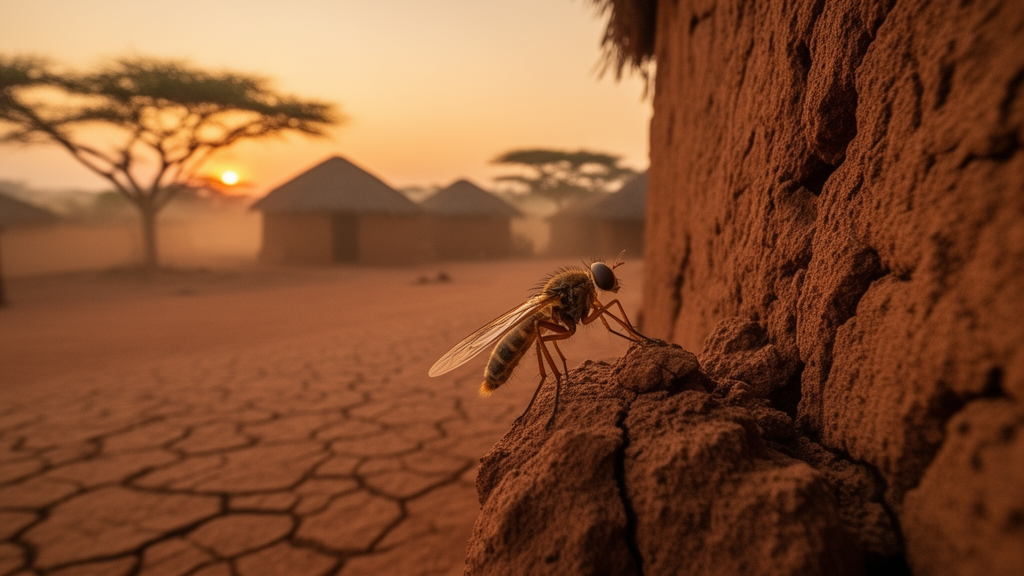
The rural advantage for sandflies appears to stem from concrete housing and land-use features. Dwellings in rural and peri-urban Kousseri are typically built from unplastered mud walls whose cracks and fissures provide ideal resting, breeding and mating sites for adult sandflies. Nearby rice paddies and animal compounds offer sugar sources for energy and blood meals for egg development, bringing flies, livestock and people into close contact. By contrast, the urban sites surveyed were predominantly residential with plastered walls and modern infrastructure, conditions that previous work suggests can substantially reduce sandfly populations.
Diversity analysis reinforced the complexity of the community. Shannon-Wiener indices exceeded 1 in all ecotopes and months, indicating high evenness, and Simpson diversity values ranged from 0.56 to 0.83 across the year. Species richness varied from six to nine species per month, with the lowest recorded in October. Non-metric multidimensional scaling based on Bray-Curtis dissimilarities revealed distinct seasonal clustering, with September, December and March grouping together, October and November forming a separate pattern, and the peak rainy-season months of April, May, June and August sharing similar species abundance profiles.
Notably, the dry-season peak in Kousseri contradicts earlier findings from the Mokolo cutaneous leishmaniasis focus in Cameroon, where sandfly numbers rose during the rainy season. The pattern instead aligns with observations from arid and semi-arid regions of Iran and parts of Kenya, where optimal microclimatic conditions during dry months favour sandfly activity. Kousseri’s temperatures, which swing from 11 degrees Celsius in December to 45 degrees Celsius in the shade by April and May, fall within the 25 to 28 degree range that sandflies favour for much of the year, helping explain their continuous presence.
The findings carry direct implications for public health. Because sandflies remain active throughout the year but surge in January and March, surveillance and interventions such as insecticide application and insecticide-treated bed nets should be prioritised in those months, particularly in rural settings where abundance is highest. Plastering the cracked mud walls of homes and animal shelters could further reduce breeding and resting sites. The researchers also stress that the true vector of visceral leishmaniasis in Kousseri remains unidentified, and that Sergentomyia species, traditionally associated with reptile parasites, have been implicated elsewhere in transmitting Leishmania infantum to dogs and potentially pathogenic species to humans. Determining blood-meal sources, feeding behaviour and natural Leishmania infection rates, alongside multi-year monitoring of climatic drivers, will be essential to building an evidence-based control strategy for a region where the disease remains neglected and untreated.
Subject of Research: Monthly occurrence and ecology of phlebotomine sandfly species in a visceral leishmaniasis endemic focus of northern Cameroon
Article Title: Occurrence and monthly dynamics of female Phlebotomine sandfly species from Kousseri Visceral Leishmaniasis endemic focus in northern Cameroon
Article References: Tebo-Nzesseu, T. R., Ngouateu Tateng, A., Bebe Ngouateu, O., Foyet, J. V., Ngnindji-Youdje, Y., Payne, V. K., & Dondji, B. (2025). Occurrence and monthly dynamics of female Phlebotomine sandfly species from Kousseri Visceral Leishmaniasis endemic focus in northern Cameroon. African Invertebrates, 66(2), 229-249. https://doi.org/10.3897/afrinvertebr.66.160860
Image Credits: AI Generated
DOI: 10.3897/AfrInvertebr.66.160860
Keywords: leishmaniasis, sandflies, Phlebotomus duboscqi, Sergentomyia, Cameroon, vector ecology, public health, neglected tropical diseases, Occurrence, monthly, dynamics, female
Cite Scienmag News
Gavin Prescott. (October 16, 2026). Sandflies in Cameroon’s visceral leishmaniasis hotspot stay active all year, peaking in the dry season. Scienmag. https://scienmag.com/sandflies-in-cameroons-visceral-leishmaniasis-hotspot-stay-active-all-year-peaking-in-the-dry-season/
Gavin Prescott. "Sandflies in Cameroon’s visceral leishmaniasis hotspot stay active all year, peaking in the dry season." Scienmag, 16 October 2026, https://scienmag.com/sandflies-in-cameroons-visceral-leishmaniasis-hotspot-stay-active-all-year-peaking-in-the-dry-season/. Accessed 16 October 2026.
Gavin Prescott. "Sandflies in Cameroon’s visceral leishmaniasis hotspot stay active all year, peaking in the dry season." Scienmag. October 16, 2026. https://scienmag.com/sandflies-in-cameroons-visceral-leishmaniasis-hotspot-stay-active-all-year-peaking-in-the-dry-season/


