


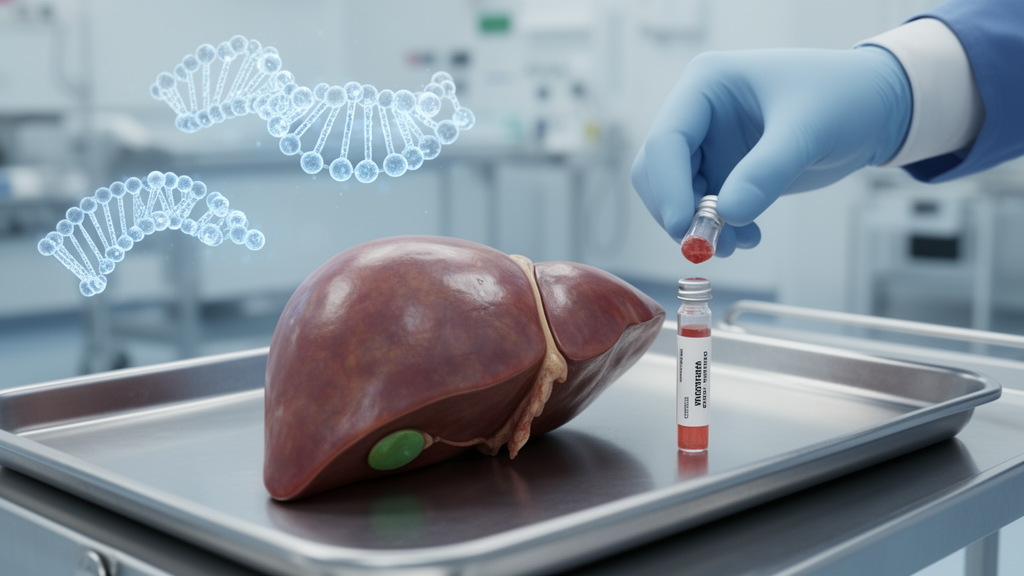
Every transplanted liver carries a hidden molecular record of the injury it endured on its journey from donor to recipient. A team of Spanish surgeons and researchers has now shown that this record can be read in real time, from three different biological compartments at once, during the delicate hours of organ procurement. In a prospective feasibility study published in Transplant International, investigators at Hospital Universitari Vall d’Hebron in Barcelona demonstrated that donor-derived microRNAs can be reliably quantified in serum, liver tissue, and preservation fluid from deceased donors, opening a window onto graft biology that conventional clinical assessment cannot provide.
The study addressed a pressing challenge in modern transplantation. Donation after brain death remains the principal source of organs, but the persistent shortage of livers has driven a dramatic expansion of donation after circulatory death, a pathway that now accounts for more than 25 percent of deceased organ donation worldwide and over half of liver transplants in countries where it is established. These two donor types expose grafts to fundamentally different insults. DCD livers suffer warm ischemia between withdrawal of life-sustaining therapy and the restoration of oxygenated perfusion, while DBD livers are spared warm ischemia but endure the catastrophic systemic storm triggered by brain death itself, including hemodynamic instability, cytokine release, and leukocyte activation that heighten graft immunogenicity.
MicroRNAs offered the researchers an ideal molecular probe. These short regulatory RNA molecules are remarkably stable in circulation, where they survive degradation by associating with protein complexes, lipoproteins, and extracellular vesicles. In the liver, specific microRNAs have been linked to hepatocellular injury, ischemia-reperfusion damage, biliary complications, and adverse postoperative outcomes. Yet despite their promise, data on liver-derived microRNA expression in donor samples and preservation fluids remained scarce, leaving surgeons without objective molecular information about graft condition before transplantation begins.
Between October 2019 and May 2021, the team prospectively collected liver wedge biopsies, preservation fluid, and serum samples from adult deceased organ donors at their tertiary referral centre. From 38 donors initially sampled, seven were excluded for failing predefined RNA quality-control criteria and eight were diverted to a parallel methodological study, leaving a final analytical cohort of 20 transplantable donors, 10 DBD and 10 DCD, plus three DBD grafts declined for moderate-to-severe steatosis. In total, 79 biological samples were analysed across all compartments, including paired serum samples from DCD donors taken before withdrawal of therapy and again from the extracorporeal circuit during abdominal normothermic regional perfusion, the technique that reperfuses abdominal organs with oxygenated blood for 90 to 120 minutes before organ retrieval.
The researchers quantified five liver injury-associated microRNAs, miR-122, miR-148a, miR-155, miR-22, and miR-222, using reverse transcription quantitative PCR, normalizing expression against five endogenous reference genes selected through geNorm and NormFinder stability algorithms. miR-122 dominated the liver tissue compartment, expressed at roughly 48-fold higher levels than reference genes, with comparable abundance between donor types. In preservation fluid, miR-122 again reigned supreme at approximately 17-fold above reference levels, though it tended to be higher in DBD grafts. The most striking compartment-specific pattern emerged in preservation fluid, where DCD grafts recovered after aNRP showed significantly lower expression of miR-148a, miR-222, and miR-22 than their DBD counterparts, with fold changes of 0.33, 0.36, and 0.45 respectively and p values between 0.02 and 0.04.
This finding initially appears counterintuitive if interpreted solely through the lens of warm ischemic injury, since previous studies had reported higher miR-122 and elevated miR-122/miR-222 ratios in conventionally recovered DCD grafts without regional perfusion. The authors argue that the distinct biological environment created by aNRP explains the discrepancy. Unlike conventionally recovered DCD organs, these grafts undergo a period of oxygenated reperfusion and metabolic recovery before preservation, restoring oxygen delivery, mitochondrial function, and ATP stores while allowing partial recovery from warm ischemic damage. Preservation fluid, moreover, is a procedure-derived compartment whose microRNA concentrations reflect the combined effects of intracellular abundance, active extracellular secretion, passive release from injured cells, reperfusion during aNRP, and vascular washout during graft flushing, rather than injury magnitude alone.
The direction of change for miR-148a and miR-222 was internally consistent across preservation fluid and DCD serum collected after warm ischemia during aNRP, suggesting the observations are unlikely to reflect technical variation. In DCD donors, serum from the aNRP circuit showed reduced miR-148a expression at 0.45-fold compared with DBD serum, alongside a non-significant increase in miR-122. Pre-procurement serum microRNA profiles did not differ between donor types, implying that in carefully selected grafts the systemic inflammatory and hemodynamic changes of brain death may not translate into major differences in circulating liver-specific microRNAs, a notable result given that brain death induces a pro-inflammatory response involving cytokine release, complement activation, and endothelial dysfunction.
The exploratory analysis of three declined steatotic DBD grafts, confirmed histologically at 30, 45, and 60 percent macrovesicular steatosis, revealed patterns biologically compatible with heightened hepatocellular stress. These grafts showed lower miR-122 in liver tissue at 0.48-fold relative to transplantable DBD grafts, lower miR-222 in preservation fluid at 0.36-fold producing a threefold higher miR-122/miR-222 ratio, and strikingly elevated circulating miR-122 at 12.9-fold with an approximately 25-fold serum miR-122/miR-222 ratio. Because donor serum was obtained before procurement, the increased circulating miR-122 may reflect either greater vulnerability to brain death-associated inflammatory and hemodynamic changes or intrinsic alterations in miR-122 regulation associated with hepatic steatosis, as both reduced hepatic and increased circulating miR-122 have been described in steatotic liver disease.
Among the 20 transplanted recipients, six developed peak transaminase levels exceeding 1000 IU/L within the first postoperative day and four developed early allograft dysfunction. Preservation-fluid miR-155 showed a statistically significant inverse correlation with peak transaminase levels, with a Spearman rank correlation coefficient of minus 0.63 and a p value of 0.024, consistent with miR-155’s recognized role in inflammatory and immune signaling pathways. Grafts associated with higher transaminase peaks and early allograft dysfunction showed directional trends toward higher serum miR-122 and elevated miR-122/miR-222 ratios, though these did not reach statistical significance in this small cohort, which was not powered to detect clinical outcome differences.
The study’s principal contribution is methodological proof that multi-compartment donor-derived microRNA profiling is feasible during contemporary liver graft procurement, providing compartment-specific expression patterns that vary by donor type. The prospective paired sampling strategy, particularly the inclusion of aNRP circuit serum before and during regional perfusion, allowed intra-donor changes to be assessed while reducing interindividual variability. Standardized RT-qPCR techniques with validated normalization strategies yielded low technical variability, and the use of a single preservation solution, IGL-1, across all grafts minimized preservation-associated redox effects. The authors emphasize that these findings provide a framework for future studies evaluating compartment-specific molecular markers for graft assessment, though larger cohorts, external validation, and integration with complementary biochemical and inflammatory biomarkers will be essential to translate this molecular readout into clinical decision-making for the growing population of marginal donor livers.
Subject of Research: Multi-compartment profiling of donor-derived microRNAs during liver graft procurement: a prospective feasibility study
Article Title: Multi-compartment profiling of donor-derived microRNAs during liver graft procurement: a prospective feasibility study
Article References: Dalmau, M., Charco, R., Bilbao, I., Dopazo, C., Caralt, M., Molino, J. A., Sandiumenge, A., Sapisochin, G., & Gómez-Gavara, C. (2026). Multi-compartment profiling of donor-derived microRNAs during liver graft procurement: a prospective feasibility study. Transplant International, 39, Article 17090. https://doi.org/10.3389/ti.2026.17090
Image Credits: AI Generated
Keywords: Multi-compartment, profiling, donor-derived, microRNAs, during, liver, graft, procurement, prospective, feasibility, scientific research
Cite Scienmag News
Drew Townsend. (October 16, 2026). MicroRNAs Reveal Hidden Molecular Fingerprints of Donor Livers During Organ Procurement. Scienmag. https://scienmag.com/micrornas-reveal-hidden-molecular-fingerprints-of-donor-livers-during-organ-procurement/
Drew Townsend. "MicroRNAs Reveal Hidden Molecular Fingerprints of Donor Livers During Organ Procurement." Scienmag, 16 October 2026, https://scienmag.com/micrornas-reveal-hidden-molecular-fingerprints-of-donor-livers-during-organ-procurement/. Accessed 16 October 2026.
Drew Townsend. "MicroRNAs Reveal Hidden Molecular Fingerprints of Donor Livers During Organ Procurement." Scienmag. October 16, 2026. https://scienmag.com/micrornas-reveal-hidden-molecular-fingerprints-of-donor-livers-during-organ-procurement/


