


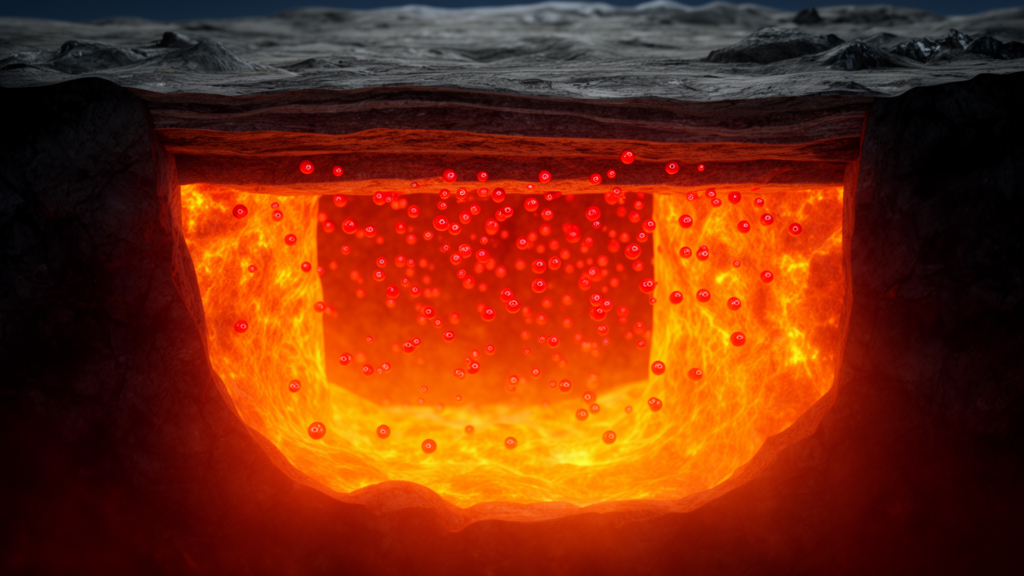
Molten rock deep inside the Earth can hold far more oxygen than scientists ever thought chemically possible, according to a new study that may rewrite one of the central chapters of planetary history. A research team led by Dr. Yanhao Lin and Dr. Ho-kwang Mao of the Center for High Pressure Science and Technology Advanced Research, together with Prof. Haiyang Niu of Northwestern Polytechnical University and Prof. Wim van Westrenen of Vrije Universiteit Amsterdam, reports in National Science Review that silicate magma can dissolve oxygen as an independent volatile component, storing up to roughly five weight percent of it under the pressures found hundreds of kilometers below the surface. As that magma rises and decompresses, the surplus oxygen would be released, providing a previously unrecognized pipeline for transporting oxidizing power from the planet’s interior to its crust, oceans and atmosphere.
Oxygen is, by atom count, the most abundant element in the silicate Earth, making up more than half of the atoms in the planet’s rocky interior. For generations, geoscientists have treated the oxygen budget of a magma as something that is fixed rather than free. In conventional thinking, the total oxygen in a molten rock is dictated by the amounts and charge states of the other elements it contains, such as silicon, magnesium and iron, which bond with oxygen in rigid stoichiometric proportions. Water and carbon dioxide, by contrast, have long been recognized as volatiles, meaning they dissolve into magma in quantities that depend on pressure and temperature and then escape as gas when the melt ascends. Oxygen, because it was assumed to be locked into the silicate framework, was never considered a candidate for such volatile behavior, and the question of whether silicate melts themselves could store oxygen beyond what their chemistry demands has remained largely unexplored until now.
To test that assumption, the team conducted a series of high-pressure experiments on a synthetic mid-ocean ridge basalt, one of the most common rock types produced by melting in the Earth’s upper mantle. The samples were melted at pressures ranging from one atmosphere up to seven gigapascals, equivalent to conditions at depths of several hundred kilometers, and at temperatures between 1200 and 1800 degrees Celsius, using piston-cylinder and cubic anvil presses. To guarantee an oxygen-rich environment, the researchers added platinum oxide to the starting material. After quenching the molten samples into glass, they measured the concentrations of all major elements as well as water and carbon dioxide. They then calculated the oxygen needed to chemically balance every other element present, subtracted that amount along with the oxygen bound in water and carbon dioxide, and defined whatever remained as excess oxygen, a quantity that should have been zero under the traditional view.
It was not zero. The quenched glasses turned out to store substantial amounts of excess oxygen, and the quantity rose steeply with pressure. At one atmosphere the excess was close to nothing, but at seven gigapascals the glass held more than five weight percent, an enormous figure for a component that was not supposed to exist independently in silicate melts at all. Control experiments run at identical pressures and temperatures without the added platinum oxide yielded only 0.2 to 0.5 weight percent, confirming that the signal in the doped runs reflected genuine oxygen uptake from an oxidizing reservoir rather than an artifact of the apparatus. Raman spectroscopy of the glasses detected no signature of free oxygen gas, indicating that the surplus oxygen is not sitting in trapped bubbles but is instead incorporated directly into the structure of the glass itself. Because some oxygen may have escaped during the rapid quench, the researchers note that the measured values likely represent a lower limit on the true storage capacity of the melt.
The experimental results are backed by theoretical simulations led by Prof. Niu. The team employed deep neural network interatomic potentials, a machine-learning approach that achieves ab initio accuracy while allowing molecular dynamics simulations of far larger systems and longer timescales than conventional quantum mechanical calculations permit. In these simulations, oxygen dissolved into the magnesium-silicon-oxygen melt until an equilibrium concentration was reached, reproducing the experimental behavior. Because the modeled system was simplified to only three elements, the simulated concentrations were lower than those measured in the basalt experiments, but the same pressure dependence emerged: the richer the melt became in oxygen, the more it continued to accept as pressure increased. The computational work also provided a mechanistic picture of what happens inside the melt as it becomes oxygen-saturated.
That mechanism centers on the bonding environment of oxygen itself. The simulations showed that as the melt grows richer in oxygen, the electric charges carried by individual oxygen atoms spread over a progressively wider range, and a small fraction of the oxygen atoms begin to form peroxide-like bonds, in which two oxygen atoms link directly to one another. This structural flexibility gives the melt a way to accommodate oxygen atoms that do not fit into the ordinary silicate network, effectively opening new storage sites that conventional stoichiometric thinking never accounted for. The increase of dissolved oxygen with pressure, the authors note, closely parallels the way water and carbon dioxide dissolve more readily in magma at higher pressures, leading them to propose that oxygen should be treated as a separate, pressure-dependent component of silicate melts alongside the classical volatiles.
If magma can stash oxygen at depth and surrender it on the way up, the consequences for surface chemistry could be profound. Magma generated in oxidized regions of the mantle could carry substantial excess oxygen in solution. As it ascends, decompression would drive that oxygen out of the melt, and the released gas could oxidize the shallow mantle, the crust and ultimately the atmosphere above it. This mechanism offers a possible physical link between two of the great puzzles of Earth history: episodes of massive interior magmatism and the long-term rise of atmospheric oxygen, which for billions of years was constrained by the need for a sink to consume the oxidizing power arriving from below. A deep source of excess oxygen would help relax that constraint.
The timing is suggestive. Major rises in atmospheric oxygen roughly 2.5 to 2.0 billion years ago, spanning the Great Oxidation Event and its aftermath, overlap in time with the formation of some of the largest large igneous provinces ever recorded, colossal volcanic outpourings produced by mantle plumes and other deep-sourced melting events. The researchers offer a rough estimate that illustrates how potent the new mechanism could be: if magma erupted during this period released excess oxygen at a concentration of just 0.27 weight percent, the amount liberated would be sufficient to supply all of the oxygen present in today’s atmosphere. Given that the experiments measured storage capacities an order of magnitude higher than that threshold at high pressures, even partial degassing of such melts could have delivered oxidizing power on a planetary scale.
Beyond explaining ancient atmospheric evolution, the findings open new avenues for assessing how magma oceans on young terrestrial planets evolved and degassed, and how volatile cycling shaped the long-term habitability of rocky worlds. If oxygen can dissolve into silicate melts as an independent component, then models of planetary differentiation, core formation and early atmosphere development may need to account for a previously ignored reservoir. The same physics could apply to other terrestrial planets, where the interplay between interior magmatism and surface oxidation helped determine whether a planet retained a breathable atmosphere or lost its volatile inventory to space. The study reframes magma not merely as a passive carrier of pre-existing chemistry but as an active, pressure-responsive vessel whose cargo changes with depth.
What began as a careful measurement of quenched experimental glasses has thus grown into a proposal with planetary reach. By demonstrating that excess oxygen storage in silicate melt rises with pressure, that the surplus oxygen sits in the glass structure rather than in bubbles, and that simulations independently reproduce both the uptake and its mechanism, the team has assembled a coherent case that oxygen belongs in the volatile inventory of magma alongside water and carbon dioxide. The work, published in National Science Review with the DOI 10.1093/nsr/nwag539, suggests that the air future generations breathe may owe its existence not only to photosynthesis and biology but also to the hidden, pressure-driven chemistry of melts rising through the deep Earth, delivering their oxidizing burden one decompressing plume at a time.
Subject of Research: Excess oxygen storage in deep Earth silicate magma and its role in atmospheric oxidation
Article Title: The 'excess oxygen' stored in deep Earth magma may help explain how Earth’s atmosphere became oxygen-rich
Article References: The 'excess oxygen' stored in deep Earth magma may help explain how Earth’s atmosphere became oxygen-rich. (n.d.). Original publication
Image Credits: AI Generated
DOI: Not provided
Keywords: magma, excess oxygen, silicate melt, high-pressure experiments, Great Oxidation Event, large igneous provinces, mantle, volatiles, peroxide bonds, atmospheric oxygen, molecular dynamics, Earth's interior
Cite Scienmag News
Russell Cooper. (October 16, 2026). Deep Earth Magma Stores Surplus Oxygen That May Have Filled the Sky. Scienmag. https://scienmag.com/deep-earth-magma-stores-surplus-oxygen-that-may-have-filled-the-sky/
Russell Cooper. "Deep Earth Magma Stores Surplus Oxygen That May Have Filled the Sky." Scienmag, 16 October 2026, https://scienmag.com/deep-earth-magma-stores-surplus-oxygen-that-may-have-filled-the-sky/. Accessed 16 October 2026.
Russell Cooper. "Deep Earth Magma Stores Surplus Oxygen That May Have Filled the Sky." Scienmag. October 16, 2026. https://scienmag.com/deep-earth-magma-stores-surplus-oxygen-that-may-have-filled-the-sky/


