


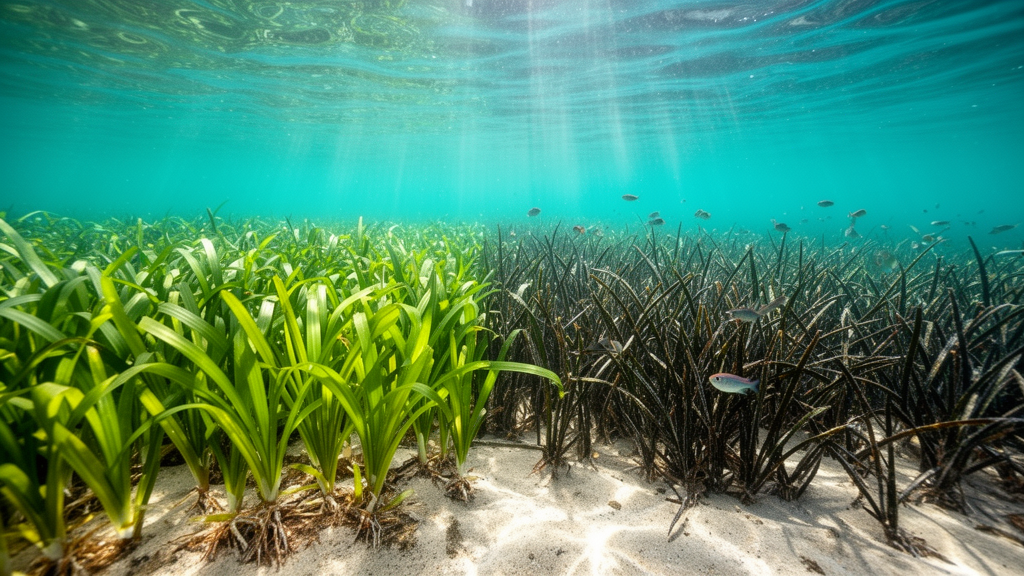
An invasive seagrass that has swept across the Mediterranean Sea appears to gain a hidden advantage from an unlikely source: the microbes it acquires when growing alongside the very native species it displaces. A new study published in Frontiers in Marine Science reveals that the globally invasive seagrass Halophila stipulacea harbors distinctly different bacterial communities when it grows in mixed assemblages with the native Mediterranean seagrass Cymodocea nodosa compared to when it grows alone, and those microbial shifts coincide with the enhanced growth that has made this invader so successful. The findings suggest that the microscopic passengers riding on seagrass leaves may play a far larger role in marine plant invasions than scientists previously appreciated.
Halophila stipulacea is no ordinary newcomer. Originating in the Red Sea and Indian Ocean, this small, fast-growing seagrass is a Lessepsian migrant, meaning it crossed into the Mediterranean Sea through the Suez Canal after its opening in 1869. It was first observed in the Mediterranean in 1894 and later reached the Caribbean Sea, likely transported by boats, with the first Caribbean sighting reported in Grenada in 2002. Today it ranks among only three known invasive seagrass species worldwide, and its tolerance of wide ranges in light, depth, temperature, salinity, and water movement has long been credited with its spread. What has remained unclear is whether its associated microbes contribute to that remarkable ecological flexibility.
To probe that question, a research team led by scientists at the University of Puerto Rico Río Piedras, working with collaborators in Spain, the United States, Cyprus, and Puerto Rico, built on a previously published controlled competition experiment conducted in Cyprus. Intact cores of naturally co-occurring seagrass containing both species were collected by SCUBA from donor beds and transplanted into 24-liter flow-through mesocosms at a marine aquaculture facility in Larnaka. The experiment ran for six weeks under natural conditions and included four treatments with ten mesocosm replicates each: native and invasive grown together at natural densities, both species together at reduced densities, invasive monoculture, and native monoculture. Monocultures were created by selectively removing one species, while reduced-density mixed treatments were established by removing roughly half the shoots of both species while maintaining their co-occurrence.
The team focused on the phyllosphere, the microbial community living on the surface of seagrass leaves, because shoot dynamics had responded strongly to competition in the earlier experiment. At the start and end of the six-week period, researchers scraped epibionts from blades of both species, washed and centrifuged the samples, and extracted DNA using a commercial soil kit. They then sequenced the V4 region of the 16S rRNA gene, the workhorse marker for characterizing bacterial communities, following the Earth Microbiome Project protocol. Sequencing was performed on an Illumina MiSeq platform, and the resulting data were processed with the QIIME 2 microbiome platform using the DADA2 pipeline to denoise sequences and assign them to amplicon sequence variants, or ASVs, which represent distinct bacterial taxa. Taxonomy was assigned with a naive Bayes classifier trained on the SILVA database.
Alongside the microbial work, the researchers measured an array of biochemical and morphological indicators of plant health. They extracted photosynthetic pigments including chlorophyll a, chlorophyll b, and carotenoids from leaf tissue, quantified hydrogen peroxide as a marker of oxidative stress using the potassium iodide method, and measured malondialdehyde, a product of lipid peroxidation that signals cellular damage. Growth was assessed by counting changes in shoot numbers over the experiment, and the team also recorded aboveground and belowground biomass, rhizome internode length, and sediment nitrate and nitrite concentrations. This combination of microbial, biochemical, and morphological data allowed the researchers to look for associations between bacterial communities and the physiological state of each seagrass species under different competitive conditions.
The results revealed a striking asymmetry. In the competition experiment, the invasive H. stipulacea increased by an average of 3.7 shoots, roughly a 59 percent gain, when grown in mixed assemblages with the native seagrass, while the native C. nodosa lost about one shoot, a 29 percent decline, under the same conditions. When density was reduced in mixed treatments, the invader grew by 4.3 shoots, an increase of roughly 150 percent, while the native showed a modest gain of 0.2 shoots. Aboveground biomass followed the same pattern: natives produced significantly more biomass when grown alone than when mixed, whereas the invader maintained or increased its biomass in mixed treatments. Notably, the native seagrass had internode lengths roughly three times longer than the invader, a morphological difference that had not been documented in the earlier work.
Biochemical measurements added another layer of intrigue. Hydrogen peroxide concentrations were more than sevenfold higher in the native C. nodosa, averaging 4.18 micromoles per gram compared with just 0.62 in the invader, indicating substantially greater oxidative stress in the native species. Malondialdehyde levels were also higher in the native seagrass, and the difference varied by treatment. Photosynthetic pigment levels told an opposite story for the two species: the native seagrass had higher pigment concentrations when grown in mixed communities than when alone, while the invader showed the reverse pattern, producing significant treatment-by-species interactions for chlorophyll a, chlorophyll b, and carotenoids. Sediment nitrate and nitrite concentrations, by contrast, did not differ significantly between treatments or species.
On the microbial side, sequencing of 41 libraries yielded 301,907 raw reads, of which 169,068 high-quality reads survived quality control, chimera removal, and filtering. After rarefaction to a standardized depth of 1,500 reads per sample, the final dataset comprised 826 bacterial ASVs with an average of 220 ASVs per sample. Alpha diversity, measured as Shannon diversity and Pielou evenness, did not differ significantly between species or treatments. However, beta diversity analysis using Bray-Curtis dissimilarities revealed significant overall differences in community composition among groups, with group identity explaining 63.7 percent of the variation in a PERMANOVA test. Complementary ANOSIM analysis supported this separation, and tests for homogeneity of multivariate dispersion confirmed that the differences were not driven by unequal within-group variability. Results from an alternative normalization approach, Scaling with Ranked Subsampling, were consistent with the rarefied analyses, strengthening confidence in the findings.
The taxonomic composition of the two seagrass microbiomes diverged sharply. Proteobacteria dominated across all samples, accounting for 72.1 percent of sequence reads, followed by Bacteroidota at 7.7 percent and Planctomycetota at 3.7 percent. The native C. nodosa in monoculture harbored the richest microbiome, with elevated proportions of genera such as Oceanicella, uncultured Microtrichaceae, Hyphomonas, Methylotenera, and Lentimonas. When the native grew alongside the invader, its microbial diversity declined and several taxa associated with nutrient cycling and stress tolerance, including the sulfate-reducing genus Desulfobulbus and the hydrocarbon-degrading genus Bermanella, became strongly associated with monoculture conditions. Conversely, the invader’s microbiome was most abundant in mixed environments: the genus Pseudoalteromonas reached 32.7 percent relative abundance in full mixed density compared with just 6.5 percent in monoculture, and genera such as Vibrio, Photobacterium, Zeaxanthinibacter, and Tenacibaculum were more prevalent when the invader grew with the native. Modeling with MaAsLin 2, which integrates microbial data with experimental covariates while correcting for multiple comparisons, confirmed these associations, and a sensitivity analysis with reduced predictor sets produced qualitatively consistent results.
The authors propose several hypotheses to explain these patterns. One possibility is microbe-mediated allelopathy: the invader may harbor bacterial associates that produce compounds harmful to the native species, a mechanism well documented in terrestrial plants but not yet reported between seagrasses. Supporting this idea, recent work has shown that H. stipulacea produces a distinct volatilome compared with native seagrasses, including allelopathic compounds such as apocarotenoids and isothiocyanates. Another hypothesis is that the invader actively selects beneficial microbes when competing, or alternatively passively acquires its microbiome from environmental sources. The study has limitations: it examined only phyllosphere bacteria, leaving rhizosphere and sediment communities unexplored, and the compositing strategy used to reduce technical variation may have underestimated within-treatment variability. Sequencing depth was also constrained by quality filtering. Nevertheless, the correlative patterns are compelling, and the authors emphasize that future work must determine whether the microbial shifts are a cause or a consequence of competitive success. As climate change is expected to further promote the expansion of H. stipulacea in the Mediterranean, understanding whether these microbes are drivers or passengers of invasion could prove critical for predicting and managing the future of seagrass ecosystems on two continents.
Subject of Research: Microbial communities associated with enhanced growth of the invasive seagrass Halophila stipulacea when mixed with native Mediterranean seagrass Cymodocea nodosa
Article Title: Better together? Microbial communities associated with enhanced growth of the invasive seagrass Halophila stipulacea when mixed with a native Mediterranean seagrass Cymodocea nodosa
Article References: Better together? Microbial communities associated with enhanced growth of the invasive seagrass Halophila stipulacea when mixed with a native Mediterranean seagrass Cymodocea nodosa. (n.d.). https://doi.org/10.3389/fmars.2026.1871379
Image Credits: AI Generated
DOI: 10.3389/fmars.2026.1871379
Keywords: seagrass, invasive species, microbiome, Mediterranean Sea, Halophila stipulacea, Cymodocea nodosa, 16S rRNA, phyllosphere, marine ecology, plant competition, oxidative stress, Frontiers in Marine Science
Cite Scienmag News
Morgan Morrow. (October 16, 2026). Invasive Seagrass Thrives With Microbial Help From Native Rivals in the Mediterranean. Scienmag. https://scienmag.com/invasive-seagrass-thrives-with-microbial-help-from-native-rivals-in-the-mediterranean/
Morgan Morrow. "Invasive Seagrass Thrives With Microbial Help From Native Rivals in the Mediterranean." Scienmag, 16 October 2026, https://scienmag.com/invasive-seagrass-thrives-with-microbial-help-from-native-rivals-in-the-mediterranean/. Accessed 16 October 2026.
Morgan Morrow. "Invasive Seagrass Thrives With Microbial Help From Native Rivals in the Mediterranean." Scienmag. October 16, 2026. https://scienmag.com/invasive-seagrass-thrives-with-microbial-help-from-native-rivals-in-the-mediterranean/


