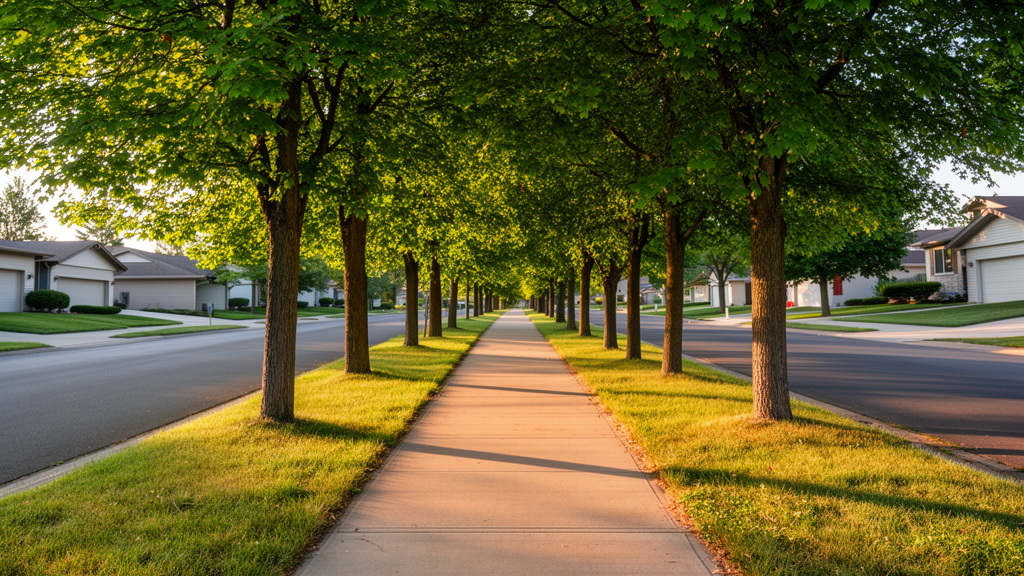
The humble strip of grass between the sidewalk and the curb goes by many names: tree lawn, hell strip, planting easement, right-of-way. It is one of the most ordinary features of the modern street, so easy to overlook that most pedestrians never give it a second glance. Yet a new study from Michigan State University suggests that this narrow band of land may exert a surprisingly large influence on whether a street feels inviting to walk or hostile and exposed. Across nearly nine thousand individual ratings of simulated streetscapes, researchers found that what fills that strip matters, and that the simple addition of street trees to a planted buffer was associated with the most favorable perceptions of walkability in both urban and suburban settings.
The study, published in Frontiers in Built Environment, examined how seven different landscape buffer typologies shaped pedestrians’ perceived walkability across four distinct street contexts. The seven scenarios ranged from a bare concrete strip, the control condition, to lawn, manicured shrubs, and mixed herbaceous plantings described by the authors as biodiverse planting, each of which was also combined with street trees in three further scenarios. Participants rated each scene on five dimensions of perceived walkability: overall satisfaction, safety from crime, aesthetic pleasure, safety from cars, and comfort. These five dimensions are widely used in perception research because they capture the subjective quality of a street environment that objective measurements such as street connectivity or land-use density cannot.
Perceived walkability has become an increasingly important concept in planning and public health research. Compared with purely objective assessments of the built environment, subjective measurements show stronger positive correlations with physical activity levels, the choice to walk rather than drive, and quality of life measures including happiness, social cohesion, and life satisfaction. Perception also leaves room for personal history, travel preferences, values, and culture, all of which objective indices ignore. Yet decades of walkability research have concentrated overwhelmingly on neighborhood-scale attributes such as street network connectivity, land-use density, and land-use diversity, leaving street-level microscale features like planting buffers comparatively understudied despite growing evidence that they can shape walking behavior.
The research team, led by Coryn Brinks with Xiaowei Li, Jun-Hyun Kim, and Zeenat Kotval-Karamchandani, used digitally manipulated photographs of four real sidewalk locations in mid-Michigan, two classified as urban because a building facade sat directly beside the pedestrian path, and two classified as suburban because no adjacent facade existed and the streetscape was more open. Within each of the four settings, the sidewalk alignment and viewpoint were held constant while only the buffer treatment changed. This meant participants compared identical streets where the only difference was the ground cover and planting between the curb and the walkway, producing twenty-eight simulated images in total for the main phase.
Phase I was conducted online between October and November 2024, reaching an estimated 5,353 people through university email lists. The final dataset contained 95 survey records, and the main statistical model analyzed 8,768 ratings from 74 respondents using linear mixed-effects models, Type II Wald chi-square tests, and estimated marginal means. The results were striking in their consistency. The model identified significant main effects of landscape buffer scenario, setting, and perception dimension on walkability ratings, as well as significant two-way and three-way interaction effects among these factors, all at p less than 0.001. In practical terms, the effect of a buffer design depended on both the street context and the perceptual dimension being judged, which the researchers say justifies treating streetscape design as context-sensitive rather than universal.
The ratings climbed steadily from the concrete condition to the vegetated ones, with scenarios containing street trees generally receiving the highest scores. In the suburban setting, the bare concrete buffer received the lowest model-adjusted mean across the five perception dimensions at 1.90, rising to 2.59 for lawn, 3.13 for shrubs, and 3.46 for biodiverse planting, and reaching 4.24 for biodiverse planting combined with street trees, the highest suburban score. The urban scenes followed the same trajectory, from 2.73 for concrete to 4.43 for biodiverse planting with street trees. Notably, urban scenes were rated more positively than suburban scenes for the same buffer design, but the gap between the two settings was largest for the concrete and lawn conditions and smallest once street trees were added, suggesting that trees may help suburban streets close the perceptual distance to their urban counterparts.
The five perception dimensions did not respond identically. Safety from crime tended to receive lower ratings than other dimensions in the more vegetated scenarios, though it was not the lowest dimension in every condition. Safety from cars, by contrast, was generally higher in scenarios with street trees, consistent with the idea that vertical vegetation creates a perceived separation between pedestrians and traffic. The authors caution that this pattern aligns with defensible space theory, which holds that crime-related judgments depend more on visibility, passive surveillance, transparency, maintenance, and activity levels than on planting treatments alone. In other words, greenery can make a street feel pleasant and shielded from cars, but it cannot substitute for the sightlines and openness that make people feel secure from crime.
The theoretical explanation the researchers propose draws on several strands of environmental psychology. Tree canopy and vertical planting define spatial edges, creating a room-like feeling of enclosure that can offer comfort and a better microclimate. The concept of thigmotaxis, the tendency to seek proximity to vertical boundaries, suggests that edges contribute to perceived protection and orientation, while prospect-refuge theory holds that comfortable environments combine protective edges with expansive outward views. At the same time, excessive enclosure can increase vulnerability by limiting surveillance, a warning reflected in the open-ended comments of participants who noted that overly dense planting could feel confining.
Phase II added an exploratory twist: seven returning participants rated the same twenty-eight scenes again, this time in Michigan State University’s Digital Scholarship Lab 360 Room, an immersive visualization space with a wrap-around projection screen. The overall media comparison was not statistically significant, and the authors are careful to stress that a nonsignificant result does not establish that two-dimensional images and immersive projection are interchangeable. Some context-specific differences appeared, with certain suburban scenarios rated higher in the immersive condition and certain urban scenarios rated lower, and safety from crime rising slightly while aesthetic pleasure fell. Because all participants saw the 2D images first and the media order was never randomized, media effects cannot be separated from familiarity, elapsed time, or repeated exposure. Qualitatively, all seven participants found the immersive condition more realistic and easier to interpret at human scale, and most pointed to trees, canopy cover, separation from cars, and open sightlines as the factors that determined their comfort.
The study has clear limitations that the authors lay out candidly. Scenario and setting order were fixed rather than randomized, so the observed gradient from concrete to lushly planted buffers could partly reflect contrast, habituation, expectation, or fatigue rather than design alone. The immersive phase involved only seven self-selected participants, the imagery came from just four mid-Michigan sites, and the respondent pool skewed young, university-based, and design-literate. The biodiverse planting treatment was a visual description rather than a measured biodiversity index, and the study assessed perceptions without observing actual walking behavior, mode choice, or health outcomes. Even so, the findings point toward a practical opportunity, especially for suburbs. Where density, block length, or destination access cannot easily change, planted buffers and street trees may offer a feasible, context-sensitive way to improve how streets feel to pedestrians, and the largest perceptual gains appeared precisely in the suburban scenes that started from the lowest baseline. The authors call for future studies with randomized sequences, counterbalanced media, larger and more diverse samples, and real-world behavioral benchmarks before translating these perceptual patterns into general design prescriptions, but their message to planners is already hard to ignore: the strip of land between curb and sidewalk is not leftover space, and what you plant there may shape whether anyone walks at all.
Subject of Research: Effects of landscape buffer typologies and street trees on perceived walkability in urban and suburban streetscapes
Article Title: Landscape buffers as microscale streetscape design factors for enhancing perceived walkability
Article References: Brinks, C., Li, X., Kim, J.-H., & Kotval-Karamchandani, Z. (2026). Landscape buffers as microscale streetscape design factors for enhancing perceived walkability. Frontiers in Built Environment, 12, Article 1976360. https://doi.org/10.3389/fbuil.2026.1976360
Image Credits: AI Generated
DOI: 10.3389/fbuil.2026.1976360
Keywords: walkability, landscape buffers, street trees, streetscape design, urban planning, perceived safety, suburban design, immersive visualization, environmental perception, pedestrian comfort, microscale design, green infrastructure
Cite Scienmag News
Violet Maxwell. (October 16, 2026). Trees on the Strip: How Planted Street Buffers Could Make Suburbs Feel Far More Walkable. Scienmag. https://scienmag.com/trees-on-the-strip-how-planted-street-buffers-could-make-suburbs-feel-far-more-walkable/
Violet Maxwell. "Trees on the Strip: How Planted Street Buffers Could Make Suburbs Feel Far More Walkable." Scienmag, 16 October 2026, https://scienmag.com/trees-on-the-strip-how-planted-street-buffers-could-make-suburbs-feel-far-more-walkable/. Accessed 16 October 2026.
Violet Maxwell. "Trees on the Strip: How Planted Street Buffers Could Make Suburbs Feel Far More Walkable." Scienmag. October 16, 2026. https://scienmag.com/trees-on-the-strip-how-planted-street-buffers-could-make-suburbs-feel-far-more-walkable/