

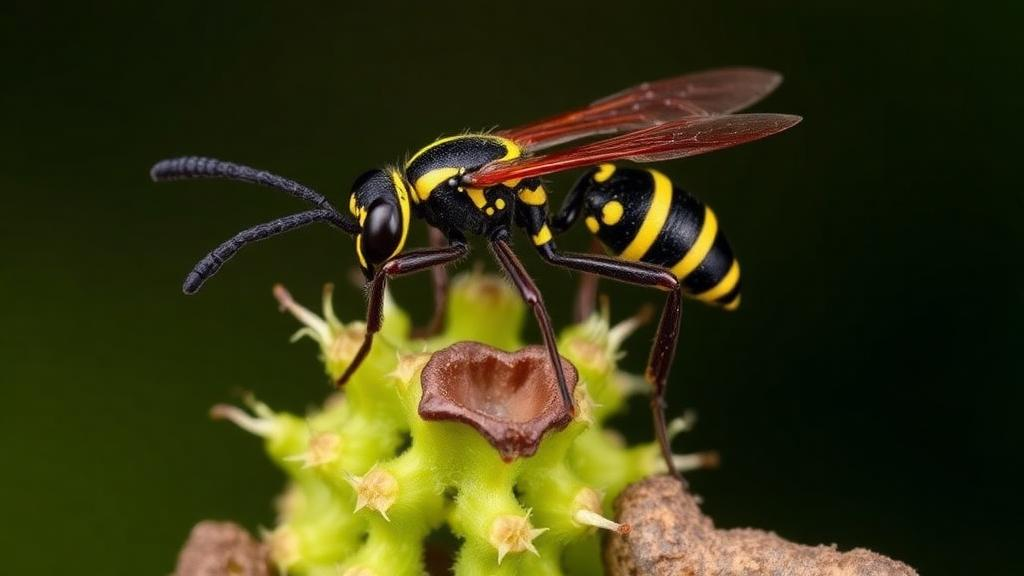
A solitary wasp that provisions its nests exclusively with aphids is attracting attention as a potential biological control agent, and a new study has now worked out exactly what kind of twig it needs to thrive. The digger wasp Pemphredon lethifer, a holarctic species that excavates its nest tunnels inside the soft pith of twigs, was tested in field trials and under controlled laboratory conditions to determine its pith diameter preferences and how those choices shape its reproductive success. The findings, published in the Journal of Hymenoptera Research, offer a technical blueprint for designing nest boxes that could turn this aphid-hunting wasp into a practical tool for pest management.
Unlike cavity-nesting bees and wasps that simply occupy pre-existing tubes, pith-nesting species dig their own tunnels within twigs of a given diameter. This distinction matters because decades of research on cavity-nesting Aculeata have shown that tube diameter influences offspring number, sex ratio, body size and even hunting ability, but it remained unclear whether those findings apply to species that excavate their own nests. Pemphredon lethifer typically nests in cut stems of Rubus species such as brambles, but also uses other pithy plants, and seldom consumes the full pith diameter available. Its nests can be linear or branched, with brood cells separated by pith, and females prey exclusively on aphids, completely removing them from the plant.
The research team, working in Braunschweig, Germany, and the surrounding area, set up trap nests in 2022 and 2023 at study sites chosen for sun exposure and the presence of elderberry and bramble. Each trap nest consisted of sixteen bundled twigs of Sambucus nigra cut to thirty centimetres, with four twigs of each of four pith diameter categories: greater than 2.5 to 4.5 millimetres, greater than 4.5 to 6.5 millimetres, greater than 6.5 to 8.5 millimetres, and greater than 8.5 to 10.5 millimetres. The twigs were sealed at one end with polylactide filament using a 3-D pen to prevent nesting from that side, and attached to aluminium holders at an angle of thirty degrees and a height of one metre, with the open end oriented east. Sites were at least 300 metres apart to prevent females from nesting at multiple locations.
The field results were unambiguous. In both years, nesting probability increased with pith diameter, and the largest category was significantly preferred. In 2022, 81 percent of nests of the genus Pemphredon were built in the largest diameter category, compared with less than 17 percent in each of the others. In 2023, when 108 nests could be clearly assigned to Pemphredon lethifer, 66 percent were in the largest category, with all other categories below 26 percent. In the laboratory cage experiment, where individual females were offered one twig of each diameter without competition or parasitoids, the smallest category was used least often, at just 4 percent, while the three larger categories were each chosen at 32 percent. The team concludes that a pith diameter below 4.5 millimetres is likely the minimum suitable for the species, since the wasp must be able to dig tunnels wide enough to move and turn within them.
Under controlled conditions, 31 females built a total of 50 nests, averaging 1.6 nests per wasp. Twelve females built only one nest, fourteen built two, four built three and one built four. Interestingly, the proportion of females building a second nest was higher when the first nest was in a small diameter than in a larger one, at 54.6 versus 40.0 percent, suggesting that females may compensate for suboptimal first choices. In the 2023 field trial, female head width was correlated with diameter choice: larger females showed a higher probability of nesting in the largest category and a lower probability of nesting in the medium category. Larger females also built longer nests and built more linear rather than branched structures, indicating that body size may be a more decisive influence on nest architecture than pith diameter itself.
The fitness data revealed a strong seasonal effect. In the 2023 field trial, 106 nests of Pemphredon lethifer produced offspring, averaging 6.7 per nest. The number of offspring was highest early in the season, at 8.9 in the first time period, dropping to 3.8 in the second and 3.0 in the merged third and fourth periods. Mortality followed the opposite pattern, rising from 9 percent early in the season to 54 percent at the end. The probability of producing female offspring was 61 percent in the first period and 54 percent in the second, but collapsed to just 4 percent in nests built late in the season. Offspring emerging without a cooling interval were more likely to be female, at 38 versus 21 percent, consistent with observations that other Aculeata produce more males in the overwintering generation.
Sex ratio was also shaped by pith diameter, but not in the way many studies of cavity-nesting species would predict. Rather than the largest diameter producing the most female offspring, the medium category of greater than 6.5 to 8.5 millimetres yielded the highest probability of females, at 46 percent, compared with 16 percent for the smallest and 29 percent for the largest category. This suggests there is a diameter optimum for skewing sex ratio toward females, which is crucial for biocontrol purposes since only females collect aphids to provision their nests. The finding parallels results with the cavity-nesting bee Megachile rotundata, where the largest diameter offered did not produce the highest proportion of females. The team notes that Pemphredon lethifer can control its nest size by digging, which may explain why larger twigs do not automatically result in more female offspring.
Parasitism was substantial but independent of pith diameter. In 2022, 42 percent of nests with offspring of the genus Pemphredon were parasitised, and in 2023, 40 percent of nests with offspring of Pemphredon lethifer. Chrysididae were the most abundant parasitoids, followed by Ichneumonidae and Chalcidoidea. When only solitary parasitoids were considered, allowing unambiguous determination of cell numbers, 13 to 15 percent of all cells were parasitised. Crucially, branched nests were more frequently parasitised than linear nests, an effect that occurred regardless of the number of offspring. The researchers suggest that parasitoids can reach several cells in branched nests more easily even after nesting is finished, and can more easily hide in unfinished nests. Mortality also increased with nest length, possibly because offspring in long tunnels cannot find their way out or the path is blocked by other cells.
For practical application, the study offers clear design criteria. A nest box intended to promote Pemphredon lethifer should contain pith diameters between 6.5 and 8.5 millimetres to achieve a more female-based sex ratio, while diameters smaller than 4.5 millimetres are unsuitable for nesting. Tube length should be kept shorter to reduce mortality, and there is a trade-off to consider: within a given nest box size, fewer large-diameter twigs can be installed, which reduces the number of potential nests. Efficacy of the wasp as a biocontrol agent is expected to be highest early in the nesting season, when offspring numbers, female proportion and survival are all at their peak. The researchers emphasise that much remains unknown about other nesting parameters such as angle, height and material, and that laboratory rearing conditions need optimisation for continuous rearing of the species.
Subject of Research: Pith diameter preferences and fitness parameters of the digger wasp Pemphredon lethifer
Article Title: Pith diameter preferences and their impact on fitness parameters of the digger wasp Pemphredon lethifer : a potential biocontrol agent against aphids
Article References: Furtwengler, J., Gabriel, D., & Böckmann, E. (2026). Pith diameter preferences and their impact on fitness parameters of the digger wasp Pemphredon lethifer: a potential biocontrol agent against aphids. Journal of Hymenoptera Research, 99, 877-895. https://doi.org/10.3897/jhr.99.186471
Image Credits: AI Generated
Keywords: digger wasp, Pemphredon lethifer, biocontrol, aphids, nest boxes, pith diameter, Hymenoptera, entomology, Pith, diameter, preferences, impact
Cite Scienmag News
Scienmag. (October 16, 2026). Digger wasp with a taste for big twigs could become aphid biocontrol agent. https://scienmag.com/digger-wasp-with-a-taste-for-big-twigs-could-become-aphid-biocontrol-agent/
Scienmag. "Digger wasp with a taste for big twigs could become aphid biocontrol agent." Scienmag, 16 October 2026, https://scienmag.com/digger-wasp-with-a-taste-for-big-twigs-could-become-aphid-biocontrol-agent/. Accessed 16 October 2026.
Scienmag. "Digger wasp with a taste for big twigs could become aphid biocontrol agent." Scienmag. October 16, 2026. https://scienmag.com/digger-wasp-with-a-taste-for-big-twigs-could-become-aphid-biocontrol-agent/


