


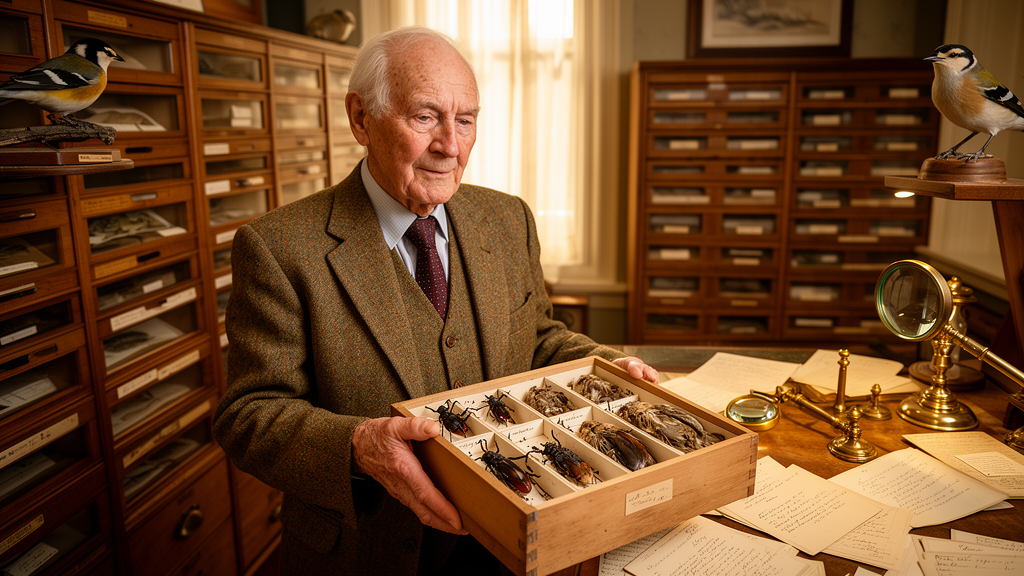
The Natural History Museum Vienna has lost one of its most quietly influential figures. Dr. Ernst Bauernfeind, ornithologist, entomologist and longtime curator of the museum’s bird collection, died on 23 May 2025 in his home village of Starzing in Lower Austria at the age of 75. His passing, announced in the Annals of the Natural History Museum Vienna, closes a career that spanned more than four decades of scientific work, from the food ecology of greylag geese to the taxonomy of mayflies, and left a permanent mark on one of Europe’s great historical natural science collections.
Bauernfeind was born on 4 May 1950 into a teacher’s household in Vienna, the first of two sons. Both parents, Ernst and Eva, taught at secondary schools and were also active as academic painters. That artistic environment appears to have shaped what colleagues described as his creative streak, which later enriched the illustrations accompanying many of his publications. His work repeatedly bridged science and art, most notably in the catalogue essay “Das Vogelskelett – Funktionalität und Ästhetik” (The Bird Skeleton – Functionality and Aesthetics), written for the 2003 exhibition “Like a Bird” by the prominent architect Santiago Calatrava at the Kunsthistorisches Museum. After completing his secondary education with the school-leaving examination in June 1968 at BRG Rainergasse in Vienna, he began studying zoology and palaeontology at the University of Vienna the same year.
Before his museum career took off, Bauernfeind spent nearly two decades as a schoolteacher. From September 1974 he worked as a contract teacher for biology and environmental studies at BG and BRG Baden, remaining there until January 1992. He later recalled with pride that he had motivated several of his students to pursue zoology degrees, and former pupils later spoke of him in respectful terms, crediting his ability to inspire enthusiasm for his subjects. He completed his doctorate on 31 March 1980, with a dissertation supervised on the suggestion of Antal Festetics and approved by Univ.-Prof. Dr. Friedrich Schaller, addressing the food ecology and population of the greylag goose at Lake Neusiedl. That early ornithological focus laid the groundwork for his scientific career, even though, by his own account, he had always intended to become a researcher rather than remain a pedagogue.
Bauernfeind had been active at the museum as a freelance collaborator from 1980, working for the Austrian Society for Ornithology, the library, the bird collection and the second zoological department (entomology). He was formally assigned to the bird collection as curator on 17 February 1992. When the collection’s head, Dr. Herbert Schifter, took early retirement for health reasons, Bauernfeind assumed that role on 1 December 1994 and held it until 30 September 2011. His first year in charge coincided with a major event: the 21st International Ornithological Congress, held in Vienna’s Hofburg from 20 to 25 August 1994, which brought an academic swarm of visiting specialists through the bird collection, all eager to examine its numerous valuable historical specimens.
In preparation for that congress, Bauernfeind had overseen the elaborate reinstallation of Hall 29 of the public exhibition, the so-called “Austria Hall,” to present the collection to the international audience in new splendour. A New Zealand colleague later reflected on the visit in memorable terms, noting that Ernst Bauernfeind and Herbert Schifter bowled him over with their courtesy and mastery of the English language, and that his mother spent considerable time trying to recall which film she had seen Ernst in, something about a man in a white coat, agreeing that they had never seen someone look so much like a character in a 1950s movie. The description was apt: Bauernfeind could be a charming host in the rooms of the bird collection, communicating in impeccable English when needed, and his white, sometimes slightly too small, work coat was his typical attire, usually covering an impeccable suit and tie that formed his everyday dress.
Under his direction, the rehousing of the scientific collection in curatorially adequate steel sheet collection boxes, begun by Schifter in the 1980s, was consistently continued, and the old wooden boxes of the original fittings gradually disappeared. He was particularly committed to expanding and documenting the skeleton collection, which had been somewhat neglected, investing considerable time in building an impressive reference and comparison collection that is now actively used. His hunting and fishing contacts also contributed valuable specimen material, as evidenced by series of tufted duck skeletons from Lake Traunsee and cormorants from Lake Neusiedl in the collection. Former students were also deployed in the first digitisation efforts from 1994 onwards, providing valuable help that greatly benefited the museum.
Bauernfeind’s scientific publishing was notably multifaceted, with an ambivalent relationship between his two main interests. He was internationally known and respected as an expert on mayflies (Ephemeroptera), while in ornithology he devoted himself, as a “complete museum man,” to taxonomic questions, the study of type material, science-historical topics, and the identification of bird bone material and eggshells from archaeological excavations. His expertise in feather identification was particularly valued, especially in the context of historical Mexican feather paintings, cultural artefacts and fashion accessories. On taxonomic matters he was a sought-after colleague, applying the International Code of Zoological Nomenclature with rare skill. Among his most important ornithological publications are the study of valuable skeletons of New Zealand birds from the Andreas Reischek collection (1995), which had been forgotten in the museum for decades, the recovery of the previously unknown ornithological correspondence of Crown Prince Rudolf of Austria with the Swiss doctor A. Girtanner (1999, with B. Schneider), the updating of the Leverian Museum specimens (2004), which had been acquired for Emperor Franz I for the Vienna collection in 1806, and the type catalogue of non-passerines (2007, with H. and T. Schifter). In 2007, European bird curators met at the museum at his invitation, leading to a 2010 conference volume co-edited with A. Gamauf, H.-M. Berg and Y. Muraoka that offers a helpful cross-section of work and methods in the context of museum bird collections.
In the final five years of his active career, from October 2011, Bauernfeind returned unexpectedly to his favourite animals as curator of the mayfly and dragonfly collections at the museum, and he continued his scientific work there even after retiring in May 2015 as Hofrat, a senior advisory title, until only a few months before his death. He was a welcome guest and speaker at specialist conferences, where his entomological ambitions predominated, and he was also respected in fishing circles for his expertise. He constructively engaged with the tension between fish-eating wild animals such as cormorants, grey herons and otters and human interests, and his efforts to protect waterways, particularly the Pielach river in the Lower Austrian Alpine foothills, served birds and fish alike. Beyond his professional duties, he served on the board of the “Friends of the Natural History Museum Vienna” association from 1995 to 2001 and in the Lower Austrian State Fishing Association.
Colleagues remember Bauernfeind not only for his impeccable professional reputation but also for his exceptionally courteous manners, expressed in the almost ceremonial tipping of his hat at greetings. In discussions, his comments never came hastily; he waited, then spoke with clear ideas about the matter, though some found his contributions somewhat didactic. He held firmly to his life philosophy, standing critically opposed to modernist currents, which occasionally manifested in small everyday habits, such as the television needing to be removed from his holiday quarters, the same room at the Hotel Post in Traunkirchen, over decades, before his arrival. Traunkirchen was not chosen by accident: nearby on the Gmunden Traun, masters of fly fishing such as Charles Ritz and General Eisenhower had practiced their craft. For Bauernfeind, fly fishing was evidently not only technical skill but also a meditative activity, as some of his written reflections show.
Bauernfeind is survived by a family shaped by his deep bond with his wife Elisabetta, known as Lisa, née Simantiri, whom he met during his studies and married on 20 August 1971 in Vienna. She died early, on 22 November 2003, a painful turning point in his life. He expressed his appreciation for her through the dedication name of a newly described Greek mayfly, Rithrogena lisettae (Bauernfeind 2003). His valuable personal Ephemeroptera collection was gifted to the Natural History Museum in 2023. With Ernst Bauernfeind’s death, the museum has lost not only a wealth of specialised knowledge but also a rare diversity in thinking and action, a colleague whose courtesy, expertise and devotion to the natural world enriched the institution for decades.
Subject of Research: In memoriam HR Dr. Ernst Bauernfeind (1950–2025)
Article Title: In memoriam HR Dr. Ernst Bauernfeind (1950–2025)
Article References: Berg, H.-M. (2025). In memoriam HR Dr. Ernst Bauernfeind (1950–2025). Annals of the Natural History Museum Vienna, 126, 211-215. https://doi.org/10.3897/anhmw.180719
Image Credits: AI Generated
DOI: 10.3897/anhmw.180719
Keywords: Ernst Bauernfeind, Natural History Museum Vienna, ornithology, mayflies, Ephemeroptera, bird collection, taxonomy, museum curator, greylag goose, fly fishing, Andreas Reischek, biodiversity
Cite Scienmag News
Gavin Prescott. (October 16, 2026). Remembering Ernst Bauernfeind: Ornithologist, Entomologist and Museum Curator (1950–2025). Scienmag. https://scienmag.com/remembering-ernst-bauernfeind-ornithologist-entomologist-and-museum-curator-1950-2025/
Gavin Prescott. "Remembering Ernst Bauernfeind: Ornithologist, Entomologist and Museum Curator (1950–2025)." Scienmag, 16 October 2026, https://scienmag.com/remembering-ernst-bauernfeind-ornithologist-entomologist-and-museum-curator-1950-2025/. Accessed 16 October 2026.
Gavin Prescott. "Remembering Ernst Bauernfeind: Ornithologist, Entomologist and Museum Curator (1950–2025)." Scienmag. October 16, 2026. https://scienmag.com/remembering-ernst-bauernfeind-ornithologist-entomologist-and-museum-curator-1950-2025/


