


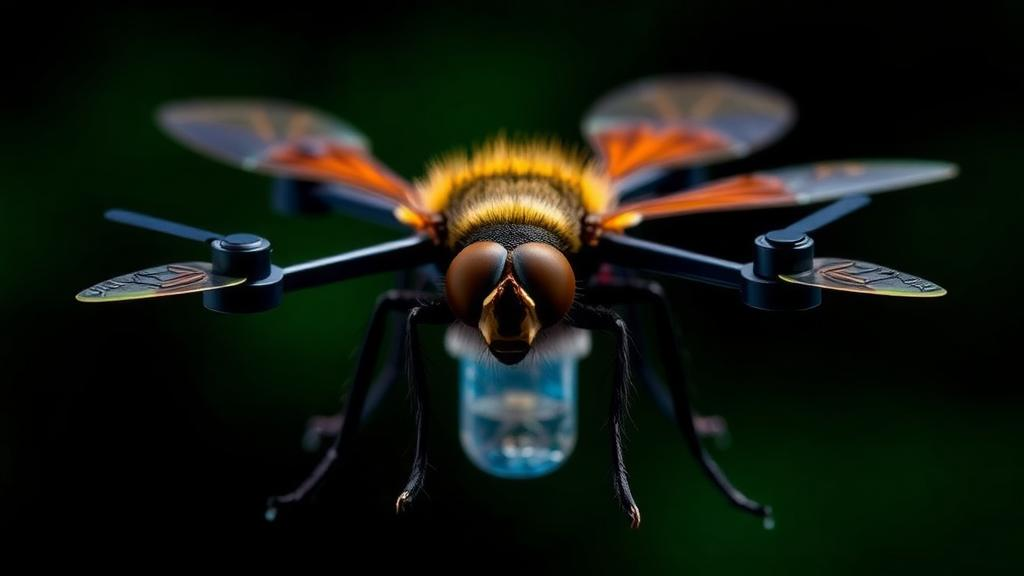
The drone fly Eristalis tenax, a bee-mimicking hoverfly found on every continent except Antarctica, is about to acquire a digital twin. In a new formal model description published in the Food and Ecological Systems Modelling Journal, researchers have laid out the blueprint for an agent-based simulation of this widespread pollinator, designed to run inside the Animal Landscape and Man Simulation System, or ALMaSS. The goal is ambitious: to give pesticide regulators a realistic, spatially explicit way to assess how agrochemicals affect a pollinator group that has long lived in the shadow of bees.
Hoverflies are among the most important wild generalist pollinators worldwide, with more than 6,000 species. Yet while honey bees and bumblebees have attracted detailed population models, saprophagous hoverflies, those whose larvae feed on decaying organic matter, have never been simulated in a spatially explicit, individual-based framework linked to a detailed landscape model. The new E. tenax model fills that gap. Each fly, from egg to adult, will be represented as a separate object with its own age, location and pesticide burden, moving through a simulated landscape rendered at a resolution of one square metre and updated daily with weather, crop management and vegetation growth.
The choice of species is deliberate. Eristalis tenax is well studied, synanthropic and abundant near human activity centres across temperate and continental climates. Its larvae, the famous rat-tailed maggots, thrive in stagnant, manure-polluted water, making the species a natural fixture of intensively farmed landscapes. Adults are generalist pollinators with a striking preference for yellow flowers, and the species has even been investigated as a managed crop pollinator and a candidate for biodegradation of organic waste. Crucially for regulators, its larvae live in exactly the farm environments, slurry pits, drainage ditches and manure ponds, where pesticide exposure is plausible.
The model’s main drivers are temperature, the distribution and quality of larval habitats, and the availability of nectar and pollen in space and time. Development from egg to pupa is governed by temperature, with larval development additionally shaped by density, which itself depends on habitat quality. The pupal stage, identified by researchers as one of the most critical moments in the life cycle, is represented using thermal performance curves fitted to published data. Among the candidate models tested, the Lobry–Rosso–Flandrois curve was selected, predicting a pupal development optimum of 26 degrees Celsius, with critical minimum and maximum temperatures of 2.16 and 31.59 degrees respectively.
Some of the model’s most interesting mechanics emerge at the larval stage. Drawing on laboratory experiments with pig slurry, the model captures a linear relationship between larval density and both development time and survival: the more crowded the larvae, the slower they grow and the more die. The same density dependence was confirmed in the related species Eristalis cerealis, which also shows reduced adult weight under nutritional stress. By linking habitat quality indices, soil moisture, slope, solar radiation and even drought indices from the European Drought Observatory, the model generates a shifting map of maximum larval densities across the landscape, year by year, producing the kind of population variability observed in the field.
Adult behaviour is modelled with equal care. Activity is driven by hourly temperature: half the population becomes active at 11 degrees Celsius and all of it at 15 degrees, with activity capped at 30 degrees and restricted to daylight and acceptable wind and rainfall. Foraging is organised around reproductive goals. Following observations of the related species Rhingia campestris, females switch their diet depending on ovarian development, targeting a 90:10 pollen-to-nectar ratio while maturing eggs and a 20:80 ratio during mating and oviposition. Gut filling is tracked separately for pollen and nectar, with gut volume scaled to body mass, and fecundity assumed to rise linearly with female weight.
Oviposition behaviour draws on some of the most vivid field observations in the literature. Female drone flies are attracted to the odour of manure and stagnant water, but only when mature: immature females are repelled by the smell, developing females indifferent. Egg-laying is not a single flight but a gradual process of exploration over several days, with many females inspecting a site repeatedly before committing. The model reproduces this staged approach, and adds a further layer of realism by allowing eggs that cannot be laid in full clutches to be resorbed, a mechanism known from other hoverflies but not yet confirmed in saprophagous species.
Dispersal and migration posed their own design challenges. Drone flies are strong fliers, capable of at least 10 metres per second in short bursts and continuous flights of at least 75 kilometres over open ocean. Genetic studies across Europe show no population structure at landscape scales, suggesting the species is limited by habitat availability rather than dispersal ability. The model treats E. tenax as partially migratory, with autumn-generation females either hibernating in dark, humid crevices or migrating out of the landscape. For the first version, however, migration probability is set to zero, a deliberate simplification to prevent the dilution of pesticide effects in regulatory scenarios.
The toxicological component, though deliberately simple, is the model’s regulatory heart. Exposure can occur through three pathways: consumption of contaminated nectar and pollen, contact with sprayed plant surfaces, and direct overspray during spraying events. An accumulated pesticide burden drives a daily probability of acute mortality above a threshold, with a decay rate clearing the chemical from the body. The authors stress this is a starting point; future versions may add sublethal effects and toxicokinetic-toxicodynamic models. The need is real: existing studies show larvae are highly sensitive to environmentally relevant concentrations of imidacloprid, while adults tolerate oral doses far above typical field levels, yet even sublethal exposure can impair the visual neurons that flight and navigation depend on.
The authors are candid about the model’s limits. Data on thermal performance are sparse and drawn from narrow temperature ranges, survival data for juvenile stages are patchy, and much of the diet and reproduction information comes from laboratory studies or related species. Calibration will follow a pattern-oriented modelling approach, using multiple empirical patterns to iteratively refine structure and parameters. Even so, the formal model represents a structured synthesis of everything currently known about E. tenax biology, from egg clusters laid beside slurry tanks to females hibernating in castle ruins, and provides a robust baseline against which pesticide-induced effects on a neglected but vital pollinator can finally be tested at landscape scale.
Subject of Research: Agent-based modelling of the hoverfly Eristalis tenax for pesticide risk assessment in agricultural landscapes
Article Title: The Formal Model for the hoverfly Eristalis tenax ( Diptera , Syrphidae ) agent-based model in the Animal Landscape and Man Simulation System (ALMaSS)
Article References: Ziółkowska, E., Walczyńska, A., & Topping, C. J. (2025). The Formal Model for the hoverfly Eristalis tenax (Diptera, Syrphidae) agent-based model in the Animal Landscape and Man Simulation System (ALMaSS). Food and Ecological Systems Modelling Journal, 6, Article e152847. https://doi.org/10.3897/fmj.6.152847
Image Credits: AI Generated
DOI: 10.3897/fmj.6.152847
Keywords: Eristalis tenax, hoverfly, agent-based model, ALMaSS, pollinators, pesticide risk assessment, thermal performance curve, larval habitat, drone fly, ecotoxicology, agricultural landscape, individual-based modelling
Cite Scienmag News
Margaret Porter. (October 16, 2026). Building a Virtual Drone Fly: New Agent-Based Model Aims to Protect Hoverfly Pollinators from Pesticides. Scienmag. https://scienmag.com/building-a-virtual-drone-fly-new-agent-based-model-aims-to-protect-hoverfly-pollinators-from-pesticides/
Margaret Porter. "Building a Virtual Drone Fly: New Agent-Based Model Aims to Protect Hoverfly Pollinators from Pesticides." Scienmag, 16 October 2026, https://scienmag.com/building-a-virtual-drone-fly-new-agent-based-model-aims-to-protect-hoverfly-pollinators-from-pesticides/. Accessed 16 October 2026.
Margaret Porter. "Building a Virtual Drone Fly: New Agent-Based Model Aims to Protect Hoverfly Pollinators from Pesticides." Scienmag. October 16, 2026. https://scienmag.com/building-a-virtual-drone-fly-new-agent-based-model-aims-to-protect-hoverfly-pollinators-from-pesticides/


