


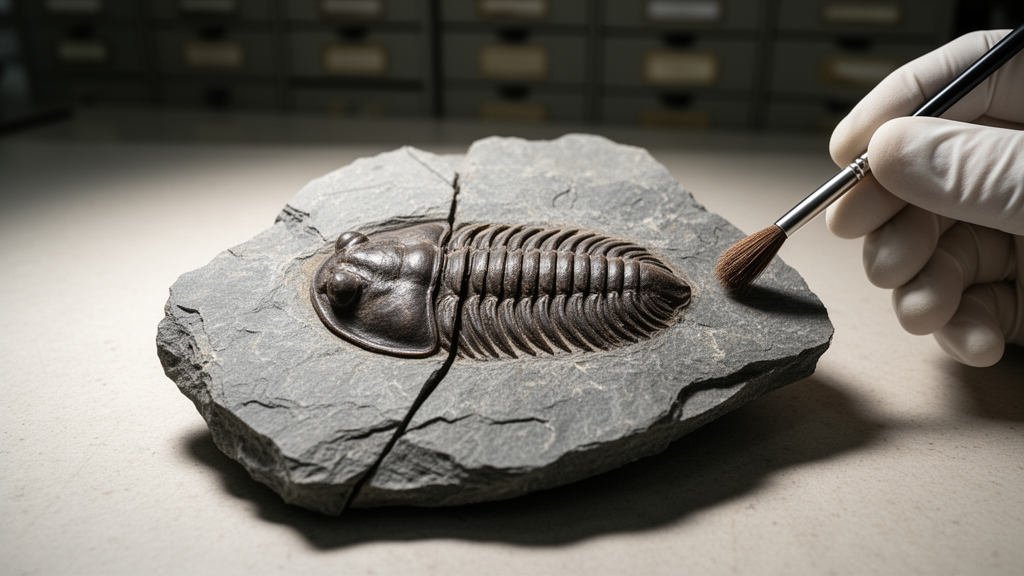
Trilobites are among the most iconic animals of the Cambrian explosion, and a new study of a 500-million-year-old species from southern China is now offering an unusually detailed look at how these ancient arthropods grew up. By tracking hundreds of specimens of the trilobite Kaotaia globosa through nearly every stage of its post-embryonic life, researchers have reconstructed its developmental sequence from tiny juveniles with just three trunk segments to fully mature adults bearing fourteen. The findings, published in the Swiss Journal of Palaeontology, reveal that the animal’s body segments were governed by a continuously increasing growth gradient running from head to tail, a mechanism that may explain how trilobites managed to build their bodies so efficiently across nearly 270 million years of evolutionary history.
The fossils come from the Kaili Biota, a rich Cambrian deposit preserved in the Kaili Formation of eastern Guizhou Province. The study focused on material from the Miaobanpo section, where the team selected 145 exceptionally preserved specimens from two closely spaced rock beds. These included 136 internal molds and nine external molds showing minimal postmortem distortion, ideal conditions for measuring fine anatomical details. The Kaili Formation was deposited in a low-energy slope environment below the storm-wave base, near the redox interface, which helped preserve delicate articulated exoskeletons rather than scattered fragments.
Trilobites are particularly valuable to developmental biologists because their biomineralized exoskeletons fossilized at nearly every growth stage, from newly hatched larvae to adults. Like other arthropods, they grew by molting, shedding their exoskeletons periodically and secreting new, larger ones. Each molt could add segments to the trunk, and the sequence of these additions provides a record of developmental change that is rarely available for any extinct group. The new study takes advantage of this record by documenting K. globosa from meraspid degree 3, when the animal had three free thoracic segments, through to the holaspid period, when segment number stabilized at fourteen.
The researchers combined traditional morphological description with geometric morphometrics, a quantitative technique that captures shape variation using landmark points placed on homologous structures. They digitized 19 landmarks on the cranidium, the central part of the trilobite head shield, and used principal component analysis to identify the major axes of shape change during development. The results showed that the most significant modifications occurred in the glabella, the facial suture, and the palpebral lobes. The glabella shifted from elongated and narrow in early juveniles to shorter and wider in adults, while the relative width of the cheek regions decreased and the eyes migrated posteriorly along the head.
Statistical tests confirmed that these changes were significant rather than random variation. A multivariate analysis of variance produced a Wilks’ lambda of 0.07359 and a Pillai trace of 1.42, both indicating highly significant differences between developmental stages. The first principal component, accounting for nearly 30 percent of shape variance, was associated primarily with changes in the anterior branch of the facial suture and the anterior border of the head shield. The second component, explaining about 13 percent, captured variation in glabellar proportions and the occipital ring at the rear of the head.
Beyond the head, the team examined how trunk segments grew relative to one another. They calculated the average per-molt growth rate and the allometry coefficient for each thoracic segment, following methods previously developed for the Silurian trilobite Aulacopleura koninckii. Two competing hypotheses have been proposed to explain how segment growth is controlled in trilobites. The Segmental Gradient Hypothesis holds that each segment grows autonomously at a constant rate, with its final size determined by its position in the sequence. The Trunk Gradient Hypothesis instead proposes that a continuous growth field spans the entire trunk, with each segment’s growth rate dictated by its position within that field.
When the researchers fitted mathematical growth models to their segment data, the exponential function associated with the Trunk Gradient Hypothesis produced the best fit, with a correlation coefficient of 0.975. This indicates that K. globosa trunk segments were not growing independently but were instead responding to a graded signal that increased in strength from the anterior to the posterior of the trunk. The finding aligns with patterns previously documented in other trilobite species and suggests that positional specification along the body axis was a widespread developmental control mechanism in the group.
One unexpected result was an anomalously high growth rate calculated for the thirteenth thoracic segment. The team investigated whether this apparent spike was real or an artifact of sampling. Because holaspid specimens made up nearly half of the total sample and spanned an almost fourfold range in body length, the researchers reanalyzed the data after subsampling and after removing larger individuals. The elevated rate for the thirteenth segment dropped substantially, and a similar pattern emerged when they reanalyzed published data for Aulacopleura koninckii. This suggests that the apparent spike was driven by the broad size range of holaspid specimens rather than by a genuine biological discontinuity in the growth gradient.
The study also addressed the broader question of how trilobites achieved their adult body sizes. Compiling holaspid length data from eighteen species across five trilobite orders, the authors found that most species showed a wide range of adult sizes, implying that significant growth continued well after segment number stabilized. For K. globosa, the smallest holaspid specimen measured 4.88 millimeters while the largest reached 18.48 millimeters, a difference the authors estimate would have required at least five additional molts. A continuously increasing growth gradient, they argue, would have allowed trilobites to complete their segmental construction relatively quickly during the anamorphic phase and then devote the remainder of development, the prolonged epimorphic phase, to increasing overall body size without adding new segments.
The findings carry implications beyond trilobite biology. Early ptychopariids like K. globosa are considered to sit close to the ancestors of several major post-Cambrian trilobite clades, making their developmental patterns potentially informative about the basal conditions from which later diversity arose. The study also weighed in on a long-standing debate about a spherical bulge on the preglabellar field of K. globosa, which some researchers had proposed functioned as a brood pouch and a marker of sexual dimorphism. Because the bulge is already present in juveniles several molts before sexual maturity could plausibly be reached, the authors conclude it is more parsimoniously interpreted as a species-specific ontogenetic feature rather than a reproductive adaptation. As complete ontogenetic sequences remain scarce for ptychopariid trilobites, this detailed growth record from the Kaili Biota provides a valuable reference point for understanding how some of the earliest arthropods organized their bodies and how those organizational principles may have been carried forward through hundreds of millions of years of evolution.
Subject of Research: Ontogenetic development and trunk growth gradient control in the ptychopariid trilobite Kaotaia globosa from the Cambrian Kaili Biota
Article Title: Ontogeny of the ptychopariid trilobite Kaotaia globosa from the Cambrian Kaili Biota of eastern Guizhou, China
Article References: Chen, S., Wang, D., Sun, Z., Chen, Z., Yang, X., & Zhao, F. (2026). Ontogeny of the ptychopariid trilobite Kaotaia globosa from the Cambrian Kaili Biota of eastern Guizhou, China. Swiss Journal of Palaeontology, 145, 801-822. https://doi.org/10.3897/sjp.145.188479
Image Credits: AI Generated
Keywords: trilobites, Kaotaia globosa, Cambrian, Kaili Biota, ontogeny, geometric morphometrics, growth gradient, arthropods, paleontology, molting, Guizhou China, developmental biology
Cite Scienmag News
Gavin Prescott. (October 16, 2026). Cambrian trilobite fossils reveal how a growth gradient built ancient bodies. Scienmag. https://scienmag.com/cambrian-trilobite-fossils-reveal-how-a-growth-gradient-built-ancient-bodies/
Gavin Prescott. "Cambrian trilobite fossils reveal how a growth gradient built ancient bodies." Scienmag, 16 October 2026, https://scienmag.com/cambrian-trilobite-fossils-reveal-how-a-growth-gradient-built-ancient-bodies/. Accessed 16 October 2026.
Gavin Prescott. "Cambrian trilobite fossils reveal how a growth gradient built ancient bodies." Scienmag. October 16, 2026. https://scienmag.com/cambrian-trilobite-fossils-reveal-how-a-growth-gradient-built-ancient-bodies/


