


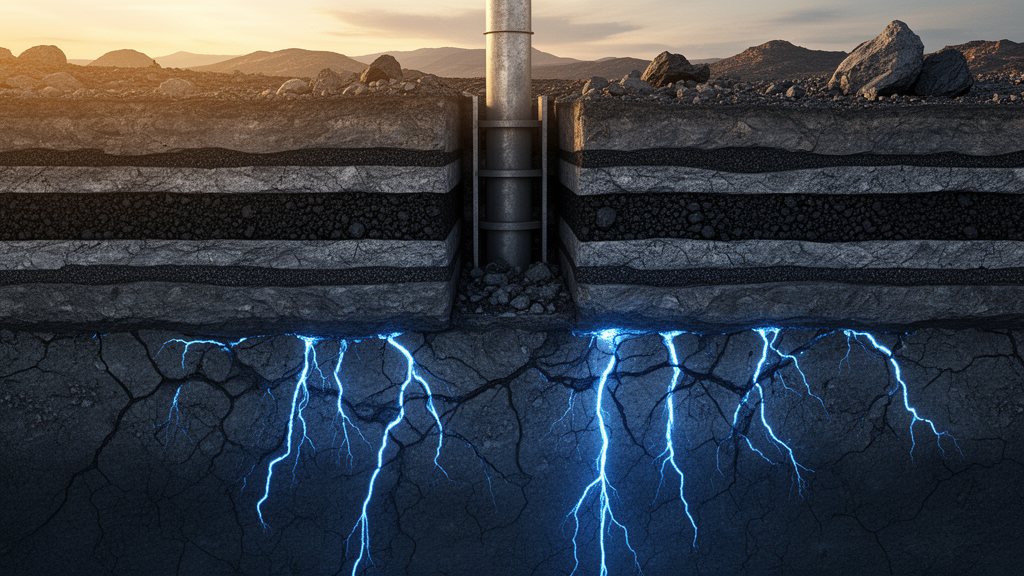
Deep beneath the coalfields of Shanxi Province in northern China, the ground above every longwall panel is quietly rearranging itself. As coal is extracted, hundreds of meters of overlying rock lose their support, bend, buckle, and fracture. Those fractures are not random damage; they form organized networks that can channel groundwater directly into mine workings. A new study published in Hydrogeology Journal by Qin Liu of Taiyuan University of Technology and colleagues dissects exactly how these mining-induced fracture networks develop and how they control where water preferentially flows, offering a framework that could reshape how engineers predict and prevent one of coal mining’s most dangerous hazards: sudden water inrush.
Water inrush ranks among the most severe threats to safe and efficient coal production. When pressurized groundwater finds a connected pathway from an aquifer down into an active working face, the result can be catastrophic flooding within minutes. The danger stems from the fact that mining disturbances progressively degrade the primary structural integrity of the overlying strata, generating dynamic hydrological pathways that dominate inrush mechanisms. Yet the geometry of those pathways has been difficult to characterize. Traditional approaches often treat the fractured zone above a mined seam as a single homogeneous layer with an average permeability, an assumption that obscures the channels through which water actually moves.
The research team focused on the No. 3307 Working Face at Fenghuangtai Coal Mine, combining numerical simulation with field measurements to track how fractures evolve as the face advances. Their modeling captured the progressive failure of overlying strata, while field validation confirmed the simulated fracture patterns against observations at the mine site. This dual approach matters because numerical models of rock mass behavior, while powerful, must be anchored to reality; the authors report that their field validation confirmed the accuracy of their central conclusions about where the dominant seepage channels develop.
The most striking finding is geometric. Mining disturbances create a saddle-shaped structure of fractures in the overlying strata, with fracture density and aperture both attenuating progressively with height above the excavation. In other words, the fractures are most numerous and widest near the mined-out void, where the rock has collapsed and separated, and they become sparser and tighter as one moves upward toward the surface. The saddle shape reflects the arching mechanics of overlying strata: fracturing is most intense along the lateral margins of the goaf and near the working face, while the central region above the extracted panel experiences different stress conditions. This spatial architecture is not merely a curiosity; it dictates the plumbing of the entire system.
Built on these fracture characteristics, the researchers classified the overlying strata into four categories of seepage units, each with distinct permeability behavior. The critical result is that the primary seepage channels, the dominant highways for groundwater, develop within the medium permeability zone, abbreviated as the MPZ. This is counterintuitive in an instructive way. One might assume that the most intensely fractured rock, presumably the highest permeability material closest to the excavation, would carry the most water. Instead, the medium permeability zone hosts the main channels, likely because it combines sufficient fracture connectivity with enough structural continuity to sustain organized flow paths. The low permeability zone, by contrast, plays a different role entirely: the study reveals that the LPZ regulates the flow rate, while the MPZ modulates the flux. In hydraulic terms, the tight upper layers act as a throttle on velocity, while the fractured middle layers determine how much volume passes through.
The role of mining height, the vertical thickness of the extracted coal seam, emerged as one of the study’s most consequential findings. When the key stratum, a stiff, competent layer within the overlying rock sequence that bears much of the load, remains intact, the number of dominant seepage pathways in the MPZ is controlled by inherent geological structures and key strata rather than by mining height. This means that simply cutting a thinner or thicker slice of coal does not change how many major water channels exist, as long as the key stratum holds. The architecture of the flow network is set by geology, not by mining parameters.
However, mining height is far from irrelevant. The study shows that mining height significantly influences the permeability of the overlying fracture zones. Under the condition of an unfractured key stratum, changes in mining height primarily enhance or reduce permeability rather than altering the fundamental structure of the seepage network. The distinction is subtle but practically vital: operators can adjust extraction height to manage how easily water moves through the fractured zone, but they cannot, within the intact key stratum regime, redesign the network’s topology. Once the key stratum itself fractures, the system crosses into a different regime where the number and arrangement of dominant pathways may change, raising the risk that previously isolated aquifers become connected to the workings.
For mine planners, these findings offer a theoretical foundation for the safe extraction of gently dipping coal seams, the geological setting typical of many Chinese coalfields. The four-category seepage unit classification gives engineers a vocabulary for locating which vertical interval above a panel will host the main flow channels, allowing protective measures such as drainage boreholes, grouting, or adjusted mining heights to be targeted at the MPZ rather than applied blindly. The separation of roles between the LPZ and MPZ also refines risk assessment: predicting an inrush requires knowing both the throttle and the highway, not just an average permeability for the whole fractured zone.
The study also connects to a broader research tradition in Chinese coal mining hydrogeology. The concept of the water-conducting fracture zone, the connected fracture network that can transmit water from aquifers into mines, has been studied for decades, with methods ranging from microseismic monitoring and P-wave anisotropy detection to empirical height prediction formulas. Earlier work established that key strata position controls the height of the fractured zone, and that cover stress re-establishment in the goaf influences fracture permeability evolution. What this new study adds is a spatially explicit, field-validated picture of how fracture density and aperture decay upward, and a functional decomposition of the fractured zone into units with distinct hydraulic roles. That decomposition turns a descriptive problem into a predictive one: if the saddle-shaped fracture geometry and the position of the MPZ can be estimated from key stratum location and mining geometry, then inrush risk can be evaluated before the face reaches the hazardous zone.
The implications extend beyond hazard prevention. In water-scarce mining regions of northern China, preserving groundwater resources while extracting coal, so-called water-preserved mining, depends on knowing exactly where fractures will propagate and which layers will conduct water. By demonstrating that the seepage network’s fundamental structure is governed by geology when the key stratum remains intact, the study suggests that protecting that key stratum from fracturing could be the decisive lever for keeping aquifers isolated from mine workings. Conversely, where the key stratum is destined to break, the permeability-modulating effect of mining height provides a secondary control. As coal mining pushes deeper and panels grow wider, the competition between extraction and groundwater protection will only intensify, and studies like this one translate the invisible fracture architecture hundreds of meters overhead into engineering parameters that can be acted upon before the water arrives.
Subject of Research: Mining-induced fracture development in coal mine overlying strata and its control on preferential groundwater flow and water inrush risk
Article Title: Mining-induced overburden fracture development and its control on preferential groundwater flow
Article References: Liu, Q., Ding, N., Du, X., Feng, G., & Chang, P. (2026). Mining-induced overburden fracture development and its control on preferential groundwater flow. Hydrogeology Journal. https://doi.org/10.1007/s10040-026-03190-4
Image Credits: AI Generated
DOI: 10.1007/s10040-026-03190-4
Keywords: coal mining, groundwater, water inrush, overburden fractures, hydrogeology, key stratum, permeability, numerical simulation, seepage channels, mining height, Fenghuangtai Coal Mine, Hydrogeology Journal
Cite Scienmag News
Violet Maxwell. (October 16, 2026). How Mining Fractures Steal Groundwater: New Study Maps the Hidden Plumbing Beneath Coal Mines. Scienmag. https://scienmag.com/how-mining-fractures-steal-groundwater-new-study-maps-the-hidden-plumbing-beneath-coal-mines/
Violet Maxwell. "How Mining Fractures Steal Groundwater: New Study Maps the Hidden Plumbing Beneath Coal Mines." Scienmag, 16 October 2026, https://scienmag.com/how-mining-fractures-steal-groundwater-new-study-maps-the-hidden-plumbing-beneath-coal-mines/. Accessed 16 October 2026.
Violet Maxwell. "How Mining Fractures Steal Groundwater: New Study Maps the Hidden Plumbing Beneath Coal Mines." Scienmag. October 16, 2026. https://scienmag.com/how-mining-fractures-steal-groundwater-new-study-maps-the-hidden-plumbing-beneath-coal-mines/


